

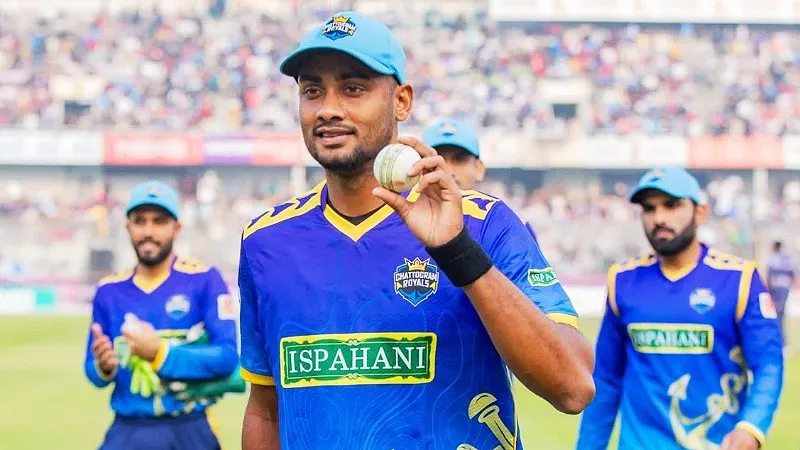

There’s a special kind of irony in cricket when your best season arrives precisely as the ground beneath you starts to shake. Shoriful Islam had just completed the tournament of his life, 26 wickets, the Best Player of the BPL, and a reputation burnished as Bangladesh’s most reliable left-arm quick when the post-match conversation swerved, predictably, away from cricket. Not swing, not lengths, not death-overs plans. Instead, Will Bangladesh even go to the T20 World Cup?
The rhythmic nature of bowling is key for any fast bowler, while the need for a team to be clear is essential for success. However, the preparation for Bangladesh for a major international competition has been clouded by confusion. After his side, Chattogram Royals, lost the championship game by 63 runs to the Rajshahi Warriors, Shoriful was asked many questions about things that did not relate to the ball he had bent all season long.
Form That Demands Bigger Stages
Let’s get one thing straight: Shoriful Islam didn’t stumble into this BPL season. He owned it. His 26 wickets weren’t inflated by flat tracks or tail-end indulgence; they came through disciplined new-ball spells, clever pace variations at the death, and an improved understanding of angles as a left-armer. In T20 leagues, consistency is currency, and Shoriful was cash-rich all season.
What makes this form particularly significant is timing. Historically, Bangladesh’s fast bowlers peak either too early or too late. Shoriful peaking now, ahead of a World Cup cycle, should be cause for strategic excitement. Instead, it became a footnote beneath administrative speculation. That contrast alone exposes a structural problem: performance is being asked to wait its turn.
When Administration Controls the Narrative
Shoriful’s repeated reminder, “Whether we go to the World Cup or not is totally a decision of the BCB,” wasn’t a deflection. It was boundary-setting. Players can only control preparation; administrators control participation. This isn’t new in Bangladesh cricket, but it’s rarely stated this plainly.
What’s striking is his refusal to moralize the issue. No frustration. No veiled criticism. Just a quiet acknowledgment of hierarchy. That restraint may sound professional, and it is, but it also reflects a system where players have learned that emotional investment in decisions beyond their control is wasted energy. In elite sport, that’s both survival instinct and silent indictment.
Mental Discipline Over Emotional Drain
Journalists were continuing to press: Are the players discussing this? How is this impacting their mental state? Shoriful’s response would be akin to a monk’s response to speculation (the focus tightens). The mental clutter in an unforgiving format of T20 cricket will cost you overs, not simply runs.
Shoriful’s thoughts are in line with the way that modern sports psychologists view mental preparation for competition: focus on what you can control. However, there may be some additional aspects to his thoughts. Bangladeshi cricketers have experienced so many uncertainties in terms of coaching, selection, and scheduling that developing an “emotional barrier” to protect themselves from being impacted by all these variables has developed into a skill. Shoriful’s “calmness” is not indicative of indifference; it is indicative of his ability to adapt.
A Final That Symbolized the Bigger Picture
Chattogram Royals’ 63-run loss in the final was heavy, but not humiliating. Shoriful still struck twice, still competed. But finals, like World Cups, are about momentum, and momentum thrives on clarity. Rajshahi Warriors had certainty. Chattogram had questions swirling outside the boundary rope.
It’s tempting to overread symbolism here, but cricket often mirrors its environment. When teams know where they’re headed, performances sharpen. When futures are debated in boardrooms, players are left defending their present.
Yet the larger takeaway is uncomfortable. Bangladesh currently has a fast bowler in peak T20 rhythm, emotionally steady, tactically sharp, and physically primed. These windows don’t stay open long. History tells us that when momentum meets indecision, momentum loses.
Whether Bangladesh boards the World Cup plane or not, Shoriful’s stance should be instructive. Performers will always perform. The question is whether systems are ready to get out of their way or continue turning press conferences into battlegrounds for issues cricket cannot solve.
Key Takeaway
Shoriful Islam’s silence isn’t avoidance; it’s professionalism forged in uncertainty.
FAQs
- What made Shoriful Islam the BPL’s Best Player?
His 26 wickets, consistency across phases, and impact spells under pressure.
- Why didn’t Shoriful comment on World Cup uncertainty?
He emphasized that selection decisions lie with the BCB, not players.
- How can uncertainty affect a T20 squad mentally?
Speculation disrupts focus, which is critical in a format decided by fine margins.
Disclaimer: This blog post reflects the author’s personal insights and analysis. Readers are encouraged to consider the perspectives shared and draw their own conclusions.
Step into the world of cricket with JeetBuzz News—where expert opinions, trending Blogs, and behind-the-scenes insights meet all your favorite topics. Stay informed, stay entertained, and never miss the stories shaping the cricketing world—only on JeetBuzz News!