

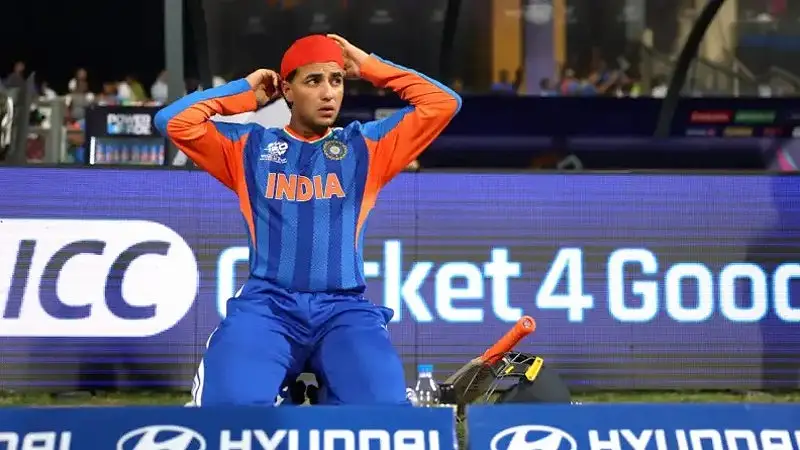

India were 92 without loss at the end of the powerplay. That number tells you everything about how the T20WC 2026 Final began. Abhishek Sharma walked out to open the batting against New Zealand at Narendra Modi Stadium and immediately made the match about one question: how many, not whether. His 52 off 21 balls, including six fours and three sixes at a strike rate of 247.62, was the most explosive powerplay innings by an Indian opener in a World Cup final. New Zealand’s bowling plans lasted approximately four deliveries.
How He Attacked From the Very First Over
The first sign that this innings would be different came in over two. New Zealand opened with disciplined lines designed to build pressure and force India into cautious early strokeplay, the template that has worked against aggressive openers in knockout cricket before. Abhishek rejected that template immediately.
He targeted the square boundaries against pace, found the gaps down the ground against any width, and refused to allow even good deliveries to feel threatening. By the end of the third over, New Zealand’s captain was already adjusting field placements, a concession that meant the gaps Abhishek had been hitting were closing, but new ones were opening elsewhere.
His left-handed angle created additional problems. Right-arm pace bowlers who rely on angling the ball into the right-hander found their natural line reversed, and adjusting mid-over to a left-hander of Abhishek’s intent is not a simple recalibration.
India’s T20 World Cup 2026 Final Powerplay Dominance
The partnership at the top produced 92 runs without loss in the T20 World Cup 2026 powerplay, one of the most commanding starts in final history. To put that in context, the average power-play score in this tournament’s knockout stage was significantly lower. India didn’t just score quickly; they scored without giving New Zealand any moment of control whatsoever across the first six overs.
Abhishek’s 52 accounted for the majority of that platform. His eighteen-ball fifty is among the fastest by any Indian batter in a knockout match at this level. The Ahmedabad surface, true bounce, consistent pace, and reliable carry suited his game perfectly. He hit the ball hard and trusted the pitch to do the rest.
What It Did to New Zealand’s Bowling Strategy
New Zealand’s bowling unit is built around structure. Mitchell Santner identifies matchups, manages his resources carefully, and creates pressure through collective discipline rather than individual brilliance. Abhishek’s innings removed the foundation that the structure depends on.
When a bowling unit concedes 92 in six overs, the plans for overs seven through fifteen become irrelevant. The target has shifted. Containment becomes damage limitation, and the middle-order batters who arrive after a powerplay platform of 92 face an entirely different match from the one their opponents prepared for. Suryakumar Yadav walking in at 92 for no wicket is a fundamentally different proposition from Suryakumar walking in at 55 for two.
What This Innings Means for Abhishek Going Forward
Abhishek’s tournament before the final had been quiet by his own standards. The final was his statement. A player who delivers 52 off 21 on the biggest stage in the format, against a disciplined international attack, in conditions that rewarded good bowling as well as good batting, that player has answered every question about whether he belongs at this level.
The innings won’t be forgotten the way some match-winning knocks are. The scorecard is too striking. 52 off 21. Strike rate 247. Powerplay 92 without loss. Those numbers speak for themselves.
- Did Abhishek Sharma’s powerplay innings change the final before New Zealand had a chance to compete? Drop your take in the comments and follow for cricket coverage.
FAQs
What made Abhishek Sharma’s innings in the T20WC 2026 final special?
His 52 from just 21 balls combined aggressive stroke-play with smart powerplay targeting, giving India a rapid start in the final.
How fast was Abhishek Sharma’s half-century in the match?
He reached his fifty in only 18 deliveries, making it one of the quickest half-centuries by an Indian player in T20 World Cup history.
Why was the powerplay crucial for the Indian Cricket Team in this final?
India’s strong powerplay scoring created early scoreboard pressure, allowing the middle order to bat with greater freedom later in the innings.
How did New Zealand Cricket respond to the aggressive start?
New Zealand was forced to adjust its field placements and bowling plans earlier than expected due to the rapid scoring.
Can this performance change Abhishek Sharma’s role in future ICC tournaments?
A decisive innings in a major final often strengthens a player’s reputation, and this performance could cement his role as a key top-order batter for India.