

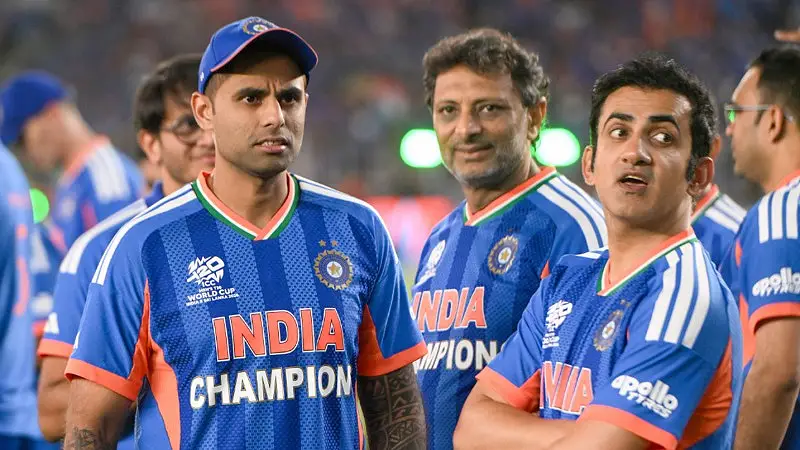

Two ICC trophies in consecutive tournaments. A batting order restructured around powerplay aggression rather than traditional accumulation. A spinner brought back from the fringes and turned into India’s most dangerous middle-over weapon. Gautam Gambhir made decisions that looked like risks and turned them into a system. The Champions Trophy 2025 proved the system could win tournaments. The 2026 campaign proved it could dominate them. Here is the case for why Gambhir’s tenure has already redefined what an India T20 coach can achieve.
The Tactical Identity He Built From Scratch
Before Gambhir, India’s T20 approach often relied on individual brilliance to compensate for structural hesitancy. Batters protected starts. Captains managed risks conservatively. The team trusted its talent more than its system.
Gambhir reversed that priority. He built a culture where powerplay intent was non-negotiable, batting roles were defined by match situation rather than reputation, and players were evaluated on impact rather than personal milestones. The result was a batting unit that functioned as a collective attacking force, one where the loss of one wicket didn’t trigger a reversion to caution because the next batter was trained to maintain the same intent.
India’s ability to adapt that philosophy across spin-friendly surfaces, high-scoring venues, and knockout pressure throughout the 2026 campaign was the clearest evidence that the tactical identity had genuinely taken root rather than simply appearing in favourable conditions.
Three Selection Decisions That Changed Everything
The Samson-Abhishek opening combination was Gambhir’s most consequential selection call. A right-left combination at the top broke the left-hand heavy pattern that had made India vulnerable to off-spin in the powerplay. Samson’s presence forced opposing captains to reconsider front-loading spin, removing a tactical advantage teams had reliably used against India’s top order for years.
Restoring Varun Chakravarthy to a central role was the second. A mystery spinner who had drifted out of favour returned under Gambhir as India’s primary middle-over wicket-taker, ending the tournament with 13 wickets and a 3/7 that remains the most destructive single spell of the campaign.
The third was using Shivam Dube as a bowling option and promoting Tilak Varma in the order. Neither decision looked orthodox. Both increased tactical flexibility in ways that opponents struggled to plan for.
How the T20 World Cup 2026 Proved Gambhir’s Methods Work
The T20WC 2026 was the definitive test of whether Gambhir’s system could perform under maximum pressure across multiple consecutive knockout matches. India posted 253 against England in the semifinal. They produced 92 without loss in the powerplay of the final. They won by 48 runs. Those numbers don’t happen accidentally; they reflect a batting order executing a plan with collective confidence rather than individual improvisation.
The Champions Trophy 2025 win showed Gambhir could prepare India for a fifty-over tournament. The 2026 campaign showed he could build a T20 system capable of dominating opponents in every phase simultaneously, powerplay, middle overs, and death, across a full knockout tournament on home soil.
What Consecutive ICC Titles Actually Mean
Coaching legacies in cricket are almost always defined by trophies. One trophy can be a circumstance. Two consecutive trophies in different formats against quality opposition is a pattern. Gambhir’s tenure has now produced both the Champions Trophy 2025 and the T20 World Cup 2026, making him the only India coach to win ICC trophies in consecutive tournaments across different formats.
The debate about the greatest T20 coach will continue beyond any single tournament result. But the combination of a clearly defined philosophy, bold selection decisions that proved correct, and back-to-back ICC titles gives Gambhir an argument that is increasingly difficult to challenge.
- Is Gambhir already India’s greatest white-ball coach, or does he need more tournament wins to make the case conclusively? Drop your view in the comments and follow for cricket coverage.
FAQs
Why is Gautam Gambhir considered a successful T20 coach?
His emphasis on aggressive batting, tactical flexibility, and fearless team culture helped India perform consistently in major tournaments.
What tactical changes did Gautam Gambhir introduce in India’s T20 strategy?
He emphasized flexible batting orders, aggressive powerplay scoring, and multi-role players to adapt to different match conditions.
Which players benefited most from Gambhir’s coaching approach?
Players like Sanju Samson, Abhishek Sharma, Varun Chakaravarthy, and Tilak Varma gained important roles within the team structure.
Can India continue dominating T20 cricket under Gambhir?
If the current tactical system and player development continue, India has the potential to remain a leading T20 force in future ICC events.