

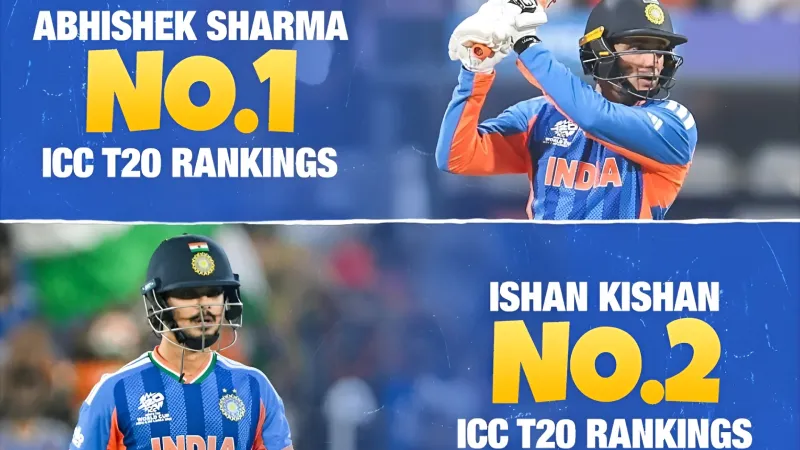

Abhishek Sharma held No.1 in the ICC batting rankings after the tournament. Ishan Kishan moved to No.2, four rating points behind, on the back of 317 tournament runs. Rashid Khan reclaimed No.1 among bowlers, overtaking Varun Chakravarthy. Sikandar Raza retained No.1 among all-rounders while Hardik Pandya reached a career-high rating. Jacob Bethell surged seventeen places to sixteenth. Finn Allen’s 33-ball century against South Africa pushed him into the batting top twenty. One tournament, one month, and the entire ICC T20I rankings structure shifted across every category simultaneously.
Why India’s Top Order Dominated the Batting Rankings
Abhishek Sharma’s retention of the No.1 batting ranking after the tournament reflects the specific value his powerplay role created throughout the campaign. His half-century in the final against New Zealand, produced at a strike rate that forced New Zealand’s captain to exhaust bowling options in the first six overs, was the innings that confirmed rather than created his No.1 position. The consistency across nine matches that built the ranking was more significant than the single final innings.
Ishan Kishan’s move to No.2 on 317 tournament runs represents the most significant batting ranking climb of any player not already in the top five. The four-point gap between him and Abhishek reflects a tournament where both players produced elite returns simultaneously, a rare occurrence that compressed the rating gap rather than one player pulling away from the field.
How International Players Rewrote Their Ranking Trajectories
Jacob Bethell’s seventeen-place climb to sixteenth represents the largest single-tournament ranking movement among batting top-twenty entrants. His aggressive innings across England’s campaign demonstrated the specific value of left-handed powerplay batting against right-arm spin, the matchup advantage that tournament conditions amplified across multiple matches on subcontinent surfaces.
Tim Seifert’s climb to sixth reflects New Zealand’s consistent top-order performance across the tournament, a campaign that reached the final before India’s 96-run victory ended their title challenge. Finn Allen’s 33-ball century against South Africa in the semifinal stage was the single innings that moved him into the batting top twenty, confirmation that one dominant performance in a knockout match carries disproportionate ranking weight compared to equivalent performances in bilateral series.
Why T20 World Cup 2026 Matches Carry More Ranking Weight Than Bilateral Series
The T20 World Cup 2026 ranking movements across batting, bowling, and all-rounder categories confirm a pattern consistent across previous editions. ICC tournament matches generate larger rating shifts than equivalent bilateral series performances because the opposition quality and match stakes are simultaneously higher. Rashid Khan’s return to No.1 among bowlers despite not playing in the tournament’s final week illustrates this dynamic; his earlier tournament performances accumulated enough rating points against high-ranked opposition to overtake Chakravarthy’s bilateral series returns.
Jasprit Bumrah’s move to sixth and Axar Patel’s climb to seventeenth reflect the same tournament amplification; both players produced figures in knockout matches against England and New Zealand that carried significantly higher rating value than equivalent performances against lower-ranked bilateral series opposition.
What the All-Rounder Rankings Reveal About Modern T20 Squads
Sikandar Raza’s retention of No.1 among all-rounders and Hardik Pandya’s career-high rating arriving simultaneously confirms the strategic premium ICC rankings now place on multi-skill players. Pandya’s contributions with both bat and ball across the tournament produced the rating points that pushed him to a career high, evidence that his dual role creates rating accumulation opportunities unavailable to specialists who contribute in only one department per match.
Will Jacks advancing to thirteenth and Mitchell Santner climbing to ninth among all-rounders reflects the same trend across multiple teams; the players gaining ranking ground fastest in T20 cricket are consistently those who contribute across departments rather than dominating one phase exclusively.
- Which ranking movement surprised you most, Bethell’s seventeen-place climb, Rashid Khan reclaiming No.1, or Pandya’s career high? Drop your pick in the comments and follow for cricket coverage.
FAQs
What are the ICC T20I Player Rankings 2026 based on?
The rankings are calculated using a points system that evaluates recent international performances, match impact, and opposition strength.
Why did players move up after the ICC Men’s T20WC, 2026?
World Cup matches carry highly competitive value, so strong performances in the tournament can significantly influence the Men’s Rankings positions.
Which Indian players improved their rankings after the tournament?
Players like Abhishek Sharma, Ishan Kishan, Jasprit Bumrah, Axar Patel, and Hardik Pandya gained positions due to their tournament performances.
How often are ICC Men’s Rankings updated?
The rankings are usually updated weekly to reflect results from recent international matches.
Can bilateral series change the ICC T20 rankings after the World Cup?
Yes. Strong performances in international series following the tournament can continue to influence the rankings and alter player positions.
Disclaimer: This blog post reflects the author’s personal insights and analysis. Readers are encouraged to consider the perspectives shared and draw their own conclusions.