

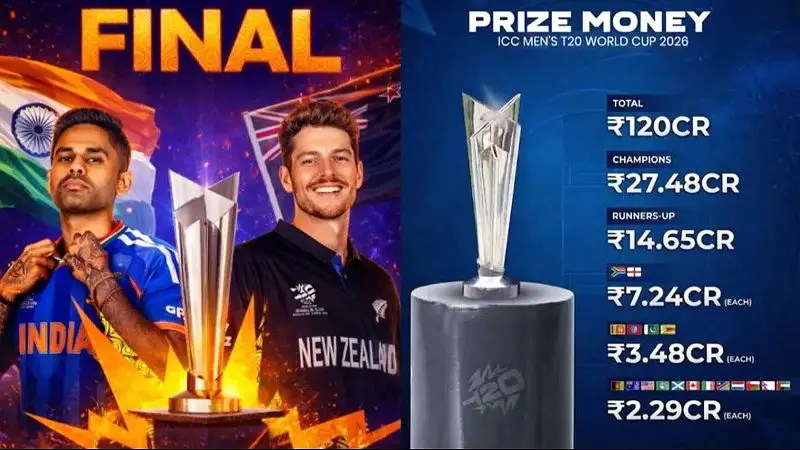

India earned $2,639,423. New Zealand collected $1,422,692. Every team that qualified received a guaranteed base payment of $225,000, before a single match was played. The total prize pool across all 20 teams reached $11.25 million, the largest in T20 World Cup history, distributed through a layered structure that rewards participation, match wins, and tournament progression simultaneously. Here is where every dollar went and why the system is designed the way it is.
How the Top Four Teams Split the Largest Payouts
India’s $2,639,423 reflects their championship finish plus the progression bonuses accumulated across nine matches, winning eight of them. New Zealand’s $1,422,692 as runners-up represents their second consecutive final appearance and the additional earnings generated by defeating South Africa in a high-scoring semifinal.
South Africa and England, both semifinalists, crossed the million-dollar mark despite missing the final. South Africa’s unbeaten run through the group stage and Super Eights generated substantial progression bonuses before their semifinal exit. England’s strong campaign, which pushed India into the last four, placed them just under South Africa’s total. The gap between semifinalists and teams exiting at the Super Eight stage reflects how significantly each additional round multiplies earnings in the ICC’s payout model.
How T20 World Cup 2026 Prize Money Rewards Every Stage of the Tournament
The T20 World Cup 2026 prize money structure ensures that performance at every stage translates directly into additional earnings rather than only rewarding the final four. Teams reaching the Super Eight stage, including West Indies, Pakistan, and Sri Lanka, earned sizable rewards through progression bonuses on top of their $225,000 base.
Each group stage win generates a fixed bonus added to the base participation fee. Each knockout round cleared adds a larger progression multiplier. The result is a system where a team winning three group matches and reaching the Super Eight earns approximately three times the base payout, without winning a knockout match. For associate nations still building their cricket economies, that distinction between good group-stage performance and early exit carries genuine financial significance.
Why Associate Teams Gained the Most From the New Structure
Italy’s victory over Nepal, their first win at ICC tournament level, pushed their earnings above the minimum payout threshold. Zimbabwe’s upset victory over Australia during the group stage significantly boosted their final prize share, translating a single famous result into meaningful additional funding for domestic cricket development.
For Scotland and Ireland, consistent group-stage performances across wins and competitive losses generated earnings that represent genuine investment capital for player contracts, domestic league infrastructure, and junior development programmes. The ICC’s decision to guarantee $225,000 to every qualifying team regardless of results ensures that associate nations don’t return from tournaments financially worse off, a policy that directly supports the sport’s global expansion.
Why the $11.25 Million Total Matters Beyond This Tournament
The ICC confirmed that prize pools across major tournaments would reach record levels from 2024 onwards, driven by increased broadcasting revenue and expanded global cricket investment. The $11.25 million total for this edition represents a significant increase from earlier T20 World Cup prize pools, which reached $5.6 million in 2021 and $8.68 million in 2024.
That trajectory, effectively doubling the prize pool across five years, reflects how the commercial value of T20 cricket has grown alongside the format’s global audience. For players at every level of the game, from India’s champions to Italy’s historic first winners, the financial rewards of competing in ICC tournaments have never been larger.
- Do you think the ICC’s prize money distribution fairly rewards associate nations, or should the base participation fee be even higher? Drop your view in the comments and follow for cricket coverage.
FAQs
How much did the winners earn in the T20WC 2026?
India received $2,639,423 after winning the tournament final against New Zealand.
Why does the ICC increase prize money in tournaments?
The ICC raises prize pools as broadcasting revenue and global cricket investment continue to grow.
Which teams earned the minimum payout in the tournament?
Teams eliminated early received the base participation payment of $225,000.
How does prize money benefit smaller cricket nations?
Earnings from tournaments help associate teams invest in player development, domestic leagues, and cricket infrastructure.