

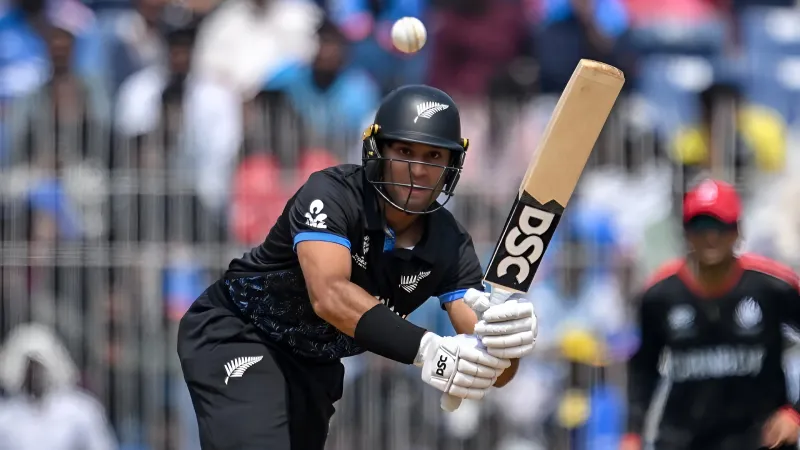

Rachin Ravindra came into this tournament known as a batter who bowls. He is leaving it as something considerably more dangerous. His 11 wickets in the T20WC have matched Daniel Vettori’s record for the most by a New Zealand spinner in a single men’s campaign, and he has done it not through mystery spin or raw pace, but through bowling intelligence that has quietly dismantled batting line-ups across every surface the tournament has offered.
Why His Variations Are So Hard to Read
Ravindra bowls left-arm finger spin, which on paper sounds predictable. In practice, the way he adjusts seam position, pace, and trajectory ball by ball makes him genuinely difficult to settle against.
Against right-handers, he works with a traditional seam position to generate natural turn and bounce off the surface. Against left-handers, where a left-arm spinner is theoretically easier to target, he shifts to scrambled seam deliveries at slightly higher pace, pushing the ball across the batter rather than into the hitting arc. That adjustment removes the predictable angle that left-handers typically exploit against this type of bowling. The result is a bowler who offers no comfortable matchup regardless of which hand you bat with.
How Pitch Conditions Have Shaped His Approach
The multi-venue nature of this tournament has actually worked in Ravindra’s favour, because it has forced him to develop two distinct versions of his bowling.
At spin-friendly venues like Colombo, he tosses the ball higher, invites the drive, and lets overspin do the work. The extra bounce from his action produces mistimed lofted shots, the kind that look like the batter played the right shot but got it slightly wrong. On the flatter Indian surfaces, he adjusts immediately: quicker through the air, tighter lengths, containment over turn. The goal shifts from taking wickets with spin to creating pressure that produces wickets through mistakes.
His T20 World Cup Numbers Tell the Story
Eleven wickets. Economy rate is just over six runs per over against right-handers. Consistent pressure across the middle overs in match after match. These T20 World Cup numbers don’t just reflect a good tournament; they reflect a bowler who has found a method and repeated it under knockout pressure.
Matching Vettori’s record matters beyond the statistic itself. Vettori was New Zealand’s most complete spin bowler of his generation. For Ravindra to reach the same wicket tally in a single campaign, while also contributing with the bat, signals a genuine all-round development that New Zealand’s selectors could not have fully anticipated when the tournament began.
What India’s Batting Lineup Presents Next
The final against India is the hardest test his bowling will face. India’s lineup carries aggressive left-handers who target spin from the first ball, and their familiarity with left-arm finger spin on home surfaces is as deep as any batting group in the world.
Ravindra’s answer will likely be the scrambled seam approach he has used throughout the tournament against left-handers, combined with tight lengths that prevent the big stride down the track. Mitchell Santner will probably take the more attacking spin role, leaving Ravindra to build pressure from the other end and force errors rather than create them outright.
If he bowls his four overs for 24 and takes one wicket in the final, New Zealand will be satisfied. If he replicates the form that got him to 11 wickets, they might just win the tournament.
- Is Ravindra now New Zealand’s most valuable T20WC bowler ahead of Santner and Ferguson? Drop your pick in the comments and follow for IND vs NZ Final live updates.
FAQs
What makes Rachin Ravindra’s bowling effective in the T20WC?
His effectiveness comes from pace variation, overspin bounce, and the ability to adjust seam position depending on whether he faces right- or left-hand batters.
Why is Rachin Ravindra important for New Zealand in the ICC Men’s T20WC?
He provides control during the middle overs while still taking wickets, which helps New Zealand maintain pressure between the powerplay and death overs.
How has Lance Dry influenced Rachin Ravindra’s bowling development?
Lance Dry has previously highlighted Ravindra’s strong bowling intelligence and helped develop his control and tactical understanding during his time in Wellington cricket.
Can Rachin Ravindra trouble India’s batting lineup?
Yes, especially if he uses scrambled seam deliveries and varied pace to counter India’s left-handers in the India vs New Zealand matchup.
Is Rachin Ravindra primarily a bowler or batter for New Zealand?
Ravindra considers himself a batting all-rounder, but his bowling performances in this tournament show he can be a key contributor with the ball as well.
Disclaimer: This blog post reflects the author’s personal insights and analysis. Readers are encouraged to consider the perspectives shared and draw their own conclusions.