

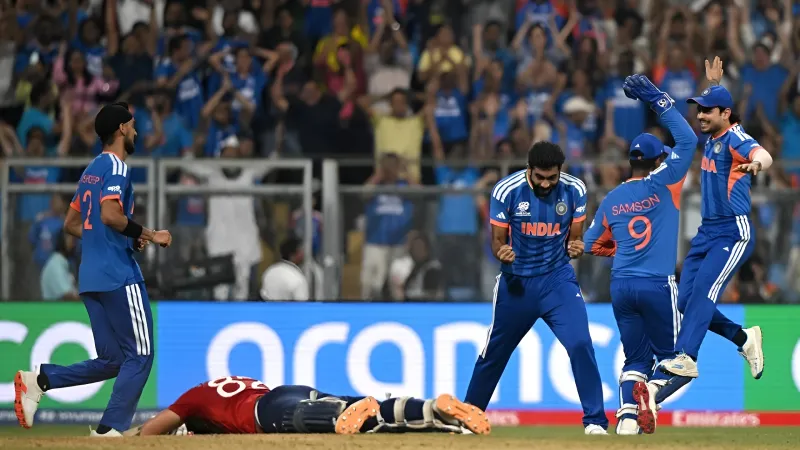

The highest combined match total in T20WC history is 499 runs, set at Wankhede Stadium when India and England turned a 2026 semi-final into the greatest run-fest the tournament has ever seen. That match sits at the top of a list that shows just how dramatically T20 scoring has changed since the first edition in 2007. Here are the five highest aggregate totals the tournament has produced.
India vs England 2026: 499 Runs
India posted 253/7 at Wankhede with Sanju Samson striking 89 off 42 balls and the middle order maintaining the assault through the death overs. England’s response should have fallen well short. Jacob Bethell’s 105 off 48 balls made sure it didn’t.
England finished on 246/7, seven runs short of the highest chase in knockout history. Wankhede’s short boundaries and true batting surface meant every mistimed shot still had a chance of clearing the rope, and both sides maximised the powerplay and death overs in a way that pushed the combined total to within one boundary of 500.
England vs South Africa 2016: 459 Runs
Before 2026, this was the benchmark. South Africa posted 229/4 at Wankhede on the back of strong opening contributions from Hashim Amla and Quinton de Kock. Joe Root then anchored England’s chase with 83 off 44 balls, composed enough to manage the required rate, aggressive enough to keep the boundary count high throughout.
England completed the chase in the final over. The same Wankhede conditions that would later host the 2026 semi-final were already producing historically high aggregates a decade earlier.
India vs Zimbabwe T20 World Cup 2016: 440 Runs
India’s 256/4 against Zimbabwe in 2016 remains one of the highest totals posted in a group match. The final five overs produced an extraordinary run rate as India’s finishing specialists dominated Zimbabwe’s pace bowling.
Zimbabwe responded with 184/6, a creditable chase given the target, but never genuinely threatening. What the match demonstrated was how flat surfaces and aggressive lower-order batting could routinely push combined totals past 400 even in one-sided contests.
Sri Lanka vs Pakistan 2026: 419 Runs
The 2026 Super 8 stage produced its own high-aggregate thriller when Pakistan posted 212/8 against Sri Lanka, anchored by a century from Shahibzada Farhan and an aggressive contribution from Fakhar Zaman. Sri Lanka, led by Dasun Shanaka, pushed the chase hard and fell five runs short.
The match saw the scoring rate exceed ten runs per over for extended periods, driven by aggressive opening partnerships on both sides and attacking field placements that invited boundaries rather than restricting them.
India vs England 2007: 418 Runs
The inaugural T20 World Cup produced its own high-aggregate classic. India scored 218/4 under MS Dhoni’s captaincy, with Yuvraj Singh’s assault on Stuart Broad producing six sixes in a single over, still one of the most replayed passages of play in the tournament’s history. England responded with 200/6, making it the first match in T20 cricket history to combine two 200-plus totals.
Scoring rates were lower in 2007 than modern standards, but this match established the attacking template that every subsequent team has built on.
- Which of these five matches produced the most entertaining cricket, the 2026 Wankhede thriller or Yuvraj’s six sixes in 2007? Drop your pick in the comments and follow for T20WC coverage.
FAQs
What is the highest aggregate total in T20WC history?
The highest combined match total is 499 runs from the India vs England semifinal in 2026
Which players played key roles in the 2026 India vs England run-fest?
Sanju Samson led India’s batting while Jacob Bethell scored a century for England.
Which venue has hosted multiple high-scoring games?
Wankhede Stadium in Mumbai has seen several high-aggregate matches due to its flat pitch and short boundaries.
Can a T20WC match cross 500 total runs?
Given current scoring trends and aggressive batting approaches, a 500-run combined total is increasingly possible in future tournaments.
Disclaimer: This blog post reflects the author’s personal insights and analysis. Readers are encouraged to consider the perspectives shared and draw their own conclusions.