

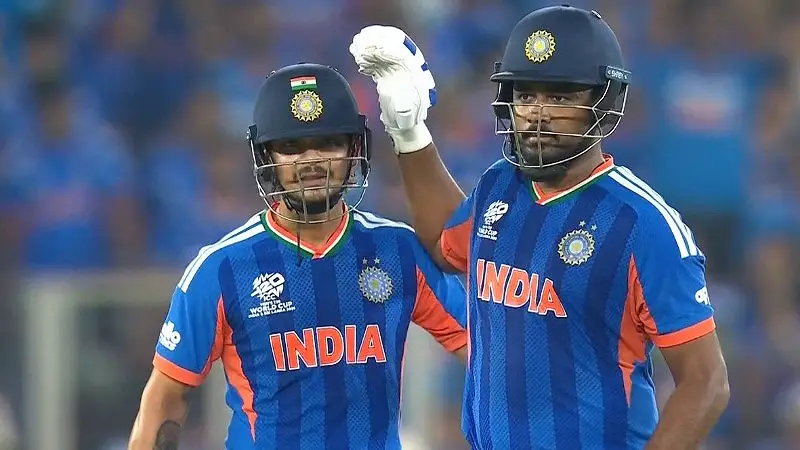

Before Sanju Samson opened the batting, India had the lowest scoring rate among full-member teams in the first ten overs against spin, 6.95 runs per over. After the batting order change that brought Samson to the top and moved Ishan Kishan to number three, that number rose to 8.64. That single tactical adjustment, quietly made during the tournament, is the real reason India’s top order dismantled New Zealand in the final. Samson, Abhishek Sharma, and Kishan didn’t just bat well. They solved a structural problem that had been there all along.
Why the Left-Hand Problem Needed Fixing
India’s original top order was heavily left-handed. That created a specific vulnerability: teams could front-load off-spin in the powerplay, target the natural angle turning away from left-handers, and force India’s aggressive openers into riskier strokes against a favourable matchup.
Introducing Samson as the opener broke that pattern immediately. A right-handed wicketkeeper batter at the top meant opposing captains could no longer guarantee their off-spin matchup would work from over one. The calculation changed. Suddenly, front-loading spin carried a risk it hadn’t before. Samson attacks off-spin effectively from the right-hand side, removing the geometric advantage the bowling team previously held.
How Abhishek and Samson Split the Powerplay Roles
With Samson solving the structural matchup problem, Abhishek Sharma could focus on what he does best, attacking without overthinking the bowling plan. His 52 off 21 balls in the final was the product of a batter who knew his role precisely and executed it without hesitation.
Samson’s presence at the other end meant Abhishek never had to be the sole aggressor. When Abhishek faced a difficult matchup, Samson rotated the strike. When Samson faced pace he could attack. Abhishek recovered composure. The partnership worked because each batter had a defined job and trusted the other to do theirs. New Zealand’s powerplay plan had no clear answer to that combination.
The T20 World Cup Stats That Prove India’s Plan Worked
The numbers make the argument cleanly. India’s scoring rate against spin in the first ten overs rose from 6.95 to 8.64 after the batting order change, not a marginal improvement but a fundamental shift. More significantly, India also recorded the best average against spin in the first ten overs among all competing teams after the adjustment, meaning they were scoring faster and losing fewer wickets simultaneously.
That combination is rare in T20 cricket. Usually, teams accept more risk to score faster, which means more wickets. India managed to do both, score more and protect wickets better, which is the clearest possible evidence that the tactical change was correct.
Why Kishan at Three Was the Final Piece
Moving Ishan Kishan to number three completed the structure. His strongest suit is attacking spin in the middle overs, and arriving at the crease with the powerplay momentum still intact gave him ideal conditions to do exactly that.
Against Mitchell Santner’s left-arm orthodox in the final, Kishan attacked while Samson, still at the crease after surviving the powerplay, rotated strike and absorbed pressure from the other end. New Zealand’s primary spin weapon was caught between two different threats simultaneously. Contain Kishan and Samson scores freely. Target Samson and Kishan attacks. There was no clean solution.
- Do you think the Samson-Abhishek-Kishan top order should remain India’s template for future ICC tournaments? Drop your take in the comments and follow for cricket coverage.
FAQs
Why did Sanju Samson open in the T20 World Cup final?
India used Samson as an opener to break their left-hand heavy top order and reduce vulnerability to off-spin during the powerplay.
How did Abhishek Sharma influence the final?
Abhishek Sharma provided early momentum with a rapid half-century, forcing New Zealand’s bowlers onto defensive plans early in the match.
Why was Ishan Kishan important at number three?
Batting at number three allowed Kishan to attack spinners in the middle overs, which improved India’s scoring rate against spin.
What role did spin play in the India vs New Zealand final?
Spin was expected to control the middle overs, but India’s top-order structure prevented New Zealand’s spinners from slowing the scoring rate.
Can this top order continue in future ICC tournaments?
If the balance between aggression and match-up control continues to work, the Samson-Abhishek-Kishan combination could remain a key part of India’s T20 strategy.