

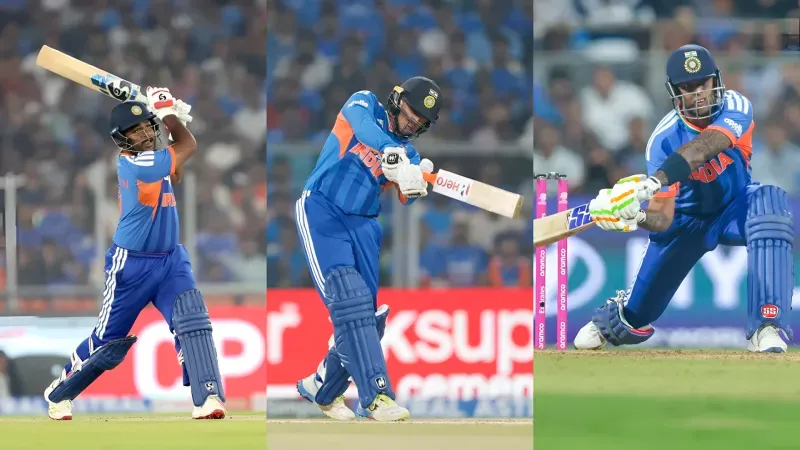

The best India top order combinations for the T20WC 2026 solution are likely the one that balances aggression and stability, especially with Ishan Kishan providing flexibility and Sanju Samson offering a right-hand option. With Tilak Varma struggling for rhythm and Abhishek Sharma still adapting to pressure situations, India must adjust their approach. The top three cannot just attack; they must also survive difficult powerplay conditions and set the platform.
Sanju Samson Opening Balance India Top Order Combo
Promoting Sanju Samson to open alongside Abhishek Sharma immediately solves India’s left-right balance concern. This tactical shift makes it harder for opposition teams to settle into predictable bowling patterns, particularly when early overs often feature seam movement and tactical field placements. Samson’s natural strokeplay allows India to maintain scoring intent in the powerplay, while Abhishek’s aggressive instincts ensure bowlers remain under pressure. This combination also allows Ishan Kishan to move into a slightly flexible role, where he can control tempo depending on match situations and prevent collapses if early wickets fall.
Abhishek Sharma Ishan Kishan Stability Pair
Retaining Abhishek Sharma and Ishan Kishan as openers remains the most continuity-based India Top Order Combo. Both players have recent experience facing the new ball in international and franchise cricket, which reduces uncertainty in knockout-type matches. Kishan, in particular, has shown he can shift gears after cautious starts, making him valuable on slower surfaces where timing becomes difficult. This combination works best in conditions where stroke-making improves after the powerplay, as it allows India to preserve wickets and accelerate later. It also creates space for Sanju Samson to enter at number three, where he can counter-spin and rebuild if necessary.
Suryakumar Yadav Number Three Flexibility
Using Suryakumar Yadav at number three offers the most tactically dynamic solution. His ability to attack both pace and spin early can immediately shift momentum, especially if India loses an early wicket. This move also reduces pressure on Tilak Varma, who can then bat in a more protected middle-order role. From a strategic perspective, India benefits when their most adaptable batter faces more deliveries, particularly on slower pitches where innovation becomes essential. This combination keeps the opening pair unchanged while strengthening the transition phase between power play and middle overs.
Conditions And Tactical Match Influence in the T20 World Cup
Top order success in this tournament has been heavily influenced by pitch behavior, especially on surfaces where early seam movement is followed by slower middle overs. In such conditions, teams that preserve wickets in the first six overs consistently build stronger totals. India’s decision must therefore prioritize adaptability rather than reputation. The presence of both left- and right-hand batters in the top order also plays a key role in disrupting bowling rhythm, which becomes critical in high-pressure matches.
India needs a combination that handles early pressure while maintaining scoring momentum through the middle overs. Tactical flexibility, rather than wholesale change, offers the best solution. Based on current form and balance needs, the Samson-Kishan-Suryakumar structure appears the strongest option because it combines stability, adaptability, and attacking intent without weakening the middle order.
Key Takeaway
India’s best winning formula is the top order combination that balances left-right variety, early stability, and flexible aggression.
FAQs
What is India’s most likely opening pair in the T20 World Cup 2026?
Ishan Kishan and Abhishek Sharma remain the most likely pair because they have recent experience opening together.
Why is Sanju Samson important for India’s top order?
His right-hand batting adds balance and helps counter bowling matchups that target left-hand heavy lineups.
Which batting position suits Tilak Varma best in T20s?
He is more effective in the middle order, where he can build innings rather than face the new ball.
Can Suryakumar Yadav bat at number three for India?
Yes, his adaptability makes him an ideal option to control momentum and counter different bowling phases.
How do pitch conditions affect India’s top order combinations?
Seam movement early and slower middle overs make stability and adaptability more important than pure aggression.
Disclaimer: This blog post reflects the author’s personal insights and analysis. Readers are encouraged to consider the perspectives shared and draw their own conclusions.