

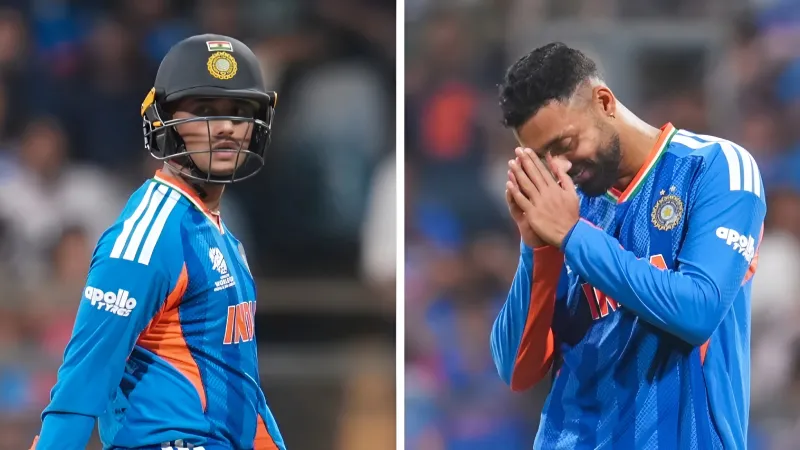

India has won every match that has mattered in this tournament. But two players have been carrying question marks into each game, Abhishek Sharma at the top of the order and Varun Chakravarthy in the middle overs. In a final against New Zealand, those question marks don’t quietly sit in the background anymore. They become the story if either player has an off day at the wrong moment.
What Abhishek’s Struggles Actually Mean
Abhishek Sharma’s powerplay role is structural, not optional. When he fires, India’s middle order enters the game with momentum underneath them and the freedom to accelerate rather than rebuild. When he doesn’t, the innings lose shape before it has found one.
The specific problem throughout this tournament has been his vulnerability to spin early in the innings. Opponents have picked up on it. Spin has been introduced earlier against him than against most T20 openers at this level, and it has worked often enough to become a pattern. New Zealand’s Mitchell Santner will have watched every over Abhishek has faced. Expect left-arm orthodox spin in the powerplay if Santner thinks the matchup is there.
His strike rate has stayed above the minimum threshold for a T20 opener, but the partnership problem is the deeper issue. A top-order batter who scores without building stands doesn’t give the innings the platform it needs.
India’s T20 World Cup 2026 Final Weak Links
Varun Chakravarthy’s issue in this T20 World Cup 2026 is more recent than Abhishek’s. His early tournament performances were threatening variations well disguised, lengths difficult to read. In the knockout stages, that disguise has occasionally slipped.
When Chakravarthy is readable, batters don’t just survive his overs; they target them. His economy rate has climbed through the semi-final stage, which means he is no longer automatically a pressure-building option. He still takes wickets. But expensive wicket-taking overs in a T20 final can hurt as much as wicketless ones.
Why One Concern Is Bigger Than the Other
India’s bowling has enough depth to absorb a below-par Chakravarthy performance. Bumrah, Arshdeep, and Hardik Pandya can carry additional overs. The attack reorganises without losing its spine.
The batting structure doesn’t have the same flexibility. If Abhishek falls cheaply in the powerplay, the innings requires immediate rebuilding at the top, and rebuilding in a T20 final while the required rate climbs is a completely different challenge from accelerating off a solid base. There is no bowling equivalent of that structural damage.
That’s why Abhishek’s form is the sharper concern of the two. Chakravarthy having an off day is a problem India can manage tactically. Abhishek, having an off day, reshapes the entire innings before most of the batting lineup has faced a ball.
How Narendra Modi Stadium Changes the Equation
Ahmedabad’s true bounce and large outfield partially offset Abhishek’s spin vulnerability; the ball doesn’t turn as sharply here as it does at Wankhede, which removes some of the threat from early spin introduction. That’s a genuine advantage for India’s opener going into the final.
For Chakravarthy, the dry surface at Narendra Modi Stadium could work either way. If the pitch grips later in the innings, his variations become harder to read again. If it plays flat throughout, New Zealand’s batters will back themselves to target him in the middle overs as they did against other spin options in the tournament.
Conditions won’t save either player if the form doesn’t show up. But they do give India reason to believe neither risk is as dangerous as it looks on paper.
- Who concerns you more heading into the final, Abhishek Sharma’s batting or Chakravarthy’s bowling? Drop your pick in the comments and follow for T20WC 2026 Final live updates.
FAQs
Why is Abhishek Sharma’s form important for the Indian Cricket Team?
As an opener, he sets the tempo during the power play, which determines how aggressively the middle order can bat later.
How has Varun Chakravarthy performed in the ICC Men’s T20WC 2026?
He has still taken wickets but has recently struggled with economy and consistency in the middle overs.
Which role is more crucial in T20 matches, opener or middle-overs spinner?
Both are important, but an opener’s performance often influences the entire batting structure of a team.
Can India adjust their bowling if Varun Chakravarthy has an off day?
Yes, the Indian Cricket Team has flexible bowling options that can redistribute overs if needed.
What makes the powerplay phase so important in T20 cricket?
Teams that score quickly without losing wickets in the powerplay usually gain a strong strategic advantage later in the innings.
Disclaimer: This blog post reflects the author’s personal insights and analysis. Readers are encouraged to consider the perspectives shared and draw their own conclusions.