

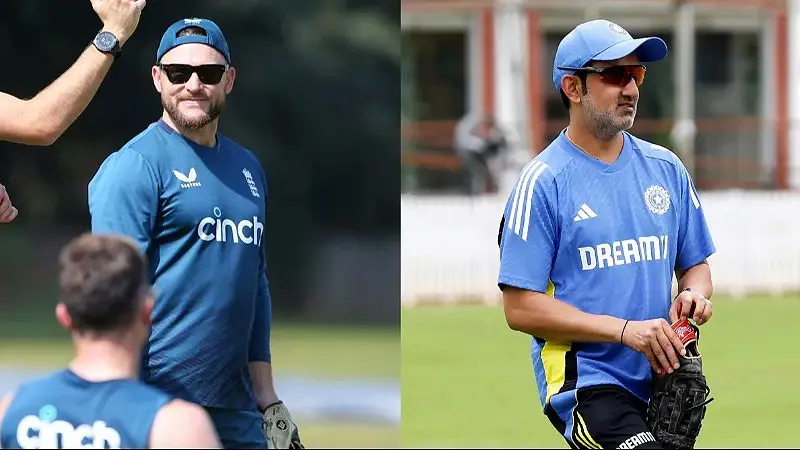

England reached the T20WC 2026 semifinal. India beat them there. The margin, Bumrah’s final-over spell restricting England to 18 runs fewer than they needed, was narrow enough to look like misfortune and wide enough to feel structural. Harry Brook backed McCullum publicly after the exit. The support was genuine. But backing a coach and answering the tactical questions his philosophy raises are two different things. England’s exit from Ahmedabad raised the second question loudly: Does Bazball work in T20 World Cup knockout cricket, or does it work despite it?
Why Aggressive Philosophy Creates Different Problems in T20s
McCullum’s coaching philosophy, attack the situation, backing your instincts, remove the fear of failure, transformed England’s Test cricket between 2022 and 2024. The approach produced results in red-ball cricket because Test matches are long enough to absorb risk and reward aggression with time. A player dismissed cheaply attacking in session one can return to the same approach in session three without structural consequence.
T20 knockout cricket operates on a different equation entirely. One power play collapse doesn’t just cost a session; it redefines the match. The aggressive approach that produces 220 on a good day produces 140 on a day where two wickets fall in the first four overs, and the margin between those outcomes in a knockout match is the difference between winning and going home. England experienced both versions of that equation across their 2026 campaign.
How the Morgan Era Set a Standard McCullum’s England Hasn’t Matched
Eoin Morgan’s England won the T20 World Cup in 2022 through a combination of aggressive batting and specific tactical planning, match-up bowling, powerplay field placements designed for particular opposition batters, and a middle-order structure built around specific pitch conditions. The aggression was calculated rather than instinctive.
McCullum inherited that squad’s talent base but a different captaincy structure. Jos Buttler’s leadership during the 2026 tournament showed flashes of the tactical precision Morgan built, but England’s middle-overs batting, the phase between overs seven and fifteen, where subcontinent surfaces are most challenging, produced lower strike rates than their powerplay and death-over phases. That middle-overs gap is the tactical problem Morgan’s England had solved, and McCullum’s England has not consistently replicated.
What the T20 World Cup 2026 Semifinal Revealed That Stats Cannot Hide
The T20 World Cup 2026 semifinal against India exposed the specific limitation that aggressive philosophy struggles to answer: what do you do when your top three are dismissed cheaply on a surface that doesn’t reward attacking stroke play, and the required run rate has already climbed beyond comfortable territory?
Brook’s 34 off 28 balls in the semifinal was technically correct, composed, responsible, and situationally aware. It was also not enough. England needed Brook to produce 60 off 28 balls in that situation, which is a different task entirely, and one that the Bazball philosophy theoretically encourages but practically cannot guarantee on an Ahmedabad surface where the ball gripped and turned from the sixth over onwards.
What McCullum Must Solve Before the Next ICC Tournament
The question isn’t whether McCullum’s philosophy has value; it demonstrably does across formats and conditions where England’s batting talent is given room to function. The question is whether that philosophy has a specific answer for subcontinent conditions in knockout matches where the surface removes England’s primary advantage, which is boundary-hitting on flat pitches.
The Morgan era had that answer. Building it again, around a younger leadership group and a squad still developing its tournament identity, is McCullum’s most important coaching challenge before England returns to ICC competition.
- Do you think McCullum’s aggressive philosophy can win a T20WC, or does England need a tactical rethink for subcontinent conditions? Drop your view in the comments and follow for cricket coverage.
FAQs
Why is the Brendon McCullum era in England under debate?
England’s recent tournament performances, including the ICC Men’s T20WC, have raised questions about whether their aggressive philosophy needs tactical refinement.
How important is Harry Brook to England’s plans?
Harry Brook is considered one of England’s key emerging leaders and a central figure in the team’s long-term batting strategy.
What challenges did England face in the ICC Men’s T20WC?
England struggled at times to balance aggressive batting with match awareness, particularly in slower pitch conditions.
Can Brendon McCullum’s coaching style still succeed in T20 cricket?
Yes, but success will likely depend on adapting aggressive tactics to different tournament conditions and opposition strategies.
What could England change after this tournament?
England may focus on improving tactical flexibility, bowling combinations, and situational batting awareness in future competitions.