

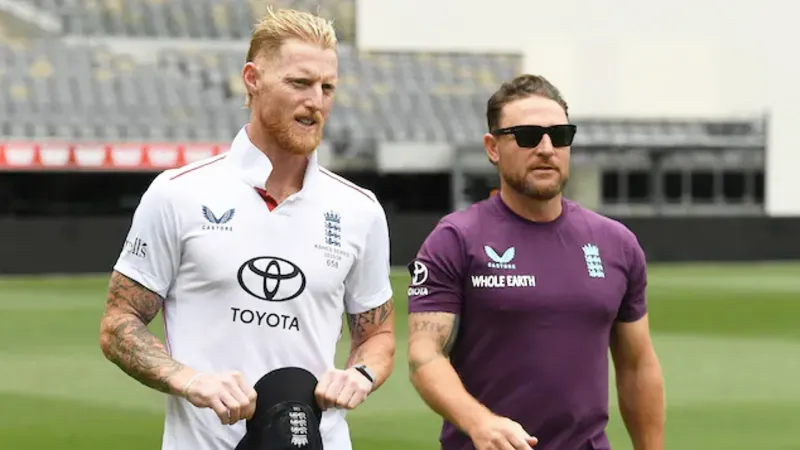

English cricket is experiencing an unusual paradox today. England beat Australia at the MCG on their own for the first time since they won there in January 2011; however, they have lost the Ashes in only 11 grueling days. The win brought relief, but it did not bring redemption. In this awkward moment between celebrating victory and having to deal with the consequences, Ben Stokes made a comment that changed the entire conversation and, to some degree, has already changed the way people view it: he can’t picture himself as captain of England’s Test team unless Brendon McCullum is on his coaching staff.
A Win That Bought Time, Not Trust
Melbourne didn’t save the Ashes, but it saved breathing space. For the ECB hierarchy, Richard Gould and Richard Thompson, that distinction matters. England’s first Australian Test win in 13 years softened the optics of a campaign that otherwise looked terminal by Adelaide. Yet even a potential 3–2 scoreline in Sydney would flatter England. This remains Stokes’ third overseas Ashes defeat, a statistic that historically triggers administrative earthquakes.
But here’s the twist: this time, the captain is arguing against upheaval. Past failures prompted mass clear-outs; Stokes is openly warning that repeating that cycle would only reset England to the dysfunction he inherited in 2022.
Why McCullum’s Contract Matters
McCullum isn’t just ideologically protected, he’s contractually insulated. His deal, which now includes white-ball responsibilities through early 2025, would cost a low seven-figure sum to terminate. Add a T20 World Cup next month, and continuity suddenly looks pragmatic rather than indulgent.
More importantly, McCullum has functioned as a shock absorber. With Rob Key acting as an administrative umbrella, Stokes and McCullum have been shielded from ECB noise. That freedom produced early miracles, but it may now require recalibration, not replacement.
Results That Reveal a Plateau
Stokes is candid enough to admit the trend line has dipped. England haven’t won four of their last five-Test series, including two each against Australia and India. The Bazball peak, roughly mid-2022 to early 2024, has flattened into inconsistency.
What’s revealing is Stokes’ response. He doesn’t call for new voices; he calls for deeper reflection. The extended break between January and England’s next Test (home vs New Zealand on June 4) is, in his words, “time and space to brainstorm.” That’s captain and coach treating stagnation as a design flaw, not a personnel failure.
Succession Is a Paper Plan
England’s alternatives are thin. Harry Brook, vice-captain and limited-overs skipper, is being groomed, but he’s not ready to inherit the most volatile job in English sport. Nor, crucially, is there another head coach Stokes believes can advance this team’s philosophy.
This isn’t blind loyalty. It’s realism. England doesn’t just lack replacements; they lack compatible ones.
When England Chose Reset Over Repair
The Stokes-McCullum axis was designed to end that loop. Their contracts run until the 2027 home Ashes, a date that may also mark Stokes’ international farewell. Dismantling that partnership now would echo the very reflex Stokes warns against: confusing disruption for progress.
The smarter lesson from this tour may be introspective. Even revolutionary systems need structure once the adrenaline fades. Ben Stokes’ endorsement of Brendon McCullum isn’t emotional insulation; it’s strategic clarity. England didn’t lose this Ashes because Bazball failed; they lost because Bazball stopped evolving while Australia adapted ruthlessly. The solution, paradoxically, may be more discipline within the same philosophy.
Key Takeaway
England’s problem isn’t belief its refinement.
FAQs
- What did Ben Stokes say about Brendon McCullum?
He stated he cannot envisage captaining England’s Test team without McCullum as head coach.
- Why is McCullum’s position relatively secure?
His long-term contract, white-ball role, and the upcoming T20 World Cup make continuity preferable.
- How have England performed under Stokes and McCullum?
They’ve won 26 Tests and lost 17, but recent form shows declining consistency in 2025.
Disclaimer: This blog post reflects the author’s personal insights and analysis. Readers are encouraged to consider the perspectives shared and draw their own conclusions.
Step into the world of cricket with JeetBuzz News—where expert opinions, trending Blogs, and behind-the-scenes insights meet all your favorite topics. Stay informed, stay entertained, and never miss the stories shaping the cricketing world—only on JeetBuzz News!