

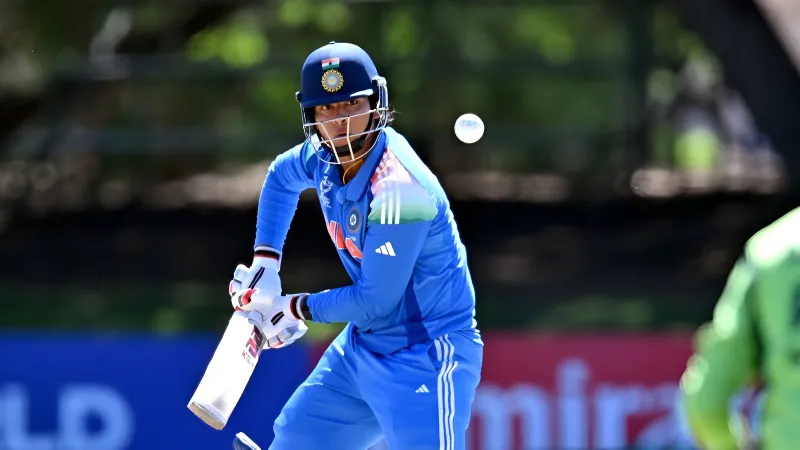

Vaibhav Suryavanshi’s final records stand among the most dominant individual achievements ever seen in youth cricket. In the final against England U19, Suryavanshi produced a breathtaking innings of 175 runs, combining raw power with elite control. His knock not only decided the match but also shattered multiple long-standing tournament records, including the most sixes in a World Cup innings and one of the fastest hundreds in competition history. Supported early by the Aaron George opening partnership for India U19, Suryavanshi’s innings marked a historic high point in the U19WC.
Record-Breaking Sixes in a Single U19 World Cup Knock
Vaibhav Suryavanshi’s biggest headlines came as he broke a U19 World Cup record for most sixes in an inning, when he hit 15 sixes against England to clear the ropes. This broke a long-standing mark set by Michael Hill with his 12 sixes, and even bested Craig Simmons’ 6-hitting record of 11. Tactically speaking england’s use of fast bowlers in the middle overs was unsuccessful in Harare, where the short straight boundary allowed Suryavanshi to repeatedly target the length balls he received, which helped his ability to maintain a consistent bat swing and therefore the intent behind his hitting as opposed to just slog hitting.
Record Sixes in a Single Tournament
Beginning with the first inning, Suryavanshi had a dominant performance throughout the rest of the tournament as he hit 30 sixes, the most sixes in a single Youth World Cup. Suryavanshi was above other notable players like Finn Allen, who have been known for their youth-aggressive style of batting with the use of sixes. The difference between Allen and Suryavanshi is how they used their sixes; Allen mostly accelerated his runs in the power play, while Suryavanshi hit his sixes over an extended period of time.
The Sixth Player to Hit a Century in a Final
By scoring a hundred in his last game, Suryavanshi became part of an elite group as one of only a few batsmen to score a hundred in a final match when pressure to be conservative exists; because of this, what stands out tactically is Suryavanshi’s decision to increase boundary percentages after reaching milestone status.
Second-Fastest Hundred in History
Suryavanshi made his century at an extremely fast rate. As such, it was the second fastest century of the Under-19 World Cup. Suryavanshi attacked very quickly and aggressively to create opportunities for himself to score runs when the pitch would offer little to no lateral movement. The aggressive nature of Suryavanshi’s batting forced fielding captains into making quick reactive changes that disrupted rhythm.
Fastest U19 150
A 71-ball 150 for Suryavanshi became the quickest in the history of U19 cricket. The fast 150 showed how unusual it is for a player to be able to play technically well while maintaining extremely high strike rates. While conditions had an impact, execution was more important than conditions, as England’s bowlers were unable to deliver consistently accurate yorkers under pressure and were punished by Suryavanshi for his ability to capitalize on their predictability.
Suryavanshi has further strengthened his position as one of the most well-rounded U-19 cricketers to come out of the last few cycles if he is nurtured appropriately. His ability to show adaptability and to play with fearlessness while showing clarity on the field in the final will likely transfer well to senior international cricket.
Key Takeaway
Vaibhav Suryavanshi’s final innings reset historical benchmarks by combining record-breaking power with rare tactical maturity.
FAQs
What records did Vaibhav Suryavanshi break in the U19WC final?
He broke records for most sixes in an innings, fastest 150, and registered one of the fastest hundreds in youth WC history.
How many runs did Vaibhav Suryavanshi score vs England U19?
He scored 175 runs, one of the highest individual scores in a youth WC final.
Why is Vaibhav Suryavanshi’s six-hitting compared to Finn Allen’s?
Both are known for aggressive batting, but Suryavanshi showed greater phase-wise consistency across an entire tournament.
Which Indian players previously scored centuries in the finals?
Unmukt Chand is a notable example, achieving the feat in the 2012 final.
Can these performances predict senior-level success?
They indicate potential, but long-term success depends on adaptability, fitness, and transition management.
Disclaimer: This blog post reflects the author’s personal insights and analysis. Readers are encouraged to consider the perspectives shared and draw their own conclusions.