

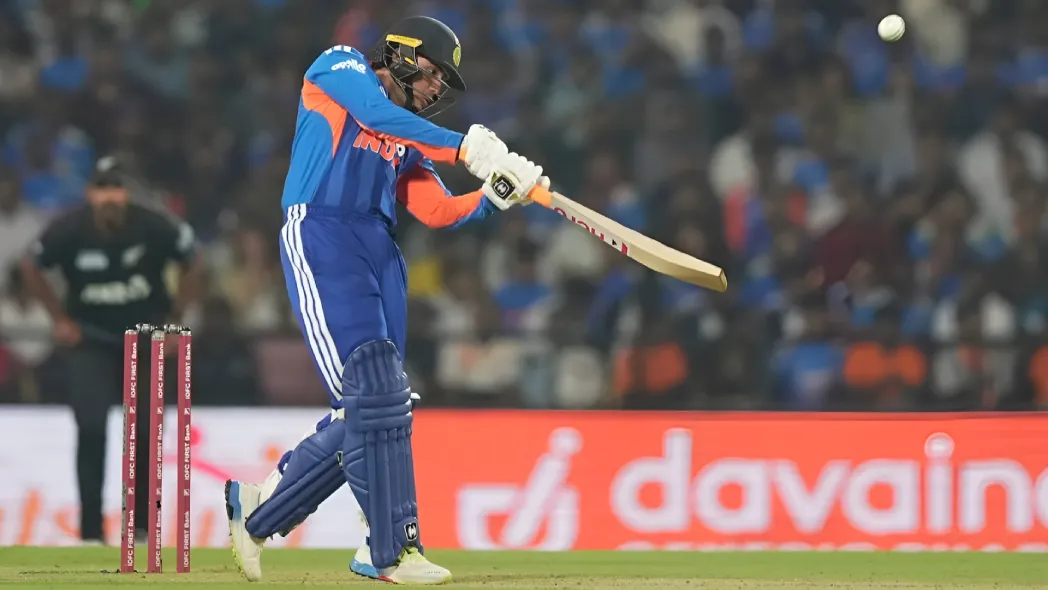

One of the destructive openers of team India’s T20 batting analysis shows why he is not just an explosive opener but a structural outlier in modern T20 cricket. His unmatched T20I strike rate, dominance vs pace and spin, and consistent Powerplay performance reveal a batter who breaks the traditional trade-off between aggression and sustainability. Unlike most aggressive batting profiles, his T20 record combines extreme scoring speed with elite averages across conditions. Let’s see how and why his approach works, what it means tactically for opponents, and whether his model signals the future direction of elite T20 batting.
Breaking the T20 Trade-Off
Traditional T20 batting balances strike rate against longevity score faster, get out sooner. He disrupts this logic. His numbers place him far from the usual strike-rate-versus-dismissal curve, meaning the reward from his aggression consistently outweighs the cost of early dismissal. Tactically, this forces bowling sides to abandon patience-based plans and defend from ball one, often with suboptimal fields. On good or slow surfaces alike, Sharma’s ceiling is so high that even shortened innings tilt match equity heavily in his team’s favour.
Unmatched Powerplay Impact
The Powerplay performance is where his value compounds fastest. Opening the innings, he attacks during the phase where boundary protection is weakest, and wicket value is theoretically highest. Yet his dismissal rate does not spike proportionally. This creates scoreboard pressure that reshapes middle-overs bowling plans, often forcing captains into defensive lengths far earlier than intended. Conditions matter here: even on slower wickets, he maintains intent by adjusting bat swing and targeting straighter lines, ensuring run acceleration without relying solely on pace-on deliveries.
Dominance Against Pace and Spin
Few elite batters maintain elite output against both pace and spin, but he does. His strike rates remain above elite benchmarks regardless of bowling type, removing matchup-based containment strategies. Against spin, he scores fast enough that even dismissals after extended stays are net positives. Against pace, his scoring zones cover behind square and straight boundaries, neutralising hard lengths. From a tactical perspective, this leaves captains without a “safe” bowling phase, a rarity at the international level.
Aggression Without Front-Loading
Many aggressive batting profiles burn brightest early and fade. Sharma’s aggression escalates as innings progress. His scoring rate increases after the field spreads, undermining the standard containment logic of middle overs. This makes defensive fields largely cosmetic. The ability to accelerate late without prior consolidation changes how teams must allocate death overs, often pulling specialist bowlers into earlier spells under pressure.
Abhishek Sharma vs Suryakumar Yadav
The generational comparison of Abhishek Sharma vs Suryakumar Yadav demonstrates a major shift in how we approach shot-making. Sharma has reduced the amount of time needed for “low intent” phases in an inning by not having “low intent” phases at all. Suryakumar Yadav makes his opportunities through improvising with the ball, whereas Sharma creates opportunities simply because he believes every ball will be one that he can score off of. This represents a strategic shift from the creative-based dominance to the inevitable dominance that comes from creating high-volume opportunities.
His T20 batting evaluation shows something clearly; this is not an ephemeral purple patch of the batting model, rather this is a model that consistently distorts T20 logic by compressing risk, time, and reward into a singular approach which overwhelms conventional bowling strategies. Aggressive batting is not dependent upon favorable matchups, flat pitches, or late innings to use in his batting. With international T20 cricket accelerating at a rapid rate, teams will increasingly value batters who are able to control phases of the game without transitional batting.
Key Takeaway
He isn’t just excelling in T20s; he is redefining how dominance in the format is measured.
FAQs
What makes his T20 batting different from others?
His strike rate remains elite without a proportional rise in dismissals, breaking the usual aggression trade-off.
How strong is India’s new Opener against pace and spin?
He maintains high strike rates against both, eliminating traditional matchup-based bowling plans.
Why is His Powerplay performance so important?
It creates early scoreboard pressure that reshapes opposition tactics for the entire innings.
Is he similar to Suryakumar Yadav?
Both are elite, but his approach is volume-based aggression rather than shot innovation.
Disclaimer: This blog post reflects the author’s personal insights and analysis. Readers are encouraged to consider the perspectives shared and draw their own conclusions.