

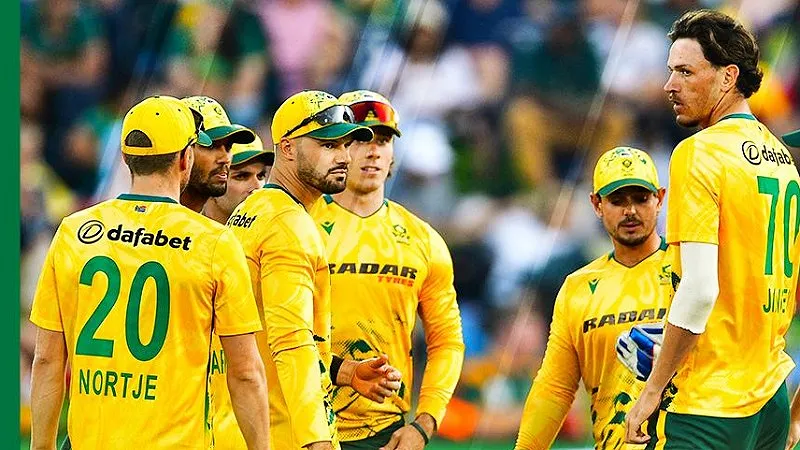

South Africa and World Cups usually come with baggage-choking metaphors, whispered history, and expectations heavy enough to bend a dressing room. Which is why this time feels… oddly quiet. Almost suspiciously so.
The Proteas are heading to India without the usual noise machine revving in the background. No grand predictions. No desperate hope campaigns. Just a team that reached the last T20 World Cup final, won a World Test Championship at Lord’s in June, and recently beat West Indies 2–1 in a T20I series that doubled as a confidence tune-up.
Here’s the twist: South African fans seem at peace with the idea that this might not be the tournament. And paradoxically, that emotional detachment may be the biggest competitive advantage they’ve had in years. The SA20 crowds were bigger than some internationals. The focus is already drifting toward 2027 at home. And somewhere in that lowered volume, South Africa is humming along, engine warm, pressure gauge barely flickering.
Momentum Without the Megaphone
The most interesting aspect of the performance wasn’t the way they played it, but the fact that they were so quiet about it. The South African team beat the West Indies in Paarl and Centurion very convincingly; yet they lost by just six runs in a “dead” (meaning there would be no further games) match that still had a lot of energy and determination. Most importantly, injuries did not ruin the story. David Miller and Lungi Ngidi both came back without injury after getting hurt in their groins and knees, respectively. Therefore, this is a complete and healthy group of players as opposed to one cobbled together.
De Kock’s Joyful Second Wind
There was something almost mischievous about Quinton de Kock’s 115 off 49 in Centurion, especially considering he borrowed Dewald Brevis’ bat after forgetting his own. It wasn’t just the runs; it was the ease. De Kock looks liberated, batting like a man playing for joy rather than legacy. Historically, South Africa’s best World Cup moments have come when senior players look free, not burdened.
Brevis, Between Promise and Proof
Brevis’ T20I series did not have huge returns, only 21 runs for his 16 deliveries, but this underestimates what he is capable of. He had 101 off 56 deliveries in the SA20 finals vs Jansen & Nortje, and that was a showcase of potential, not minimum. South Africa does not require him to perform at that level every time; all he needs to do is be prepared to help tip the scales when the game becomes unpredictable.
Spin Quietly Holding the Map
Asia changes everything. And the fact that Keshav Maharaj topped the wicket charts against the West Indies matters more than it looks. Add George Linde conceding under a run a ball, and suddenly South Africa’s traditionally pace-heavy identity looks more adaptable. Even Markram, Stubbs, and Brevis may be forced into bowling roles untested at this level, yes, but potentially disruptive in the right conditions.
By shifting the spotlight to 2027, by letting SA20 feed confidence without inflating ego, by accepting uncertainty instead of fighting it, the Proteas may have stumbled upon their most valuable tactic yet: emotional efficiency.
Will it guarantee a trophy? Of course not. But for once, South Africa isn’t trying to outrun their past. They’re letting it fall behind naturally. And that’s often how championships are won quietly, unexpectedly, and right on time.
Key Takeaway
South Africa’s strength this World Cup isn’t form it’s freedom.
FAQs
- What makes this South African team feel different?
Lower external pressure, better role clarity, and confidence built through recent trophies.
- Why is spin suddenly important for South Africa?
Asian conditions demand control, and Maharaj and Linde offer that without sacrificing balance.
- How does Jason Smith fit into the bigger plan?
As a late-innings disruptor who shifts momentum without needing big scores.