

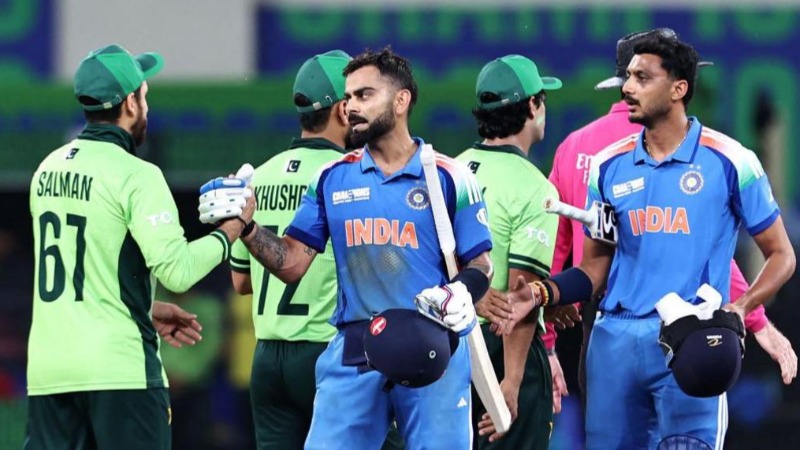

The Men’s T20 WC political controversy has become a defining factor in modern ICC tournaments, directly influencing scheduling, venues, and competitive balance. Repeated tensions around the India-Pakistan cricket boycott of the World Cup, cases where Pakistan refused to play in India cricket, and moments when India refused to play in Pakistan ICC tournaments have forced the ICC into complex logistical compromises. These political realities now affect tournament formats, neutral venues, and even rest cycles, raising serious questions about fairness, performance consistency, and the long-term credibility of global T20 events.
Political Constraints Alter T20 World Cup Design
Political tensions between major cricketing countries are changing how the International Cricket Council (ICC) will be structuring their future events. When a country’s relationship with another country falls apart, the ICC will shift the location of the game to a neutral venue or split the hosting duties. As a result of this, players’ travel load, acclimatization time, and familiarity with pitches will all be affected in terms of their ability to perform in T20 cricket. In addition, the T20 Cricket World Cup has created an internal source of noise that is now being factored into tournament planning, thus creating an inequitable playing field for teams competing in each group.
India–Pakistan Boycott Effects Explained
The India-Pakistan cricket boycott World Cup scenario remains the most influential political flashpoint. When Pakistan refused to play in India’s cricket during ICC events, and when India refused to play in Pakistan’s ICC tournaments, the ICC responded with hybrid or neutral-host models. While these decisions preserve participation, they also distort preparation cycles and reduce high-pressure group-stage encounters that traditionally define World Cup narratives.
Format Pressure And Scheduling Load
Compressed formats, like Experimental Structure, for example, using a three-match-a-day T20 World Cup format, are a common response to political or logistical restrictions. However, compressed formats, such as those utilizing back-to-back games, can increase player fatigue and diminish the number of recovery days available, while also impacting teams with fewer players on their roster to a greater degree than teams with larger rosters. Teams that compete in back-to-back matches in extremely adverse travel conditions typically perform poorly in knockout rounds, and this competitive disadvantage is most likely a result of off-field politics.
Knockout Consistency Under Neutral Conditions
Neutral venues have produced unexpected trends, including the New Zealand World Cup knockout consistency seen across multiple ICC tournaments. Playing away from subcontinental spin-friendly or home-seam conditions reduces variance, benefiting tactically disciplined sides. This pattern highlights how political venue shifts subtly favor adaptable teams while disadvantaging those built around home-specific strengths.
The political controversy surrounding the Men’s T20WC has developed from a periodic interruption to an ongoing influence on how ICC tournaments are structured. The use of neutral venues and flexible formats keeps top-tier teams engaged; however, these same elements create unseen competitive advantages, especially for scheduling, travel, and knockout preparation. The ICC is at a crossroads; it can formalize hybrid-host models with competitive protections that are both transparent and enforceable, or risk continued erosion of tournament competitiveness. If left unresolved, political intervention will be what defines success, not solely based on ability, but rather on being able to adapt to external constraints.
Key Takeaway
Political realities now shape T20WC as much as on-field tactics, quietly redefining competitive balance.
FAQs
Why do India and Pakistan avoid playing bilateral cricket?
Due to long-standing political and diplomatic tensions, bilateral series remain suspended outside ICC events.
How does political controversy affect World Cup scheduling?
It often forces neutral venues, condensed matchdays, and uneven travel demands for teams.
Can the ICC force teams to play in certain countries?
No, the ICC must negotiate participation to ensure full tournaments without withdrawals.
Which teams benefit most from neutral venues?
Tactically adaptable teams with balanced attacks tend to perform better in away-from-home conditions.