

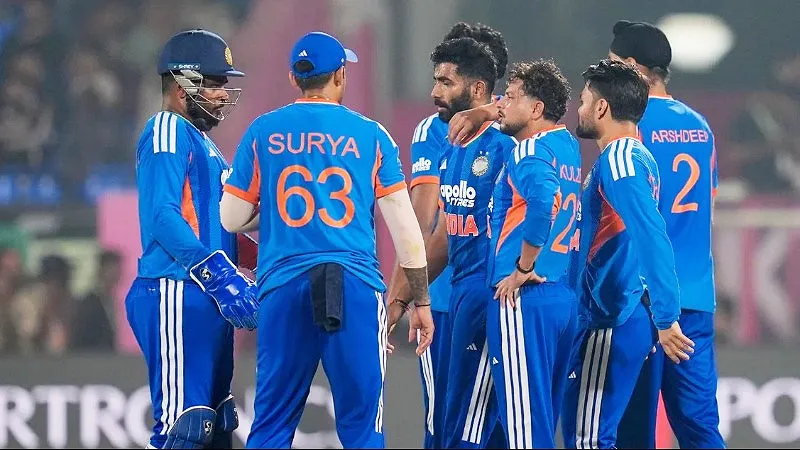

India’s T20 World Cup 2026 squad comparison vs the 2024 title-winning group points to a younger, more role-specialised side built around pace-at-the-death, spin depth, and flexible batting because the Virat Kohli Rohit Sharma absence impact forces India to replace two high-volume anchors with a higher-tempo top order. In this India T20 World Cup 2026 analysis, the biggest levers are who becomes the “stability” batter, how many spin-bowling all-rounders travel, and whether Suryakumar Yadav’s captaincy at the T20 World Cup remains the preferred leadership plan to protect batting intent and match-ups.
The 2024 core that carries over
Most of India’s 2026 structure will still be built from the 2024 spine, just with different top-order names.
High-likelihood 2026 pillars (role-based):
- Death overs: Jasprit Bumrah (and one specialist partner)
- Left-arm pace option: Arshdeep Singh’s profile fits most XI combinations
- Middle-over wicket-taking spin: Kuldeep Yadav-type wrist spin remains critical
- Floating power hitter: Suryakumar Yadav’s role stays central, regardless of batting position
- All-round depth: Axar Patel-type skillset is hard to replace in India/Sri Lanka conditions
This is where India’s T20 World Cup 2026 team balance starts: India can keep 6 bowling options without sacrificing batting explosiveness if the all-rounder mix is right.
Virat-Rohit’s absence reshapes batting
The Virat Kohli Rohit Sharma absence impact is less about “star power” and more about who absorbs pressure when the ball grips and boundaries dry up.
What changes tactically:
- Powerplay approach: likely becomes more consistently aggressive (fewer “set-up” overs)
- Middle-overs insurance: India needs at least one batter who can go 120–140 strike rate vs spin without collapsing tempo
- Chase management: Kohli’s specific strength, late-innings control, must be recreated through a combo of anchors + finishers, not one player
Selection consequence: India is incentivised to pick at least one “stability” bat (even in a high-SR era) alongside two finishers.
Suryakumar’s captaincy and clarity
If India continues with Suryakumar Yadav’s captaincy at the T20 World Cup, the biggest upside is role certainty: SKY can keep the batting plan attacking, while the XI is selected for match-ups rather than reputations.
What does that mean for the squad:
- More specialists, fewer hybrids: a clear new-ball plan, a clear death plan, and set spin pairings
- WK decision becomes strategic: pick the keeper who best fits batting slots (top-order vs middle-order) and helps spin management
- Hardik factor: if fit, he compresses the whole puzzle by adding a seam option + finishing + toss flexibility
Captaincy, here, isn’t just leadership; it directly shapes selection logic.
Conditions-first selection for India/Sri Lanka
With 2026 expected in subcontinental conditions, India’s best XI often becomes a contest between “extra pacer” vs “extra spinner,” especially with dew.
Most repeatable winning template:
- Two pacers + one pace-all-rounder (for powerplay + death)
- Two frontline spinners (one wrist spinner plus a finger spinner)
- At least one spin-bowling all-rounder to maintain batting depth
Key match-up priorities:
- Right-hand heavy opponents: wrist spin + left-arm orthodox becomes a pressure combo
- Dew-heavy nights: one additional death specialist becomes more valuable than a third spinner
- Slow Sri Lanka surfaces: batting vs spin and running between wickets becomes a selection separator
This is the heart of India’s T20 World Cup 2026 team balance: conditions decide the last 2–3 spots more than “best XI on paper.”
India will likely be stronger in 2026 if it treats transition as an opportunity to sharpen roles, not just replace names. The Virat Kohli Rohit Sharma absence impact pushes India toward a higher-tempo top order, while the tournament’s subcontinental conditions should keep spin depth and all-round flexibility at the center of planning. If Suryakumar Yadav’s captaincy T20 World Cup remains the path, expect selection to prioritise match-ups, fielding, and adaptable batting positions over fixed hierarchies. Overall, the India T20 World Cup 2026 squad comparison suggests India’s best route is a bowling-led template, Bumrah plus wicket-taking spin, supported by a batting group built to attack spin without sacrificing chase control. That’s the clearest predictive edge right now.
Key takeaway
India’s 2026 squad should win or lose on role clarity, especially death bowling and spin match-ups, more than on replacing Rohit and Kohli name-for-name.
FAQs
What are India’s biggest selection questions for the T20 World Cup 2026?
Wicketkeeper role (top-order vs middle), the pace partner for Bumrah at the death, and whether India plays two or three spinners in slow conditions.
How big is the Virat Kohli Rohit Sharma absence impact in chases?
It mostly affects “chase control” in the middle overs. India will need a new method to manage risk when boundaries aren’t easy.
Is Suryakumar Yadav the only captain option for 2026?
India could also look at other leadership candidates depending on form and a guaranteed XI spot, but continuity can matter in T20 planning.