

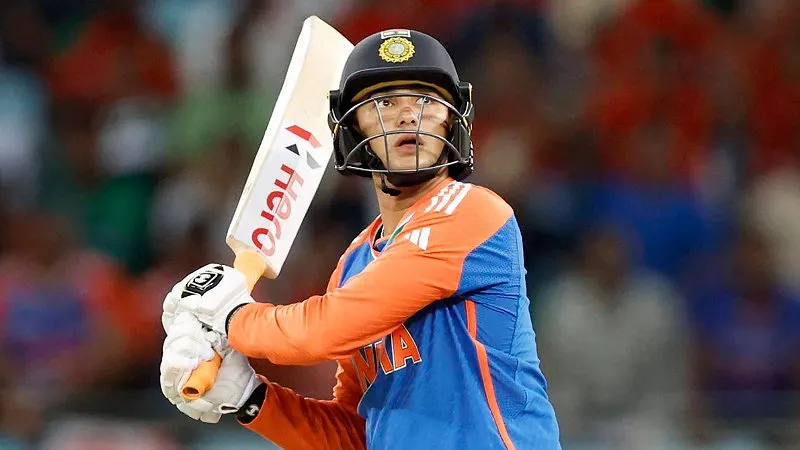

Cricket has an interesting tendency to be skeptical of the new player until that player clears the sight screen for the first time. As India approaches the 2026 ICC Men’s T20 World Cup as a team determined to become the first to successfully defend its title, one name will sit in the middle of optimism and nervousness: Abhishek Sharma.
The timing of this move could be no better. Abhishek has come into a blistering run of T20I cricket against New Zealand, where he scored 152 runs in 4 games and a mind-boggling 14-ball fifty, which was the second fastest for an Indian after Yuvi’s 12-ball 70 in 2007. Is the debate about how talented Abhishek is over? It is now about what he does to make an impact. The rest of India’s title defense may depend on him doing that.
Fearless Starts, Immediate Damage
Abhishek Sharma doesn’t negotiate with bowlers; he issues ultimatums. His power play intent is unapologetic, built on high backlift, clean swing paths, and a willingness to take on pace and spin alike. The 14-ball fifty against New Zealand wasn’t reckless hitting; it was calculated chaos. India’s recent T20 success has leaned heavily on early momentum, and Abhishek offers exactly that front-loaded damage that warps bowling plans within two overs.
Inexperience As Tactical Freedom
Ponting’s most interesting take wasn’t about runs; it was about inexperience. Abhishek hasn’t been scarred by past ICC failures, semi-final exits, or narrative baggage. That makes him dangerous. Like Kevin Pietersen in 2005 or Travis Head in the 2023 ODI World Cup, players without historical fear often redefine big stages. Abhishek plays the moment, not the occasion, and in T20 cricket, that’s a feature, not a flaw.
The Ponting Eye Test Never Lies
Ponting’s faith is based on memory rather than retrospect. Ponting first started coaching Abhishek at the Delhi Capitals when he was just 17. The image that Ponting describes of Abhishek hitting his first ball with a straight bat as he drove lofted it, and then posed while holding the pose, has all the makings of a scouting cliche, but history shows us that Ponting usually doesn’t miss. That Ponting is desperate to retain Abhishek at the Delhi Capitals says a lot about him. There’s no hype here; this is an ongoing evaluation coming to a natural conclusion.
India’s Risk-Reward Equation
Abhishek is under no pressure; his role is simply important in that if he fires for India, it will be almost impossible to beat them. And if he does not fire for India, then they are “as vulnerable as anyone else.” In Group A (USA, Pakistan, Namibia, Netherlands), for India, Abhishek’s role is not just to get India into quick runs but to establish the match so that the Indian middle order can bat with minimal scoreboard pressure. The Indian selectors see him as more of a load-bearing pillar than as a luxury.
While we can say that Abhishek Sharma was once quietly developed for greater responsibility by the Indian team management, now, thanks to Ricky Ponting’s comments, Abhishek Sharma is being put under extreme pressure, with his future playing a significant role in how the Indian national T20 side will be viewed as the dominant force in Twenty-20 Cricket.
Key Takeaway
India’s title defense isn’t about balance; it’s about how early Abhishek Sharma bends the game.
FAQs
- What makes Abhishek Sharma crucial for India in the T20 World Cup 2026?
His explosive power-play scoring can dictate matches before bowlers settle.
- Why does Ricky Ponting value Abhishek’s inexperience?
It frees him from mental baggage, allowing fearless decision-making on big stages.
- How has Abhishek prepared for the tournament?
He entered in top form, scoring 152 runs against New Zealand, including a 14-ball fifty.