

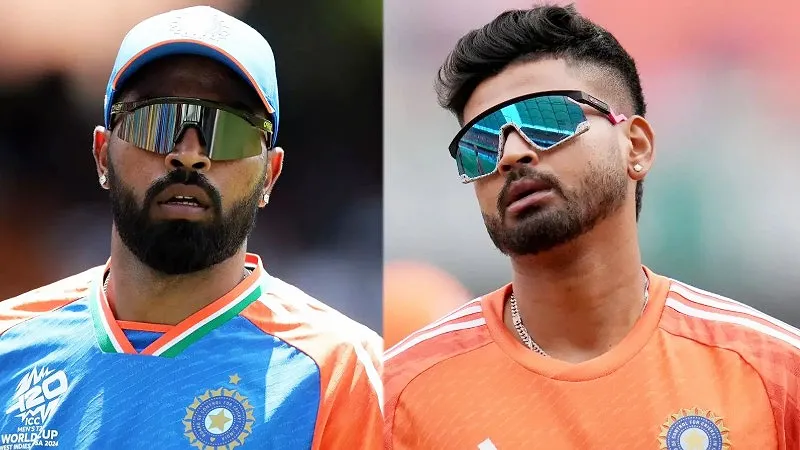

For three games, India was virtually unbeatable against New Zealand. The Indians chased with clinical precision, bowled with deadly accuracy, and had a batting lineup that seemed to have all the pieces for success going forward into the future. Then there was Vizag, where an Indian loss of 50 runs to New Zealand wasn’t just a blow to Indian pride but also exposed a structural weakness India has believed is behind them for quite some time now.
As we get closer to the 2026 T20 World Cup (which is now only days away), the fifth T20I in Thiruvananthapuram can’t be thought of in terms of redeeming a series; it’s an opportunity to ensure preparedness. Within the context of this discussion, Indian batsman Shreyas Iyer (who has been removed from consideration for the World Cup) has emerged as potentially the most important back-up plan for Team India.
Sacrificing a Specialist Bowler for Batting Depth
In the past 2 years, India’s white-ball plans have been to play aggressively (bat deep), but also collapse as little as possible. This is why the 4th T20i selection decision seemed philosophically at odds with this plan. By replacing Ishan Kishan with a 5th bowling option, India removed their safety net in the batting line-up.
Therefore, it was no surprise that once the top order fell, the rest of the team had no chance of defending a total and were forced into a damage control mode from the 12th over onwards with Rana at #7 and 4 bowlers behind him.
The answer was apparent even as late as it has been. Replace one of the four bowling specialists with Shreyas Iyer. Kuldeep Yadav, Arshdeep Singh, Ravi Bishnoi, or Jasprit Bumrah are the options. With Iyer, Shivam Dube can go back to number seven and Rana to number eight; this is a team structure that India has relied on many times before when there have been high stakes. There is no glamour to this plan, but it returns batting normalcy to the team. In my opinion, most successful T20 teams overlook batting normalcy at their own risk.
Resting Hardik Pandya to Protect India’s MVP
Suryakumar Yadav confirmed after the match that India had intentionally tried out a six-batter, five-bowler combo. A fair experiment, but Vizag proved to be the weakest link in this experiment. Hardik Pandya did not bowl any overs and is now effectively a specialist batsman in an already understrength batting unit.
That’s where logic trumps loyalty. Replacing Hardik with Shreyas Iyer achieves two objectives instantly. First, it eliminates even the smallest injury risk to India’s most irreplaceable all-rounder days before a World Cup. Second, it fixes the batting order chaos.
Iyer slots in naturally at No.3. Suryakumar Yadav returns to his most productive T20 position at No.4. Rinku Singh and Shivam Dube fall back into finishing roles where their strike rates actually influence games. With the series already sealed, resting Hardik isn’t conservative; it’s smart tournament management.
Restructuring the Middle Order by Removing a Left-Hander
Vizag wasn’t just about missing runs; it was about misplaced roles. Without Kishan, India was left with a middle order heavy on left-handers and light on positional clarity. Rinku Singh walking in at No.4 during the power play wasn’t a plan; it was a compromise.
Rinku’s 30-ball 39 showed character, but it also underlined the issue: he was playing out of position. Shreyas Iyer, by contrast, is built for that role. He has batted extensively at No.3 for India and Punjab Kings, absorbing pressure before accelerating.
If India persists with five bowlers, Iyer can replace either Rinku or Shivam Dube. Given Dube’s bowling is unlikely to be used alongside Hardik and five specialists, he becomes the logical omission. This allows Rinku to return to his finishing role at No.5 or No.6, where he’s most destructive and least constrained.
Key Takeaway
India’s real World Cup test isn’t about form; it’s whether their safety nets are match-ready.
FAQs
- What position suits Shreyas Iyer best in T20Is?
No.3, where he stabilizes the innings before accelerating.
- Why should India consider resting Hardik Pandya now?
To minimize injury risk ahead of the 2026 T20 World Cup.
- How did team balance hurt India in the fourth T20I?
Too many bowlers and miscast batters led to a fragile chase.