

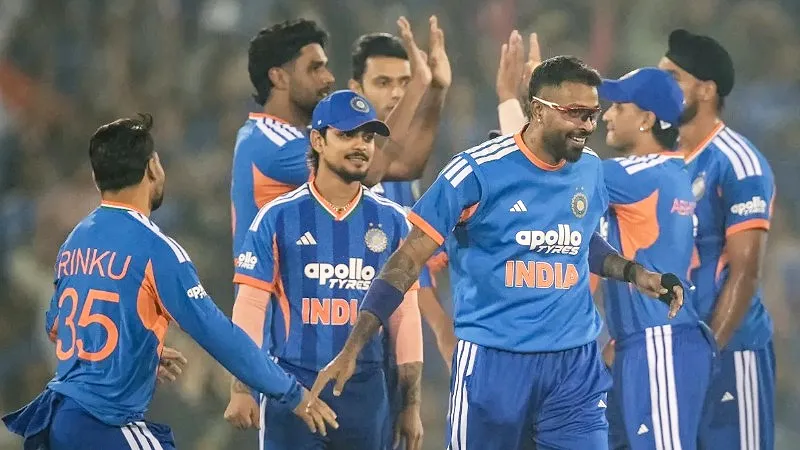

India is widely viewed as the favourite team because they combine elite individual talent with unmatched depth, tactical flexibility, and conditions-specific options. Since the 2024 T20 World Cup, India’s T20I results have underlined India’s T20I dominance since the 2024 World Cup, with a win-loss record in recent years that keeps them near the top of the rankings. Their top order and middle order boast an aggressive India T20I batting strike rate. With a strong bowling core, India’s squad profile naturally makes them favourites.
India’s T20I dominance since the 2024 World Cup
India’s claim to being the T20 World Cup favourites starts with consistency. Over recent years, their T20I win-loss record has been among the best in the world, especially at home and on subcontinental pitches, but also in away series where many teams struggle.
The IPL and domestic T20s constantly feed international-ready batters, allrounders and bowlers. Even when resting senior names, India rarely fields a “weak” XI – their second-string sides are strong enough to compete with most Full-Member teams.
Batting firepower makes them the T20 World Cup Favourites
India’s batting is the most obvious reason they are treated as the favourites. It’s not just star names; it’s how they score. Modern T20 sides are often lopsided: great vs pace but cautious vs spin, or vice versa. India increasingly fields batters who can maintain a high tempo against both.
Tactically, India gains three big advantages:
- Multiple 150+ strike-rate options
In T20, a strike rate of 150 means 9 runs per over from one batter; 170 touches almost 10. If even two batters in an innings operate at that level for 25–30 balls each, you’re already in 180–200 territory.
- Spin-proof and pace-proof line-up
Many teams slow down against spin – India’s left-handers and unorthodox shot-makers can attack quality spin with sweeps, reverse-sweeps, and range-hitting down the ground. Against high pace, their batters are used to facing quicks in the IPL and global leagues, so 140–145kph is not a shock.
- Role clarity through the order
- Explosive openers who maximise the powerplay.
- A 360-degree middle-order batter who can rescue or explode.
- A pace-bowling allrounder who can finish innings with six-hitting.
This combination means India can keep a positive run rate regardless of whether opponents attack with spin in the middle overs, or double down on pace at the death.
Bowling depth and tactical matchups
If the batting earns headlines, the bowling makes India hard to out-plan over a full tournament. Wristspin is one of the most valuable T20 weapons. Kuldeep Yadav’s T20I bowling record already shows he’s a genuine wicket-taker in the middle overs, with a strike rate and average that compare well to other leading spinners.
Alongside Kuldeep, India usually has:
- A high-class fast-bowling spearhead who can operate in all phases – new ball, middle overs, and death.
- Left-arm pace options to angle across right-handers and bring LBW/bowled into play vs left-handers.
- Finger-spinning all-rounders who can bowl hard overs to right-handers and lengthen the batting.
Then there’s the mystery factor. Even if not always first-choice, a bowler like Varun Chakravarthy offers a unique strategic card. Talk of Varun Chakravarthy’s World Cup impact reflects how mystery spin can choke scoring on slow surfaces, especially against teams that don’t face that style regularly.
Conditions, flexibility, and squad balance
T20 World Cups in recent years have been hosted in very different environments, fast and bouncy, slow and turning, or mixed across venues. India’s core strength is that their best XI and their bench are adaptable to all these scenarios.
In short tournaments, injuries and minor dips in form can derail teams that rely on 12–13 players. India’s bench strength means they can lose a first-choice player and still field a world-class replacement without radically changing their game plan.
The batting and bowling statistics support their standing as a top team in T20Is. The only concern with their position is how T20 cricket is structured; extremely small margins for error exist throughout each tournament due to its length (short), plus every game can have extremely large variance in terms of winning or losing based upon a single event in a game, such as a wicket falling or being bowled over, etc. On paper, India will be the favourite to win this year’s T20 World Cup.
Key Takeaway
India are the favourites because no other side matches their mix of batting power, bowling variety, and adaptable depth.
FAQs
What is India’s biggest weakness in the T20 World Cups?
Historically, handling high-pressure knockout games and adapting quickly to extreme conditions (very slow pitches or huge totals) has been more of an issue than raw talent or depth.
Which players make India a strong T20 WC contender?
A core of explosive top-order batters, a 360-degree middle-order anchor, a pace-bowling allrounder, at least one attacking wristspinner, and a world-class fast bowler form the backbone of India’s challenge.
How good is India’s T20I win-loss record in recent years?
India has consistently been among the better-performed T20I sides, rarely losing home series and staying near the top end of T20I rankings through most recent cycles.