

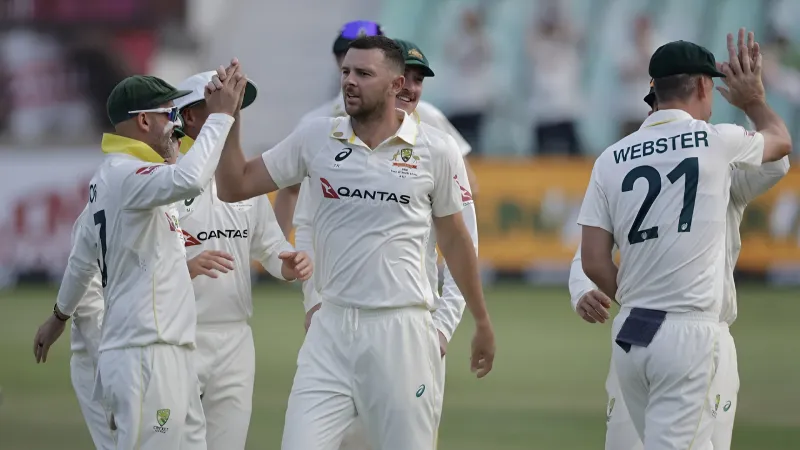

By attacking the left-hander in two different ways. In the first innings at Durban he tempted a loose drive with a full delivery outside off stump, and in the second he angled a short ball across the batter for a top-edged pull. The outcome was 2 runs from 15 balls and two dismissals, a lot of damage from a spell of only 15 balls. Hazlewood finished the match with eight wickets as Australia won the opening Test by 214 runs.
Two Innings, Two Dismissals
Rickelton’s first innings lasted three balls and produced no runs. Hazlewood pitched the ball full on a good length outside off stump, the opener pushed hard at it, and Webster held the edge at third slip. It was a dismissal born of impatience against a bowler who rarely gives away anything loose. A hard-handed drive at a full ball outside off is exactly what third slip is there to collect.
The second innings was slightly longer, 12 balls and 2 runs, but ended in a different way. Hazlewood dug in short and angled the ball across the left-hander, forcing a pull that flew off the top edge to Carey behind the stumps. Two contrasting plans had produced the same result.
Innings | Runs | Balls | Dismissal | Length and line |
1 | 0 | 3 | c Webster b Hazlewood | Full, good length outside off stump, loose drive to third slip |
2 | 2 | 12 | c Carey b Hazlewood | Short, angled across the left-hander, top-edged pull |
Hazlewood Rickelton South Africa Australia Test
The contest played out in the first Test at Durban, which ran from 9 to 13 October 2026. Across both innings Rickelton faced Hazlewood for 15 deliveries, scored 2 runs and lost his wicket twice. The numbers leave little doubt about who won the duel.
Hazlewood himself took 2 for 54 in the first innings and 6 for 49 in the second. Those eight wickets did much of the work in a 214-run victory that gave Australia a 1-0 lead, and Rickelton’s two early exits handed his side a platform in each innings. Taking the match as a whole, the second-innings burst of six wickets showed the same control that undid the opener.
Plans Against the Left-Hander
Ball-by-ball records, scoring zones and length maps were not available, so the picture rests on two wickets rather than a full dataset. That limit matters, because a pair of dismissals can hide as much as it shows about a bowler’s approach. Without those details, claims about exact stump lines or release points would be guesswork.
What the two balls do reveal is range. One tested the opener outside off stump with a full length, and the other pushed him back with pace and bounce from an angle that left him little room. A batter cannot prepare for both at once, and Rickelton paid for guessing wrong each time. Mixing the two lengths is what keeps a left-hander unsure about where to set his feet.
Record Gives Context to the Struggle
Rickelton arrived with a Test average of 37.37 from 15 matches and 897 runs, and his highest score is 259 against Pakistan in January 2025. The date of that average is unclear, and no series-only split exists, so the comparison stays loose. Fifteen Tests is a modest sample, so a single bad match does not rewrite his reputation.
Even so, a return of 2 runs from 15 balls sits far below the standard a man with a double century should expect. Hazlewood did not need anything exotic to achieve that, only patience and accurate lengths, and the quiet bat in Durban has become a headline for that reason.
Next Steps for Both Sides
Australia now hold the series lead, and Hazlewood can expect the opener to be asked the same questions again. Another failure in the next Test would turn a bad match into a pattern. A bowler who has found two ways through the same defence will keep both plans ready.
The wider Hazlewood Rickelton South Africa Australia Test battle will turn on whether the South African leaves the full ball outside off stump alone and finds a calmer answer to the short delivery. Until he does, Australia hold the advantage in this duel.
Will Rickelton survive the next spell from Hazlewood, or does Australia’s seamer own him for the rest of the series? Tell us in the comments.
Frequently Asked Questions (FAQs)
How many times has Hazlewood dismissed Rickelton this series?
He has removed the opener twice, once in each innings of the Durban Test. Webster took the catch at third slip first, and Carey caught the top edge second.
How many runs did Rickelton score in Durban?
He made 0 off three balls and 2 off 12 balls. That is 2 runs from 15 balls across the match, with both innings ending against Hazlewood.
What is Rickelton’s Test batting average?
His career Test average is 37.37. It comes from 15 Tests and 897 runs, and his career-best is 259 against Pakistan in January 2025, a mark that now looks distant.
How did Hazlewood bowl in the Durban Test?
He took 2 for 54 in the first innings and 6 for 49 in the second. That gave him eight wickets in a match Australia won by 214 runs.
How did Rickelton get out in the second innings?
He top-edged a pull off a short ball and was caught by Carey. The delivery was angled across the left-hander, which pushed him into a shot he could not control.
Disclaimer: This blog post reflects the author’s personal insights and analysis. Readers are encouraged to consider the perspectives shared and draw their own conclusions.