

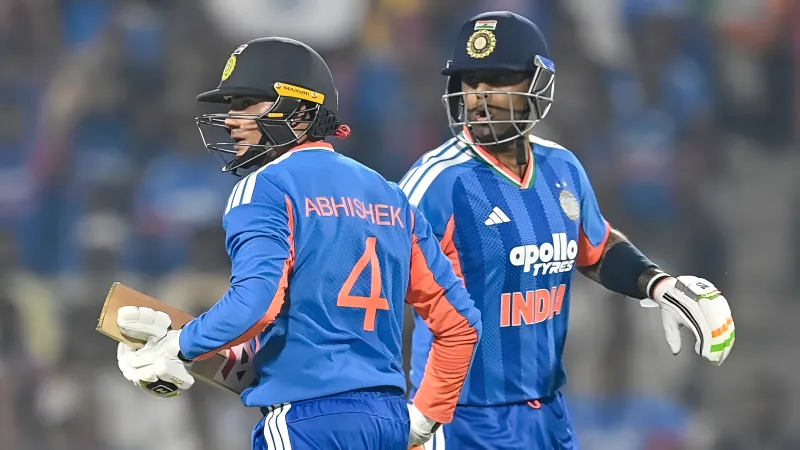

By hitting harder rather than batting longer. The left-hander needed just 1,024 deliveries to reach the milestone, while Suryakumar took 1,164, a difference of 140 balls. Abhishek actually played more innings, 64 against 56, but each visit to the crease was shorter, averaging 16.0 balls compared with 20.8. That speed comes from a ruthless boundary habit and a powerplay approach that gives bowlers no time to settle into a rhythm at all. The numbers below show where the extra pace comes from, phase by phase.
A 140-Ball Gap at the Top
Abhishek sits first on the list of quickest T20I batters to 2,000 runs, measured by deliveries faced. Suryakumar is second, and Aaron Finch, Glenn Maxwell and Tim Seifert complete the leading five, with Seifert needing 1,395 balls. Only two batters in the top five came in under 1,200 deliveries, and both are Indian. Finch and Maxwell sit more than 100 balls behind Suryakumar, a sign of how far ahead the leading pair are.
The distance between first and second is the striking part. A gap of 140 balls equals more than 23 full overs of batting, so Abhishek effectively banked an extra innings of high-pace scoring over his closest rival. That cushion is longer than a complete T20 innings.
Rank | Batter | Balls |
1 | Abhishek Sharma | 1,024 |
2 | Suryakumar Yadav | 1,164 |
3 | Aaron Finch | 1,283 |
4 | Glenn Maxwell | 1,304 |
5 | Tim Seifert | 1,395 |
Abhishek Sharma: fastest 2,000 T20I runs
Innings count tells a different story from the ball count. Abhishek needed 64 innings against 56 for Suryakumar, so he lost the race on appearances but won it on deliveries. Suryakumar’s slower rate per innings suggests a batter who builds more steadily, whereas Abhishek attacks from the first delivery.
His average stay of 16.0 balls is under three overs, while Suryakumar spends about 20.8 balls at the crease. Shorter stays carry risk, yet they also mean he scores at a pace that makes each ball count for more than it does for almost anyone else in the format.
Strike Rate Splits by Phase
The powerplay is where Abhishek does his most visible damage. His strike rate there is 192.00, well above Suryakumar’s 148.50, and he scores at 176 inside his first ten balls alone. Opposing captains have almost no time to reset after an early boundary. Pace and spin splits were not available, so the phase view is the sharpest lens for now.
Through the middle overs, the pattern holds, with 209.00 against 167.90. The death overs reverse it slightly, since Suryakumar reaches 236.60 compared with 226.30. Across a career, 195.13 for Abhishek beats 162.94 for his senior partner by a distance. Suryakumar’s death-over edge is the one department where the senior man keeps his crown.
Phase | Abhishek SR | Suryakumar SR |
Powerplay (Overs 1-6) | 192.00 | 148.50 |
Middle (Overs 7-15) | 209.00 | 167.90 |
Death (Overs 16-20) | 226.30 | 236.60 |
Career (Overall) | 195.13 | 162.94 |
Boundaries Drive the Scoring
About 79.9 percent of Abhishek’s runs come from boundaries, an unusually high share for a batter with 2,000 runs behind him. A figure near four-fifths fits an opener who clears the rope more often than he runs. Singles and twos barely feature in his scoring, which explains why his strike rate holds up so well.
Dot-ball percentages are not available for either player, so the full picture of how often he gets stuck remains open. What the boundary share does show is a batter who treats every delivery as a scoring chance and accepts the volatility that comes with it. The boundary share for Suryakumar was not found, so the comparison between the two stays one-sided.
Indian Records in Wider View
Speed is nothing new in Indian T20 history. Yuvraj Singh still holds the quickest Indian fifty, reaching it in 12 balls against England in 2007, while Abhishek got there in 14 balls against New Zealand. A 12-ball fifty still stands as the benchmark, and his effort sits only two deliveries behind.
That comparison shows his best bursts are close to the national peak. The Abhishek Sharma fastest 2,000 T20I runs balls faced mark also looks safe, because the next-best figure sits 140 deliveries away and few batters ever sustain such a strike rate. Hitters who attack at this tempo seldom last long at this level, so sustaining it is hard.
Can anyone match a 140-ball cushion at this strike rate, or will Abhishek’s record stand for years? Tell us in the comments.
Frequently Asked Questions (FAQs)
Who reached 2,000 T20I runs in the fewest balls?
Abhishek Sharma did it in 1,024 balls, the quickest of any batter listed. Suryakumar Yadav needed 1,164, a gap of 140 deliveries, while Aaron Finch took 1,283 balls to get there.
How many innings did Abhishek need for 2,000 runs?
He needed 64 innings. That is eight more than the 56 Suryakumar required, but he faced only 16.0 balls per innings against 20.8 across the whole journey to the milestone.
What is Abhishek’s career T20I strike rate?
It stands at 195.13 across his whole career. Suryakumar’s is 162.94, a gap of more than 32 points, and Abhishek leads him in the powerplay and middle overs while trailing in the death overs.
What share of Abhishek’s runs come from boundaries?
About 79.9 percent of his runs arrive through boundaries. That heavy reliance on fours and sixes explains how he scores so quickly from so few deliveries, since singles play a minor part.
Who has the fastest Indian T20I fifty?
Yuvraj Singh holds the record with a 12-ball fifty against England in 2007. Abhishek reached his half-century in 14 balls against New Zealand, only two deliveries slower than that mark.
Disclaimer: This blog post reflects the author’s personal insights and analysis. Readers are encouraged to consider the perspectives shared and draw their own conclusions.