

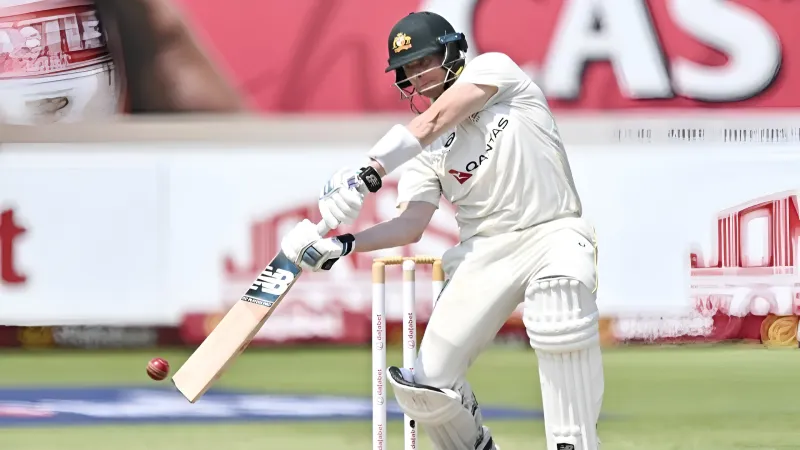

A player diagnosed with concussion in a Test cannot bat again in that match, and a like-for-like substitute arrives only with the Match Referee’s approval. Steve Smith found out how this works on day four in Durban, when Anrich Nortje struck him on the head during the thirteenth over. He did not pass testing that evening, Neser took his place in the field, and a fresh check was booked for Tuesday. The process is built to keep the player’s health ahead of the scoreboard.
ICC Clauses Set the Framework
The ICC playing conditions open with a strict test. The injury must happen during play, and the team medical representative has to diagnose it formally before any substitute is considered. The Match Referee then approves the change, and that ruling is final. Without those boxes ticked, a team has no route to a replacement at all.
Substitutes must match the injured player’s role, a principle found in both the 2025 ODI conditions and the 2026 T20 World Cup rules. A replaced player takes no further part in the match. Since 17 June 2025, each side names five possible replacements: a wicketkeeper, a batter, a seamer, a spinner and an all-rounder. Going outside that list is allowed only when the replacement is also concussed.
Steve Smith concussion return-to-play rules
On the field, the sequence is simple. A head knock triggers an assessment on the spot, and a suspected case rules out any same-day return. The team doctor then makes the diagnosis, the referee signs off a like-for-like substitute, and the symptoms are rechecked over a window of up to 48 hours. Each stage is meant to stop a player returning while symptoms still linger.
After that, an independent doctor must clear the player before he resumes. A graded comeback follows, lasting 21 days at minimum under Cricket Australia’s community guidelines, so the full process is rarely quick. The rules treat the injured player’s wellbeing as the priority, ahead of any tactical gain a side might see in a fast comeback.
Step | Action |
1 | Head knock; on-field assessment |
2 | No same-day return if suspected |
3 | Team doctor diagnoses |
4 | Referee approves like-for-like substitute |
5 | Symptoms rechecked, up to 48 hours |
6 | Independent doctor clears |
7 | Graded comeback, 21 days minimum |
Cricket Australia Adds Its Own Timeline
Cricket Australia’s guidelines are stricter than any match-day ruling. No player returns on the day of the injury, and up to 48 hours may pass before the symptoms are confirmed. The wait gives doctors time to spot symptoms that surface later. An independent doctor has to give the clearance.
The guidelines then require at least 21 days away, including 14 days without symptoms before full training resumes. They were written for the community game, and no separate stand-down figure for elite players was located, so the exact timeline for a Test side stays uncertain. Those figures show how far the cautious pathway sits from the instant call a referee makes mid-match.
Earlier Australian Head Knocks
Smith has been here before. At Lord’s on 18 August 2019, a blow ended his Test; Marnus Labuschagne became the first concussion substitute in Test cricket, and Smith missed Headingley. A knock at the SCG during a 2022 T20I against Sri Lanka ended his involvement in the rest of that series. Both episodes cost his side his services at a key moment.
Others have faced the same issue. Cameron Green suffered a mild concussion playing for Australia A against India in 2020, and Will Pucovski retired hurt at Drummoyne Oval the same year. The pattern across these cases is a cautious one.
Durban Update and Substitute Eligibility
Nortje’s delivery hit Smith on the fifth ball of the 13th over on 12 October, the fourth day. Neser covered his fielding duties. Smith was not cleared that day; a new assessment was scheduled for Tuesday, and he was then passed fit to take the field on day five. The sequence matched the cautious route set out in the protocol.
Had a substitute been needed, the five-player list and the Match Referee would have decided who came in. Anyone studying the Steve Smith concussion return-to-play rules should remember that three people hold the keys: the team doctor, the referee and the independent physician.
Should elite players follow the same 21-day stand-down as community cricketers, or is a Test-level protocol overdue? Tell us in the comments.
Frequently Asked Questions (FAQs)
Can a concussed batter bat again in the same Test?
A player replaced for concussion takes no further part in that match. If no substitute comes in, a return needs medical clearance, so the batter must pass the assessment first.
Who approves a concussion substitute in cricket?
The Match Referee approves the like-for-like replacement. The team medical representative must first formally diagnose the injury, and the referee’s decision is final under the current ICC playing conditions.
How long must a player rest after concussion?
Cricket Australia’s community guidelines set a minimum of 21 days. Fourteen of those days must be symptom-free before full training starts, though an elite figure was not located.
Who decides when a player is fit again?
The team medical representative, the Match Referee and an independent doctor each play a part. The first diagnoses, the second approves substitutes, and the third gives the final clearance before a graded comeback.
Has Smith suffered a head knock before?
Yes, at Lord’s in 2019 and again at the SCG in 2022. The Lord’s blow kept him out of Headingley, and the SCG T20I knock ended his series against Sri Lanka.
Disclaimer: This blog post reflects the author’s personal insights and analysis. Readers are encouraged to consider the perspectives shared and draw their own conclusions.