

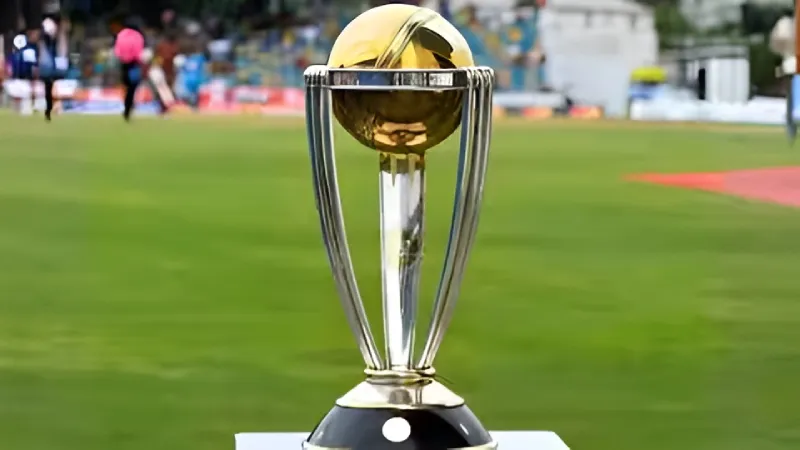

Four semifinal places are decided in the Super 7, a 21-match round-robin among seven teams who all start on zero points. The 2027 men’s World Cup, hosted by South Africa, Zimbabwe and Namibia, replaces the single round-robin of 2019 and 2023 with a four-step path for 14 teams. Two sides are cut after the Super Series, 12 play in two groups, and seven reach the Super 7. Here is how each step works and what it means for the semifinal race.
Cricket World Cup 2027 Super 7 format
The Super 7 is a single round-robin among seven teams: 21 matches, with each side playing the other six once. The top four go through, with first facing fourth and second facing third in the semifinals.
The seven teams enter with no points carried over from the group stage, so everyone starts on zero. A weak group campaign cannot be repaired here, and a strong one cannot be banked. Because every team plays the other six once, there is no easy draw and no weak group to hide in, and each of the six matches counts toward the same four places.
The Opening Series for Bottom Seeds
The three lowest-ranked qualified teams, seeded 12th to 14th, play a three-match round-robin in Windhoek on 2, 4 and 6 October 2027. Only the winner moves on, so two teams leave after two matches each. That is a short, sharp contest, with little room to recover from one bad result.
The winner joins the top 11 seeds in the group stage. Ten teams have qualified so far, and the other four will be decided at qualifying events between 22 February and 23 March 2027. That leaves the final field open until late March 2027.
Qualifying Out of the Two Groups
Twelve teams are split into two groups of six, playing 30 matches between 7 and 24 October across venues in all three host countries. Group A has India, Australia, Pakistan, Afghanistan, Zimbabwe and Qualifier A. Group B has New Zealand, South Africa, Sri Lanka, England, Bangladesh and Qualifier B. Each team therefore plays five group matches, which gives little time to recover from a slow start.
The top three in each group plus the best fourth-placed side across both groups advance, so five teams go out. Super 7 positions are pre-seeded: A1 India, A2 Australia, A3 Pakistan, AB4 England, B1 New Zealand, B2 South Africa and B3 Sri Lanka. Any team that displaces a seeded side inherits its position. Anyone who finishes fourth knows the margin is thin, because a place depends on a comparison with the other group’s fourth side.
Carry-Forward Points and Tiebreaker Rules
There is no carry-forward. A heavy group win helps only the race to finish top three or earn the best fourth place; it counts for nothing once the Super 7 begins, which runs from 25 October to 14 November. That is a harsh rule for teams that dominated their group.
That makes the group stage a qualification test, while semifinal places are earned in six Super 7 matches. The Super 7 table lists matches played, wins, losses, no-results, points and net run rate. Net run rate appears in the table, so scoring rate and bowling control will matter in a tight race. No tiebreaker order has been published.
This Edition Against Past Tournaments
The 2019 and 2023 tournaments used ten teams in one round-robin of 45 league matches, with 48 matches in total. The 2027 edition has 14 teams and 57 matches. By our count, a finalist from the top 11 seeds plays 13 matches and a Super Series winner plays 15, compared with 11 in 2019 and 2023. The extra volume comes from the new stages, not from longer groups.
Format element | 2019 | 2023 | 2027 |
Teams | 10 | 10 | 14 |
Host | England and Wales | India | South Africa, Zimbabwe, Namibia |
Opening round | None | None | Super Series for seeds 12 to 14 |
Main stage | 45-match round-robin | 45-match round-robin | 30 group matches, then 21-match Super 7 |
Teams to semifinals | 4 | 4 | 4 |
Total matches | 48 | 48 | 57 |
Final | 14 July, Lord’s | 19 November, Ahmedabad | 21 November, Johannesburg |
The Cricket World Cup 2027 Super 7 format also makes the event longer, so depth and fitness matter more than they did when ten teams played each other once.
Is a 57-match World Cup with a Super 7 stage a better test than the old round-robin? Vote in the comments.
Frequently Asked Questions (FAQs)
What is the Super 7 stage in the Cricket World Cup 2027?
The Super 7 is a 21-match round-robin between seven teams, with no points carried over. The top four reach the semifinals, with first playing fourth and second playing third.
How many teams play in the 2027 Cricket World Cup?
Fourteen teams play in the 2027 Cricket World Cup. Two are eliminated in the Super Series, leaving 12 for the group stage, and seven of those reach the Super 7.
How do teams qualify for the semifinals in 2027?
Teams must finish in the top four of the Super 7 table. First plays fourth and second plays third, after each side has played the other six teams once.
Which countries host the 2027 Cricket World Cup?
South Africa, Zimbabwe and Namibia host the tournament. Matches are spread across 12 venues in the three countries, with the final held in Johannesburg and a semifinal in Cape Town.
When is the 2027 Cricket World Cup final?
The final is on 21 November 2027 in Johannesburg. The semifinals are on 17 November in Cape Town and 18 November in Tshwane, with the Super 7 ending on 14 November.
Disclaimer: This blog post reflects the author’s personal insights and analysis. Readers are encouraged to consider the perspectives shared and draw their own conclusions.