

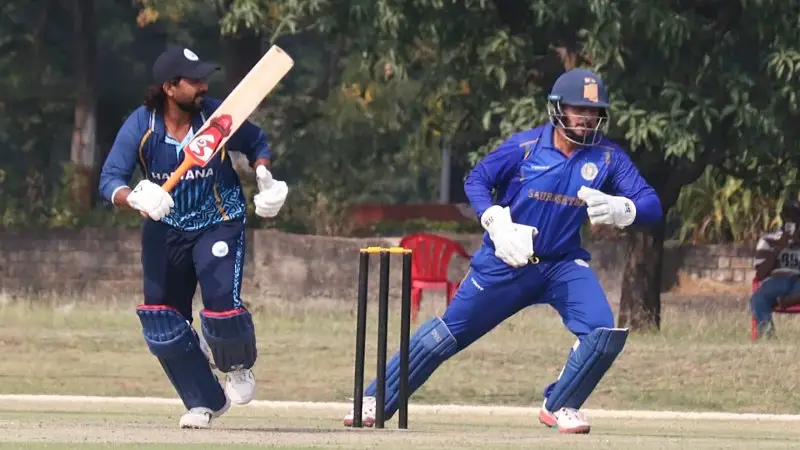

So many teams won chases because the targets were small, not because batting second carried a special edge. Round 1 produced 19 results on 14 November, ten going to chasing teams and nine to the teams that set a target, with Himachal Pradesh beating Assam on the VJD method. Eight of the ten successful chases were against totals of 172 or less. Truly tight finishes were rare, only two in the entire round, which makes the headline question more interesting than the scorecards allow.
An Almost Even Split by Innings
Chasing sides took ten of the 19 results, and the teams batting first took nine. Himachal Pradesh’s victory over Assam was settled by the VJD method, so it carries an asterisk.
The balance suggests the toss created no structural edge in this round. Group A and Group D each saw three of four winners chase, while Group C saw three of four defend. Group B split two and two, a clean 50-50 divide, and the Plate sides produced two first-innings wins against one chase.
Syed Mushtaq Ali Trophy 2026 chasing trend
Every Round 1 match appears below. A dash marks a match where no scorecard confirmed the toss.
Group | Match | Winner batted | Winner | Margin |
|---|---|---|---|---|
A | Chandigarh v Baroda | Second | Chandigarh | 3 wkts |
A | Jharkhand v Mizoram | Second | Jharkhand | 6 wkts |
A | Rajasthan v UP | Second | Rajasthan | 6 wkts |
A | Karnataka v Bengal | First | Karnataka | 19 runs |
B | Delhi v J&K | First | Delhi | 103 runs |
B | Punjab v Haryana | Second | Punjab | 4 wkts |
B | Saurashtra v Bihar | Second | Saurashtra | 5 wkts |
B | Tamil Nadu v Railways | First | Tamil Nadu | 6 runs |
C | Puducherry v Maharashtra | First | Puducherry | 15 runs |
C | Andhra v Tripura | First | Andhra | 43 runs |
C | Himachal v Assam | First | Himachal | VJD |
C | MP v Kerala | Second | MP | 5 wkts |
D | Mumbai v Hyderabad | Second | Mumbai | 7 wkts |
D | Gujarat v Odisha | First | Gujarat | 21 runs |
D | Vidarbha v Goa | Second | Vidarbha | 7 wkts |
D | Chhattisgarh v Uttarakhand | Second | Chhattisgarh | 5 wkts |
Plate | Meghalaya v Nagaland | First | Meghalaya | 18 runs |
Plate | Manipur v Arunachal | First | Manipur | 61 runs |
Plate | Services v Sikkim | Second | Services | 6 wkts |
Chases were mostly modest. Jharkhand needed only 8.3 overs to pass Mizoram’s 76, and the only bigger scores to fall were Chhattisgarh’s 197 and Punjab’s 190, both run down successfully. Defending was safer once a side passed 180, because Karnataka (184), Puducherry (204), Delhi (243) and Gujarat (250) all held on, out of six such totals.
Conditions and the Missing Dew Evidence
Nothing in the match reports mentions dew in any of the 19 matches, so it cannot be named as the culprit. Instead, the totals scatter widely: Gujarat made 250 and Delhi 243, while Mizoram managed 76 and Andhra 141 for 9.
Andhra won anyway, by 43 runs, and Delhi’s 243 produced the widest margin of the round, 103 runs over J&K. The pattern fits mismatched squads better than a pitch that favoured the side batting second.
The Closest Finishes of the Round
The tightest finish belonged to Chandigarh, who beat Baroda by three wickets, reaching 149 inside 19.5 overs with one delivery to spare. Shivam Bhambri top-scored with 45. Among defended totals, the thinnest margin was Tamil Nadu’s six-run win over Railways.
Punjab chased down Haryana’s 190 for 6 with five balls to spare, finishing 193 for 6 in 19.1 overs and winning by four wickets. No other chase went into the final over, and the remaining wins came with room to spare.
The Toss Matters Less Than Target Size
Captains should not default to fielding, and the old instinct to bowl first looks shaky. Of the nine tosses that could be confirmed, five captains opted to field and four opted to bat. Fielding first brought wins for Mumbai and Chandigarh but defeats for Bengal, Odisha and Railways, and Delhi was the lone batting captain to win.
The size of the target outweighed the toss. Chases of 172 or fewer succeeded, and defending 180-plus held four times in six. The Syed Mushtaq Ali Trophy 2026 chasing trend, then, is really a story about small targets.
Would you bat first on a par score above 180 in this tournament, or still back the chasing side? Tell us in the comments.
Frequently Asked Questions (FAQs)
Which team has won the most chases in the 2026-27 Syed Mushtaq Ali Trophy?
No team leads yet, since every side has played just once. Ten teams won while batting second in Round 1, each with a single chase.
Who won each Round 1 match at the Syed Mushtaq Ali Trophy?
All 19 winning sides appear in the match table above. Ten of them won batting second, while nine defended a total and one of those needed the VJD method.
What is the highest successful chase in the Syed Mushtaq Ali Trophy?
Jharkhand holds the record with a chase of 236 against Punjab in December 2025. Nothing in Round 1 came close, as the biggest chase was Chhattisgarh’s 197.
Does dew affect Syed Mushtaq Ali Trophy matches?
It can, but no dew report was found for Round 1, so the results cannot be tied to it. Totals ranging from 76 to 250 point to uneven teams instead.
Should teams bat first or bowl first in domestic T20 cricket?
There is no fixed rule, and Round 1 backed that view. Fielding first won only two of five confirmed tosses, and target size mattered more.