

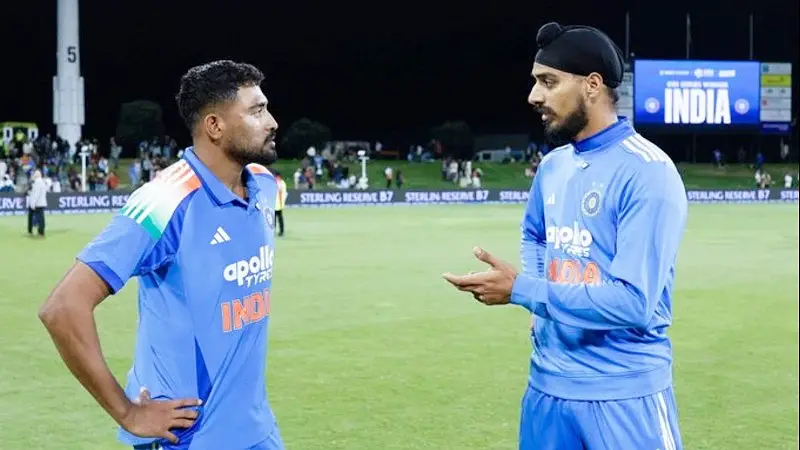

Arshdeep Singh and Mohammed Siraj turned a collapse into a total by adding 26 runs in 10 balls for the tenth wicket, lifting India from 183 for 9 to 209. That was four more than the 22-run margin of victory on 15 November at Mount Maunganui, which sealed a 3-1 series win with one game washed out. Without those runs, India would have ended on 183, and New Zealand scored 187 in a chase of 210. The tail, not the batters ahead of it, decided the decider.
A Slide Toward Collapse
The toss went to New Zealand, who chose to bowl. India were wobbling at 34 for 3 before Shreyas Iyer and Axar Patel rebuilt with a partnership of 52, which Iyer’s 22 ended. Axar then scored 46 before leaving at 121 for 5.
Then the middle order folded. Naman Dhir went at 160 for 6, and both Auqib Nabi and then Yash Thakur departed with the total stuck on 166. Ishan Kishan was the ninth batter to go, at 183, leaving the tail to find whatever it could.
Tail Batting That Changed the Mood
Arshdeep faced only four balls but made 14 of them count, lifting Jacob Duffy for two sixes in three deliveries. A slower ball then bowled him. Siraj finished not out with 14 off 20 balls, having managed just 2 from his first 14 deliveries.
Twelve of Siraj’s runs came inside the partnership, off six balls from Mitchell Santner. A six and a four against Santner pushed India beyond 200 at last. For a lineup that had lost nine wickets, the pair batted like specialists.
India vs New Zealand ODI last wicket stand
Set 210 to win, New Zealand sat at 64 for 1 before losing five wickets for 55 runs. Their reply ended at 187 after 48.1 overs, and Arshdeep’s 3 for 30 earned him the Player of the Match award. Sunil Gavaskar singled out the tenth-wicket partnership as the moment the game shifted.
The arithmetic backs him up, since 26 runs off 10 balls works out at 15.6 an over. Had India stopped at 183, the target would have been 184, and 187 would have won it. At 210, New Zealand finished 23 short.
Over | Event |
|---|---|
33.2 | Dhir out, India 160 for 6 |
35.2 and 35.6 | Nabi and Thakur out, India 166 for 8 |
40.3 | Kishan out, India 183 for 9 |
40.4 to 40.6 | Arshdeep takes 14 off Duffy |
41.1 to 41.6 | Siraj scores 12 off Santner, India 209 for 9 |
42.1 | Arshdeep bowled by Duffy, India 209 all out |
Planning Around the Tail
India’s best tenth-wicket mark in ODIs is 64, and the world record is 106 not out, which Viv Richards and Michael Holding made against England in 1984. Its value lay in the moment it arrived, since size alone never put it near the record books. The gap between 26 and the Indian record of 64 is 38 runs, and the table puts this effort fourth on the Indian list.
Pair | Wicket | Runs | Balls | Opposition |
|---|---|---|---|---|
Harbhajan Singh, L Balaji | 10th | 64 | 44 | England, The Oval, 2004 |
Ajay Jadeja, Javagal Srinath | 10th | 62 | 59 | South Africa, Sharjah, 2000 |
Ravi Shastri, Narendra Hirwani | 10th | 53 | 71 | West Indies, Gwalior, 1988 |
Arshdeep Singh, Mohammed Siraj | 10th | 26 | 10 | New Zealand, Mount Maunganui, 2026 |
Arshdeep came in with only 74 career ODI runs at 8.22 per innings, so a cameo of 14 from four deliveries cannot anchor a selection plan. The sounder lesson sits higher up the order. The tail had to carry India beyond 200 because both Rohit Sharma and Virat Kohli failed to reach double figures.
A Series Win With Cracks
India’s lead had shrunk to 2-1 after a heavy defeat by 244 runs in the fourth match, so the decider carried real weight. Victory was India’s first ODI series win away from home with Gautam Gambhir as head coach. New Zealand had not lost a home ODI series for seven years.
Those facts make the late runs look bigger than 26, and Arshdeep’s day was complete, with 14 off four balls and 3 for 30 with the ball. The India vs New Zealand ODI last wicket stand will never top a record list, yet it decided the series, which counts for more than any record.
Which mattered more, the tenth-wicket cameo or Arshdeep’s 3 for 30 with the ball? Make your case in the comments.
Frequently Asked Questions (FAQs)
How many runs came from the Arshdeep and Siraj partnership for the final wicket?
They added 26 runs off 10 balls. That took India from 183 for 9 to 209 all out, four more than the winning margin.
Who won the fifth ODI between India and New Zealand?
India won by 22 runs at Bay Oval, Mount Maunganui, on 15 November. That result sealed a 3-1 series win after a washout in the third game.
What was India’s total in the fifth ODI against New Zealand?
India were bowled out for 209 in 42.1 overs after New Zealand chose to bowl. The tail added 26 of those runs once the ninth wicket fell on 183.
What is India’s highest tenth-wicket partnership in ODIs?
Harbhajan Singh and L Balaji hold the Indian mark with 64 against England at The Oval in 2004. The world record is 106 not out, belongs to Richards and Holding.
How did India win the ODI series against New Zealand?
India won 3-1 by taking the opening two games and the decider. A washout and a defeat by 244 runs in the fourth match came in between.