

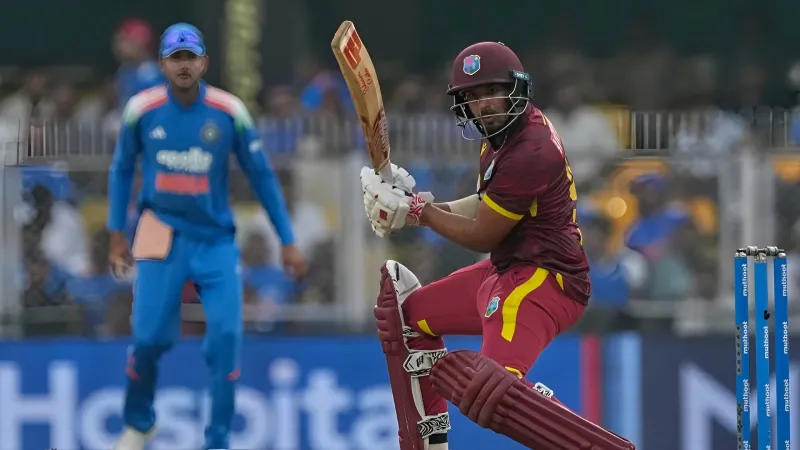

West Indies lost because their bowlers had no answer, not because 405 was too small. India raced to 92 without loss in the powerplay, Rohit Sharma and Shubman Gill added 255 for the first wicket, and a short boundary was attacked throughout the chase in Guwahati. Campbell, Hope and Jangoo all scored hundreds, yet the visitors went 26 overs without a wicket. India chased down the target in 43.3 overs, winning by eight wickets with 39 balls to spare.
Where the IND vs WI 2nd ODI 2026 slipped away
John Campbell made 101 off 68 balls, Shai Hope 104 off 94, and Amir Jangoo 114 off 77. It is the third-highest total in a losing cause, behind Australia’s 434 and Sri Lanka’s 411. India chased it in 43.3 overs.
Shubman Gill finished unbeaten on 223 off 133 balls, Rohit Sharma added 101 off 75, and West Indies took just two wickets. The match produced 811 runs, the third-highest aggregate in ODI history.
The batting stood tall, then the defence still collapsed. A total worthy of the record books lasted barely the opening spell before India took control. The table shows how evenly the damage was spread. Every bowler except Chase and Lawes went at more than eight an over, and the pair who were cheaper took no wickets.
Bowler | Overs | Maidens | Runs | Wickets | Economy |
Jayden Seales | 8.0 | 0 | 78 | 1 | 9.75 |
Alzarri Joseph | 8.0 | 0 | 89 | 0 | 11.13 |
Shamar Joseph | 6.0 | 0 | 52 | 1 | 8.67 |
Keemo Paul | 3.0 | 0 | 49 | 0 | 16.33 |
Roston Chase | 8.3 | 0 | 63 | 0 | 7.41 |
Vitel Lawes | 10.0 | 0 | 73 | 0 | 7.30 |
Powerplay damage from the Rohit and Gill stand
India made 92 without loss in the first six overs, ahead of the 75 to 80 Gill said they wanted. That left them about 43 runs ahead of the starting required pace of 8.12 an over. Rohit and Gill then added 255 in 158 balls, India’s second-highest ODI opening stand, before Jayden Seales trapped Rohit lbw in the 27th over. West Indies had no wicket for 26 overs.
After the powerplay India scored 208 more in 23.1 overs to reach 300 in 29.1, the fastest by any team in ODI history. Virat Kohli’s dismissal, caught off Shamar Joseph at 320, was the only other wicket and came with the chase already decided.
The short boundary West Indies never solved
Gill said India broke the chase into smaller targets and identified one shorter boundary to attack as the ball aged and the quicks returned. The West Indies figures show no adjustment worked: nobody conceded under 7.30 an over, and Gill alone hit 26 fours and eight sixes.
Guwahati favours batters. Its 2018 and 2023 ODIs produced 322 and 373 batting first, and 326 and 306 chasing, averages of 347.5 and 316. India’s bowlers also leaked 8.10 an over, so conditions were flat; the difference was that West Indies could not take wickets. A flat surface explains the volume of runs, but not the lack of control. West Indies needed one bowler to hold a length, and none did.
Alzarri Joseph’s expensive eight overs
Alzarri Joseph took 0-89 from eight overs, an economy of 11.13 and the most runs conceded by any West Indies bowler. Keemo Paul went for 49 in three overs. Only Seales (1-78) and Shamar Joseph (1-52) took wickets, and no West Indies bowler sent down a maiden. Roston Chase and Vitel Lawes were steadier but wicketless.
Shamar Joseph’s 1-52 from six overs was the best economy among the wicket-takers, which says plenty about the rest of the attack. West Indies used just six bowlers, so Joseph’s spell left little room to hide.
Fixes West Indies need for game three
India lead 2-0, so the series is gone, but the next match is about damage control. West Indies need powerplay wickets, because their first breakthrough came at 255.
They need a plan for the short side, and a second pace option that does not leak: Joseph and Paul conceded 138 in 11 overs between them. Runs alone will not fix a wicketless start. A score of 405 is no longer safe at this ground, and the IND vs WI 2nd ODI 2026 showed exactly why.
Should West Indies change their entire bowling attack for the third ODI, or is Guwahati’s flat surface the real culprit? Tell us in the comments.
Frequently Asked Questions (FAQs)
Who won the India vs West Indies 2nd ODI?
India won by eight wickets with 39 balls remaining. They finished on 406/2 in 43.3 overs, with Shubman Gill unbeaten on 223 off 133 balls and Rohit Sharma adding 101.
What is the highest successful run chase in ODI history?
South Africa hold the record, chasing 438/9 against Australia in Johannesburg on 12 March 2006. India’s 406 in Guwahati is now the second-highest successful chase in ODI history.
Which West Indies batters scored centuries in the 2nd ODI?
John Campbell, Shai Hope and Amir Jangoo all scored centuries. Campbell made 101 off 68 balls, Hope 104 off 94 and Jangoo 114 off 77 in a total of 405/7.
What is the highest total to lose an ODI?
Australia’s 434/4 against South Africa in 2006 is the highest total to lose an ODI. Sri Lanka’s 411 is second, and West Indies’ 405/7 in Guwahati ranks third.
How many wickets did India lose chasing 406?
India lost two wickets chasing 406. Rohit Sharma fell lbw to Jayden Seales at 255 in the 27th over, and Virat Kohli was caught off Shamar Joseph at 320.
Disclaimer: This blog post reflects the author’s personal insights and analysis. Readers are encouraged to consider the perspectives shared and draw their own conclusions.