

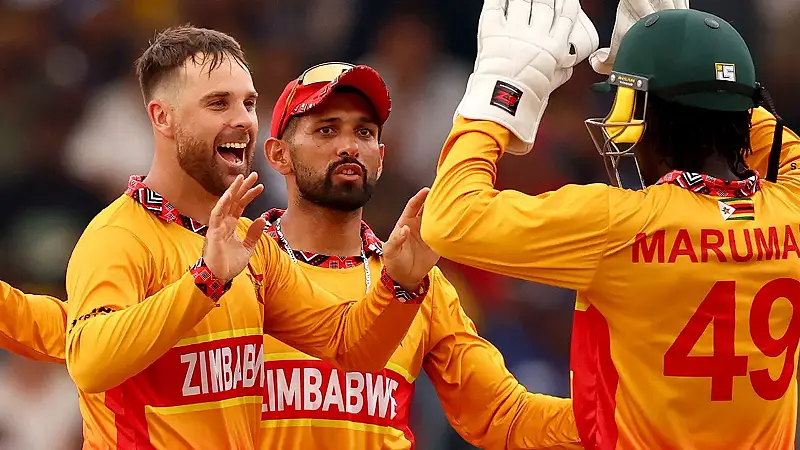

Zimbabwe T20 World Cup stars are reshaping the team’s global credibility by delivering elite-level performances that match modern T20 demands. Led by Blessing Muzarabani’s control and a third-best economy rate among high-workload pacers, and powered by Brian Bennett’s composure at the top, Zimbabwe has moved beyond feel-good narratives into genuine competitiveness at the T20WC. This isn’t a one-off upset story like Zimbabwe’s shocks against the West Indies in the past; it’s evidence of sustainable quality built on skill, fitness, and tactical clarity.
Control Through Pace and Height
Blessing Muzarabani has become the backbone of Zimbabwe’s T20 attack because he offers what few associate or mid-tier nations can: repeatable control at pace. His third-best economy rate (among bowlers with significant overs) is not built on defensive bowling but on intelligent lengths. Bowling back-of-a-length with steep bounce, he limits scoring options square of the wicket, especially on surfaces offering carry. In T20 terms, that’s premium currency dot balls without sacrificing wicket-taking intent.
Batting Calm Under Pressure in the T20WC
Brian Bennett represents the modern T20 anchor Zimbabwe lacked for years. His value isn’t raw strike rate alone, but tempo control. Against high-quality attacks, he absorbs early pressure before expanding his stroke range once conditions settle. That adaptability allows Zimbabwe to avoid collapses that historically defined their tournament exits. In matches where early wickets fall, Bennett’s presence stabilizes innings without stalling momentum, a rare balance in emerging teams.
Conditions-Based Tactical Maturity
Zimbabwe’s success at the ICC Men’s T20 World Cup is tied closely to how well these players adjust to conditions. Muzarabani thrives on bounce-heavy pitches but has shown discipline on slower surfaces by cutting pace and bowling into the pitch. Bennett, meanwhile, shows patience early against swing and uses conventional gaps rather than forcing high-risk power shots. This situational awareness marks a shift from reactive cricket to proactive game management.
Why This Is Not a One-Off
What separates this group from past Zimbabwe sides is repeatability. Performances like these aren’t isolated flashes; they’re supported by fitness standards, role clarity, and defined match-ups. Unlike previous tournaments where Zimbabwe relied on moments of brilliance, this side builds pressure over phases. That’s why results feel earned rather than accidental, even in high-profile matchups such as Zimbabwe vs West Indies.
Expert Context: From Golden Era to Tactical Era
Historically, Zimbabwe’s best sides, featuring players like Andy Flower, relied heavily on individual excellence. Comparatively, this 2026 campaign resembles a structural evolution similar to how Afghanistan transitioned from underdog to consistent threat. Analysts observing Muzarabani’s workload management and Bennett’s role definition see parallels with successful mid-tier nations that prioritized systems over star-dependence. That shift is what gives these Zimbabwe T20 World Cup stars long-term relevance rather than short-lived attention.
Zimbabwe stars are reshaping perceptions because their success is rooted in skill sustainability, not sentiment. Blessing Muzarabani provides Zimbabwe with something every competitive T20 side needs: reliable control from a strike bowler who doesn’t leak runs. Brian Bennett complements that by anchoring batting innings with maturity well beyond his experience. Together, they give Zimbabwe balance across disciplines, a prerequisite for consistent tournament success.
Key Takeaway
Zimbabwe’s T20 progress is real because it’s built on repeatable skills, tactical clarity, and players suited to modern conditions.
FAQs
What makes Blessing Muzarabani effective in T20 cricket?
His height-driven bounce, disciplined lengths, and ability to maintain a low economy rate under pressure.
Why is Brian Bennett important to Zimbabwe’s batting lineup?
He stabilizes the innings early and accelerates later, preventing collapses without killing momentum.
How has Zimbabwe improved at the ICC Men’s T20 World Cup?
Through better role clarity, fitness standards, and adapting tactics to conditions.
Can Zimbabwe beat stronger teams consistently now?
They are better equipped tactically, making upsets more repeatable rather than accidental.
Is Zimbabwe vs West Indies still their biggest benchmark matchup?
Yes, performances in those games often indicate Zimbabwe’s progress against established sides.