

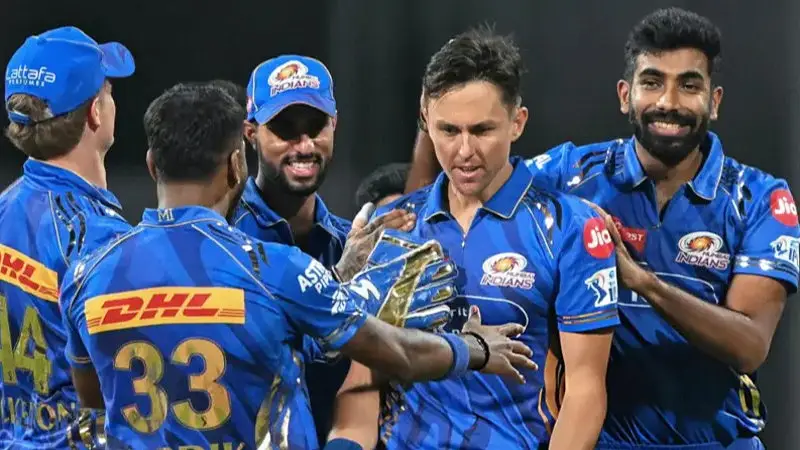

Three decisions. All made by people who knew what they were doing. All producing outcomes that were avoidable with different information processing at the moment. Handing Deepak Chahar the new ball in conditions that offered nothing for swing. Promoting Tilak Varma in a high-pressure chase phase that needed power hitting rather than anchor intent. Introducing Sherfane Rutherford as the impact player after the required rate had already climbed past the point where even his power hitting could influence the result. None of these decisions was reckless. All of them were wrong.
Chahar, with the New Ball, Was Wrong
The specific conditions of the match, minimal swing available, removed the primary justification for Chahar’s new ball selection. His value as a powerplay bowler is built on outswing that shapes away from right-hand batters and creates the edge that his field placements are designed to catch. Without conditions that support that movement, Chahar becomes a conventional full-length seamer rather than a swing specialist. Rajasthan Royals’ aggressive openers recognised the absence of swing inside the first three deliveries and attacked accordingly. The decision wasn’t wrong because Chahar is a bad bowler; it was wrong because conditions made his primary skill unavailable, and the plan wasn’t built around that reality.
Tilak’s Promotion Slowed the Chase Down
Tilak Varma’s specific batting profile, intelligent accumulation, strong against spin through placement and footwork, excellent at constructing innings across forty balls, is the profile that works when MI’s chase has a platform and needs extending rather than when the chase is under pressure and needs immediate acceleration. Promoting him into a situation where the required rate demanded boundaries from the first ball placed him in the exact match state that his natural game doesn’t produce at its highest efficiency. Rajasthan Royals’ bowling attack recognised the mismatch and deployed their spin options specifically to exploit Tilak’s more measured approach.
IPL 2026 Rutherford Substitution Came Too Late
The Impact Player substitution rule exists specifically to allow teams to introduce power hitting at the moment the match requires it most. Introducing Sherfane Rutherford after the required rate had already climbed above the threshold where his power hitting could produce a realistic run rate required to win removed the impact from the Impact Player selection. The specific advantage Rutherford provides, immediate boundary production from a batter who attacks from ball one without a settling-in phase, requires sufficient balls remaining to change the match rather than merely reduce the losing margin. By the time he arrived, too few balls remained, and too many runs were required.
Three Fixes MI Needs Right Now
Each mistake has a specific corrective decision available without requiring different players. The new ball selection requires surface-reading before the toss that determines which bowling type’s primary skill the conditions support, not which bowler has the highest reputation. The batting order requires pre-match scenario planning that defines which player bats in which specific match state, rather than which player bats in which position number. The impact player timing requires a pre-defined trigger, a specific over or required rate threshold, at which the substitution happens, regardless of how the match feels at the moment. All three fixes are planning decisions made before the match rather than in-match decisions made under pressure. That’s the specific category of mistake MI is repeating.
- Does MI fix these three tactical decision-making patterns before they cost them another match they should have won, or does the reactive approach continue producing the same three mistakes in different match situations? Drop your take and follow for IPL updates.
FAQs
Why did the Mumbai Indians lose to the Rajasthan Royals in IPL 2026?
Key tactical mistakes in bowling, batting order, and substitutions led to the defeat.
How important was Hardik Pandya’s captaincy decision in this match?
His early bowling choice and game management had a direct impact on momentum.
What role did the batting order play in MI’s loss?
Incorrect sequencing slowed scoring and increased pressure during the chase.
How did the Rajasthan Royals outperform the Mumbai Indians?
They executed better strategies, especially in controlling the middle overs and pressure phases.