

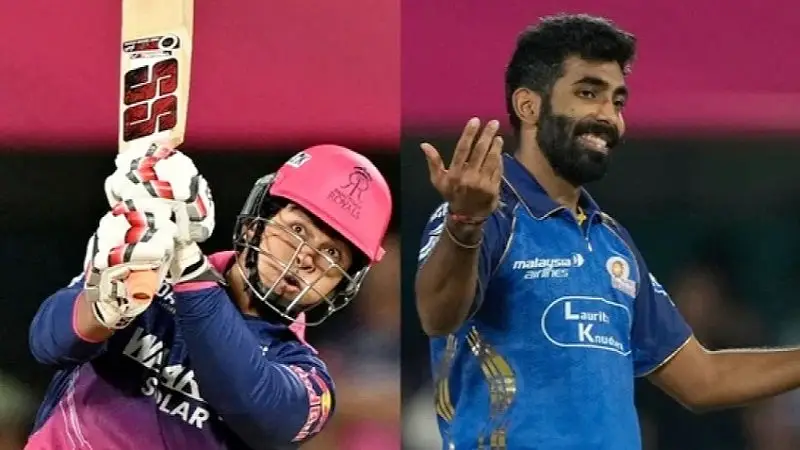

The first ball he faced was from Jasprit Bumrah. Six. Over the boundary. Gone. The Guwahati crowd processed what had happened approximately two seconds after the ball had already cleared the rope. Bumrah had bowled a delivery that would have beaten most batters at this level. Sooryavanshi had read the length before the ball pitched, loaded his weight transfer early, and generated the bat swing that sent deliveries bowled by the world’s best pace bowler into the stands. This wasn’t a fluke miscue that went over the fielder. This was a timed, controlled, deliberate six off a good delivery from the best bowler in T20 cricket.
Reading Bumrah’s Length Faster Than Expected
The specific technical quality that made Sooryavanshi’s aggression against Bumrah possible rather than reckless is length reading speed. Bumrah’s effectiveness comes from the combination of late movement, pace variation, and the specific disguise within his action that makes his length difficult to pick up until the ball is already past the halfway mark of its trajectory.
Against most batters, this disguise produces the hesitation that makes him so hard to attack; the batter commits late, and the committed shot arrives a fraction after the ideal contact point. Sooryavanshi read the length earlier. Not because Bumrah’s disguise failed, it didn’t, but because Sooryavanshi’s processing speed allows him to make committed shot decisions at an earlier point in the ball’s flight than most batters can manage.
Power Hitting Against Precision Bowling Tonight
The specific contest that made this matchup the defining moment of the match is the stylistic contradiction between the two combatants. Bumrah is built around control, the delivery that lands exactly where he intends it to land, producing exactly the outcome he planned before releasing it. Sooryavanshi is built around intent, the shot he’s committed to playing before the delivery arrives, producing exactly the boundary he identified before the ball was bowled. When a control bowler meets an intent batter, the batter has one advantage: he knows what he’s going to do before the bowler does. Bumrah had to adjust mid-plan. Sooryavanshi executed the plan he arrived with.
IPL 2026 Format Suited Sooryavanshi’s Intent
The specific match context that amplified Sooryavanshi’s impact was the eleven-over rain-reduced format that removed the assessment phase that longer games provide. In a full twenty-over match, a batter facing Bumrah in the powerplay can afford three or four deliveries of information-gathering before committing to attacking intent. In an eleven-over match, those three or four deliveries represent nearly a tenth of the entire innings.
Guwahati rain reduction created an environment where attacking from ball one wasn’t just the preferred approach, it was the only mathematically sensible one. Sooryavanshi’s natural game is built for exactly that environment. He didn’t need the assessment phase because his instinct told him everything he needed before the first ball arrived.
Even Bumrah Had No Immediate Answer
The tactical response Bumrah and the Mumbai Indians attempted, adjusting lengths, altering pace variations, and changing angles, was the correct set of adjustments. They also didn’t work within the timeframe available. A bowler who operates through control and planned execution needs time to implement adjustments after an unexpected aggressive response. A shorter game compresses that adjustment window.
Bumrah needed two or three overs to implement the length and angle changes that would have neutralised Sooryavanshi’s early attacking intent. The match didn’t provide those overs before Sooryavanshi had already established the scoring momentum that made the required rate achievable regardless of how the next bowler bowled.
- Does Vaibhav Sooryavanshi continue producing these moments against elite bowling, or does the analysis team prepare for him between matches to reduce the number of balls where his intent outpaces his experience? Drop your take and follow for IPL updates.
FAQs
What made Sooryavanshi vs Bumrah special in IPL 2026?
It showcased a rare clash where a young batter confidently attacked one of the world’s best bowlers from the start.
How did Jasprit Bumrah respond to Sooryavanshi’s aggression?
He adjusted his lengths and pace variations, but early pressure limited his usual control.
Why is Vaibhav Sooryavanshi considered a rising star?
His ability to combine power with timing and read bowlers early sets him apart in T20 cricket.
How did RR vs MI conditions affect the matchup?
The shortened format increased scoring pressure, favoring aggressive batting over cautious play.