

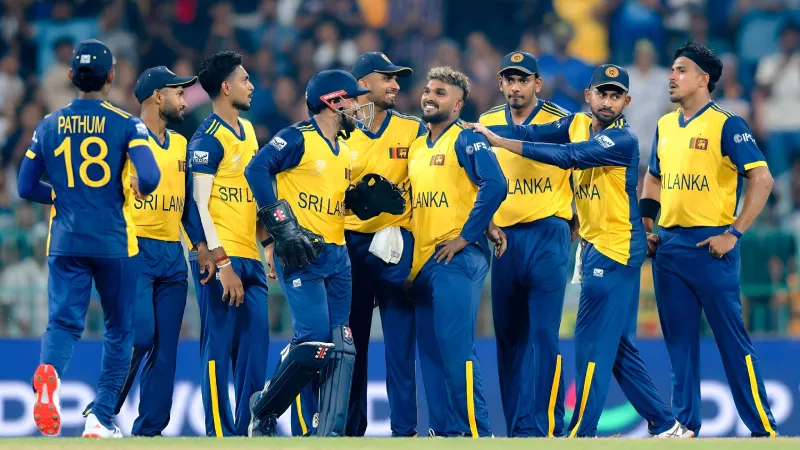

Sri Lanka will look to end their T20I series against England on a winning note when the two teams meet in the third and final match at Old Trafford, Manchester, on Saturday, September 19. The visitors have already lost the series after England secured a 2-0 lead with a dominant six-wicket victory in the second T20I at Cardiff.
Sri Lanka were competitive during the first half of their second T20I innings, reaching 56/2 in the Powerplay after Pathum Nissanka and Lahiru Udara added 50 runs from 27 balls. However, England’s bowlers pulled things back, with Liam Dawson taking 3/32 as Sri Lanka finished on 145/9. England then chased down the target in only 12.1 overs, with Tom Banton smashing an unbeaten 52 off 24 balls.
With the series already gone, Charith Asalanka and the Sri Lankan team management could consider giving a few players an opportunity in Manchester. However, there is also a strong case for retaining the core combination and allowing the players to finish the series on a positive note.
Here is the predicted Sri Lanka playing XI for the third T20I against England:
1. Pathum Nissanka
Pathum Nissanka should continue to open the innings. The right-hander provided Sri Lanka with an excellent start in Cardiff, scoring 37 off just 21 balls with four fours and a six.
His aggressive approach during the Powerplay is important for Sri Lanka, particularly against England’s attacking pace options. Nissanka will be eager to convert another fast start into a substantial score in the series finale.
2. Lahiru Udara
Lahiru Udara is expected to retain his place alongside Nissanka. He contributed 21 off 20 balls in the second T20I and was involved in the 50-run opening partnership.
Although his strike rate was lower than Nissanka’s, Udara’s ability to occupy the crease gives Sri Lanka some stability at the top. He could be particularly important if England’s new-ball bowlers make early inroads.
3. Kamil Mishara (wk)
Kamil Mishara should continue as Sri Lanka’s wicketkeeper-batter. The left-hander had an outing to forget in Cardiff, falling for a golden duck after coming in at No. 3.
However, one failure is unlikely to result in his immediate omission, particularly with the team already without regular captain Kusal Mendis due to injury. Kusal was ruled out of the series with a hamstring injury, while Charith Asalanka took over the captaincy.
4. Charith Asalanka (c)
Captain Charith Asalanka remains one of Sri Lanka’s key batters and should continue at No. 4. He scored 31 off 31 balls in Cardiff before being dismissed by Adil Rashid.
Asalanka’s leadership will be equally important. With the series decided, he will want his side to show greater consistency with both bat and ball in Manchester.
5. Kamindu Mendis
Kamindu Mendis should retain his place in the middle order. He scored a brisk 12 off eight balls in the second T20I before being bowled by Jamie Overton.
His ability to contribute with both bat and ball gives Sri Lanka valuable flexibility. Kamindu can also be promoted if the team needs to accelerate during the middle overs.
6. Dasun Shanaka
Dasun Shanaka is likely to remain the experienced finisher in the lineup. He managed only four runs in Cardiff, but his reputation as a powerful late-innings hitter makes him an important component of the Sri Lankan batting unit.
Shanaka can also provide useful overs if Asalanka requires another bowling option.
7. Wanindu Hasaranga
Wanindu Hasaranga should continue as Sri Lanka’s premier all-rounder. The leg-spinner picked up the wicket of Harry Brook in the second T20I, although he conceded 42 runs from his three overs as England attacked aggressively.
Hasaranga’s batting ability also gives Sri Lanka much-needed depth, making him difficult to leave out.
8. Tharindu Ratnayake
Tharindu Ratnayake is predicted to retain his place after replacing Pavan Rathnayake in the second T20I. He contributed with the ball, claiming a wicket while bowling two overs.
His inclusion gives Sri Lanka another spin-bowling option alongside Hasaranga and adds variety to the attack.
9. Dushmantha Chameera
Dushmantha Chameera should spearhead the pace attack. He dismissed Jos Buttler in the second T20I and finished with figures of 1/29 from three overs.
His pace and experience will be crucial against England’s aggressive top order, especially at a venue where conditions can offer assistance to fast bowlers.
10. Eshan Malinga
Eshan Malinga is expected to retain his place after taking one wicket in Cardiff. The young pacer conceded 27 runs from 2.1 overs but showed enough to remain part of the attack.
He will need to execute his yorkers and variations more consistently against England’s powerful finishers.
11. Dilshan Madushanka
Dilshan Madushanka should complete the Sri Lankan XI. The left-arm pacer was brought into the squad after Binura Fernando was ruled out with a back injury.
Madushanka featured in the second T20I and should get another opportunity to test himself against England’s right-handed-heavy batting order.
Predicted Playing XI of Sri Lanka
Pathum Nissanka, Lahiru Udara, Kamil Mishara (wk), Charith Asalanka (c), Kamindu Mendis, Dasun Shanaka, Wanindu Hasaranga, Tharindu Ratnayake, Dushmantha Chameera, Eshan Malinga, Dilshan Madushanka
Disclaimer: This blog post reflects the author’s personal insights and analysis. Readers are encouraged to consider the perspectives shared and draw their own conclusions.