

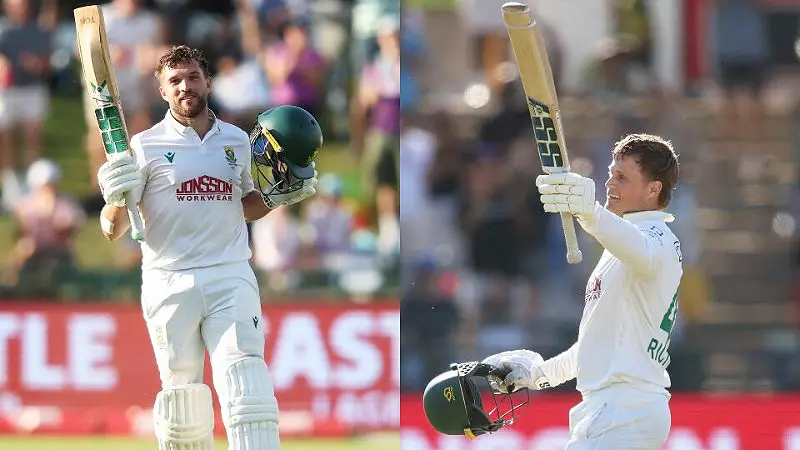

Ryan Rickelton and Wiaan Mulder erased a 100-run deficit by adding 154 for the sixth wicket, and each of them reached three figures along the way. South Africa had closed the previous evening only 40 runs ahead on 140/4, with the rubber level at 1-1. Their stand pushed the total to 387, handed Kagiso Rabada and Simon Harmer a target of 288, and led to a 176-run win. The batting, not the bowling, decided the decider, and the margin proved emphatic.
Australia’s Lead Looked Decisive
Australia carried a 100-run first-innings advantage into the decider, 429 against 329, and the contest stood at 1-1. They had taken the Durban match by 214 runs, while South Africa had replied in Gqeberha with an innings-and-31-run victory. The opening day belonged to Starc, who took 6/72, and by the close of day three South Africa were 140/4.
Australia had every reason to feel in control, and everything pointed toward a bowler’s contest. Instead, the batters wrote the story, and a single stand outweighed anything the attacks produced afterwards. The fixture rested on whether anyone could bat for long hours.
Rickelton-Mulder Newlands Test series partnership
Breetzke’s innings of 43 ended when Cummins found him at fine leg after 121 balls, which brought Rickelton and Mulder together with the sixth wicket gone. They then batted through 319 deliveries for 154 runs, a rate of 2.90 an over, which stands as the second-best sixth-wicket partnership for South Africa against Australia. Every other stand in the innings combined to score 197 at 2.71, so this pair carried a huge share of the load.
Mulder and Rabada later put on 36 off 53 balls for the tenth wicket at 4.07, the fastest of the listed stands. Overall, South Africa made 387 off 808 balls, an average of 2.87 an over.
Wicket | Batters | Runs | Balls | Run Rate |
|---|---|---|---|---|
6th | Rickelton and Mulder | 154 | 319 | 2.90 |
10th | Mulder and Rabada | 36 | 53 | 4.07 |
Other wickets | 1st-5th and 7th-9th combined | 197 | 436 | 2.71 |
Innings | South Africa 387 | 387 | 808 | 2.87 |
Two Hundreds, Two Different Tempos
Rickelton’s 101 took 219 balls and included 12 boundaries, scoring at 46.12 per hundred balls. Mulder’s 115 came from 221 deliveries, including 10 fours and four sixes, at 52.04. Both innings were built on patience, yet Mulder was the one who eventually pushed the pace.
His innings had two clear halves. He took 138 balls to reach his first fifty but only 66 for the next, and that late acceleration gave the lead its real weight. No South African at No. 6 had reached three figures in a Test’s third or fourth innings since 2022, so the double act was historic as well as decisive.
Australia Ran Out of Answers
Eight bowlers were used by Australia that day. Even so, the batters brought up their hundred partnership from 193 balls and put on 92 through the second session. After tea, ten overs yielded just 13 runs without a wicket, yet the squeeze never turned into a breakthrough. The harder the bowlers tried, the more settled the batters looked, and the scoreboard slowly turned against the visitors.
Lyon went for 101 runs while taking two wickets, Cummins took two for 71, and Starc claimed three for 65 across 24 overs, so the numbers reflect hard labour with little reward. Josh Inglis ended the stand with a run out off Rickelton in the 120th over. Mulder walked back later, holding out in the deep against Cummins, with the total at 387 after 134.4 overs.
Harmer and Rabada Finished the Job
That effort left a lead of 287, so Australia needed 288. For context, the highest fourth-innings chase ever completed at this ground is Australia’s own 331 back in 2002, and the fifth-day pitch was turning.
Rabada struck first with three early wickets, one of them Travis Head, which brought up 350 Test wickets for him. Harmer then produced career-best figures of 6/16 in 21.1 overs, finishing with 10/120 for the match. Australia folded for 111, and the 176-run victory sealed a 2-1 result and lifted South Africa to the summit of the world Test table, their first visit there since January 2016. Without the Rickelton-Mulder Newlands Test series partnership, none of it would have happened.
Does the runner-up among South Africa’s sixth-wicket stands against Australia deserve a higher ranking given what it won? Tell us in the comments.
Frequently Asked Questions (FAQs)
Which South African batters made hundreds in the Cape Town decider?
Ryan Rickelton made 101, and Wiaan Mulder made 115 in the second innings. Together they added 154 for the sixth wicket, turning a 100-run gap into a match-winning lead for the home side.
What did Australia need to chase in the second innings?
Australia needed 288 to win. That came from a second-innings total of 387 against a first-innings deficit of 100, and Australia were then bowled out for just 111.
What was the combined contribution of Rickelton and Mulder?
Together they scored 154 runs. That sixth-wicket stand lasted 319 balls at 2.90 an over in total and ranks second among South Africa’s sixth-wicket partnerships against Australia.
Who was the standout bowler in South Africa’s win?
Simon Harmer was the standout bowler. His career-best 6/16 in the second innings completed 10/120 for the match, the first time he had taken ten wickets in a Test.
What was the final result of the Cape Town decider?
South Africa took the decider by 176 runs, which gave them the series 2-1. The victory also lifted them to the top of the world Test table, their first stay there since January 2016.