

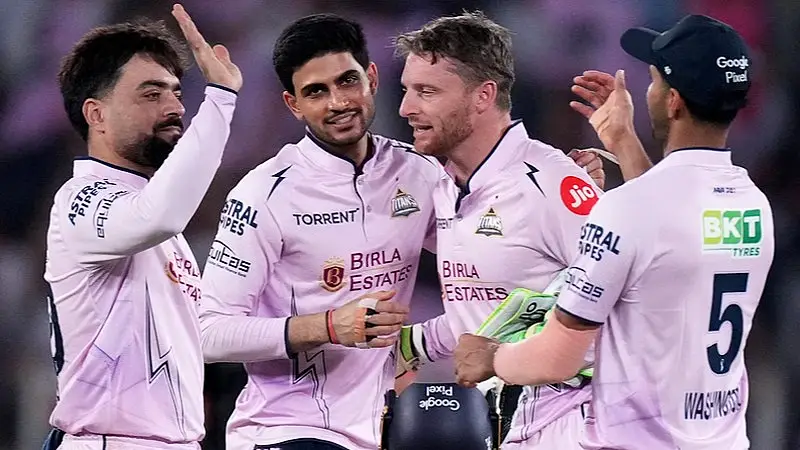

Seven matches into IPL 2026, the Gujarat Titans sat in the lower half of the table, three wins, four defeats. What followed was one of the most striking reversals of the season. GT won their next five consecutively, climbed to second on the points table with 16 points from 12 matches, and emerged as the team to beat in the playoff race. The engine behind that turnaround wasn’t their batting; it was their bowling.
Rabada and Holder’s Wicked Pace Partnership
No two bowlers have defined GT’s resurgence more than Kagiso Rabada and Jason Holder.
Rabada closed the five-game winning streak with 21 wickets in 12 matches, sharing the IPL 2026 Purple Cap with Bhuvneshwar Kumar. His powerplay dominance is the standout number: 16 powerplay wickets, the most by any bowler in IPL 2026. GT as a unit holds both the most powerplay wickets in the tournament (25) and the best powerplay economy rate (8.6). No side has attacked with the new ball as aggressively or as effectively.
Holder operates as GT’s surgical instrument across the middle overs and death. The West Indian all-rounder carries the best death-over economy rate (5.1) among all IPL 2026 bowlers with more than two overs in that phase. Against SRH in Match 56, the game that extended GT’s streak to five, he returned 3/20, ripping through their middle order after Rabada’s 3/28 had already demolished the top order in the powerplay.
Bowler | Wickets | Key Economic Stat | Standout Metric |
Kagiso Rabada | 21 | 8.6 (powerplay) | 16 powerplay wickets, most in IPL 2026 |
Jason Holder | Top 10 in IPL 2026 | 5.1 (death overs) | Best death economy among bowlers with 2+ overs |
Rashid Khan | 11 | 7.16 (career IPL avg) | Support spinner, secondary threat |
Arshad Khan | Season contributor | 10.35 (avg IPL 2026) | 3/22 vs RCB; left-arm angle in middle overs |
Gujarat Titans Bowling Blueprint IPL 2026 Philosophy
What makes GT uniquely difficult to counter is their commitment to back-of-a-length pace on surfaces where batters expect spin to dominate overs 7–16. GT has inverted that convention entirely. Rabada’s express bounce targets top-order batters before they’re set. Holder’s skiddy, foolish lengths deny middle-order batters room to free their arms. Arshad Khan, a left-arm seamer adding vital angle variation, chipped in with 3/22 against RCB during the winning run, operating as the third seam option through the middle overs.
Rashid Khan’s role in this context is revealing. Despite 11 wickets and his pedigree as one of T20 cricket’s greatest spinners, Rashid functions as a complement rather than the primary strike weapon. Pace is the plan. Spin is the reinforcement.
How the Five-Win Streak Changed GT
The turnaround from 3 wins in 7 games to 8 wins in 12 was built match by match on bowling-led performances. The SRH demolition was the starkest illustration; GT bowled them out for 86, the lowest all-out total in Hyderabad’s IPL history. GT seamers took nine wickets in that innings, only the second time they’ve achieved that in a single IPL innings. The 82-run victory margin is GT’s biggest in franchise history.
Gill’s Captaincy Through a Bowling-First Lens
Shubman Gill’s captaincy throughout the winning streak has been defined by one thing: trust in his pace attack even when his batting lineup wobbles. Against SRH, GT finished the powerplay at 34/2, their lowest powerplay total of the season. Gill showed no panic. He backed Rabada and Holder to defend 168, and they did, reducing SRH to 60/7 by the 12th over.
That bowling-first confidence, maintained even under batting pressure, is the clearest signal of what GT have become in IPL 2026. They don’t need to outscore opponents; they dismantle them. Gill has built a side that wins with the ball first and lets the bat follow.
Is Rabada’s 16-powerplay-wicket haul the most decisive individual bowling performance by any player in IPL 2026 so far? Drop your take in the comments.
FAQs
How did the Gujarat Titans turn their IPL 2026 season around?
The Gujarat Titans’ bowling blueprint in IPL 2026 reversed a 3-win-from-7 start by winning their next five consecutive matches. The turnaround was built entirely on a pace-first bowling approach led by Kagiso Rabada and Jason Holder.
Who is the Gujarat Titans’ best bowler in IPL 2026?
Kagiso Rabada leads GT’s attack with 21 wickets in 12 matches, sharing the Purple Cap with Bhuvneshwar Kumar. His 16 powerplay wickets are the most by any bowler in IPL 2026, making him the tournament’s most dangerous new-ball operator.
What is the Gujarat Titans’ powerplay bowling record in IPL 2026?
GT holds both the most powerplay wickets in IPL 2026 (25) and the best powerplay economy rate (8.6) among all franchises. Rabada’s dominance with the new ball has been the primary driver of both numbers.
What role does Jason Holder play in GT’s bowling attack?
Holder carries the best death-over economy rate (5.1) among all IPL 2026 bowlers with more than two overs in that phase. His ability to restrict and take wickets at the death complements Rabada’s powerplay aggression and gives GT control across all phases.
How did GT bowl out SRH for 86 in IPL 2026?
GT seamers took nine wickets in the innings, only the second time they’ve achieved that in a single IPL game, to bowl SRH out for their lowest-ever all-out total. The 82-run victory margin is GT’s biggest win in franchise history.