

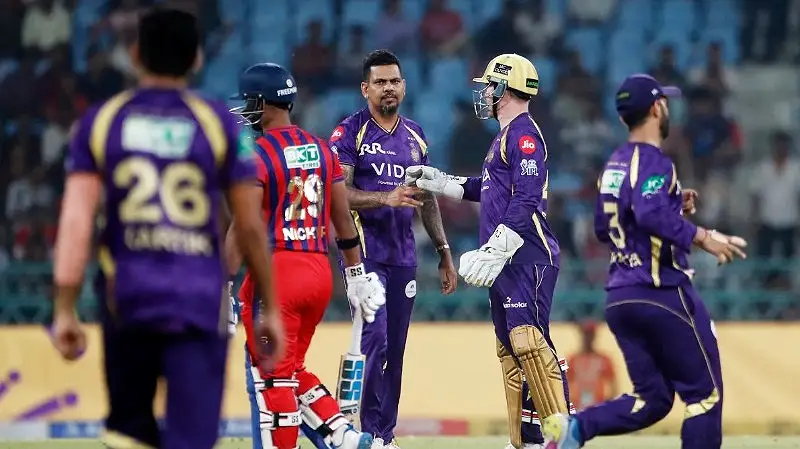

All five entries share the same structural cause: early wickets fall, the remaining batter has too few balls to recover, and disciplined bowling converts that position into an unassailable advantage. LSG’s one run, SRH’s two runs, and Punjab Kings’ repeated collapses in 2020 aren’t random failures. They’re predictable outcomes of extreme pressure, specialist death bowlers at their ceiling, and batters with no margin for a single misjudged shot.
LSG vs KKR 2026: One Run
The lowest Super Over total in IPL history arrived when Lucknow Super Giants scored just one run against Kolkata Knight Riders. Nicholas Pooran fell first ball to Sunil Narine. A cautious single followed. Another wicket ended the over.
Narine’s variations and tight lengths denied every boundary option from ball one. The pitch offered slight grip, reducing the margin for timing errors even further. Two wickets in three balls leave the batting side with arithmetic: one run off three deliveries, two wickets down, match over. LSG’s collapse was the consequence of facing a bowler executing at his peak in conditions offering assistance, against batters who didn’t survive long enough to find a boundary.
SRH vs KKR 2020: Two Runs
Sunrisers Hyderabad scored two runs against the Kolkata Knight Riders. Lockie Ferguson removed both batters within three deliveries, attacking the stumps with pace and bounce under Dubai’s lights, where the ball skidded through quickly.
Bowlers who attack the stumps with pace in these conditions eliminate the middle-ground options batters rely on. The wide delivery creates risk. The yorker creates risk. The hard-length ball lands where the batter commits before processing the length. Ferguson hit that zone six times, and two produced wickets.
PBKS vs DC 2020: Two Runs
Punjab Kings scored two runs after KL Rahul fell attempting a boundary on the first delivery. A second wicket followed immediately. Kagiso Rabada executed yorkers and hard lengths that removed every reliable scoring zone before the batter could settle.
The recurring tactical error is overcommitment to attacking a length ball before reading the trajectory. Against bowlers who land the yorker six times under pressure, that commitment to a full delivery that isn’t a yorker produces the edge or the trapped-before-wicket dismissal.
PBKS vs MI 2020: Five Runs Twice
Punjab Kings scored five runs, with Jasprit Bumrah dismissing Nicholas Pooran off the first ball and controlling every subsequent delivery through yorker execution that forced defensive strokes from batters unable to create scoring angles.
In a six-ball over where one boundary equals three or four dot balls of work for the bowling side, the batting team needed a boundary in the final three deliveries. Bumrah ensured none arrived. The same match then produced a second Super Over, with the Mumbai Indians also scoring five runs. Mohammed Shami matched Bumrah’s control across his six deliveries. Both teams struggling equally under the same conditions is the clearest evidence that Super Over collapses aren’t accidents of form.
Match | Super Over Total | Key Bowler |
LSG vs KKR 2026 | 1 run | Sunil Narine |
SRH vs KKR 2020 | 2 runs | Lockie Ferguson |
PBKS vs DC 2020 | 2 runs | Kagiso Rabada |
PBKS vs MI 2020 (1st) | 5 runs | Jasprit Bumrah |
PBKS vs MI 2020 (2nd) | 5 runs | Mohammed Shami |
IPL 2026 Confirms a Consistent Pattern
Across all five, the sequence is identical: first or second ball wicket, subsequent batters scoring singles under pressure, a total so low the bowling side chases it with a single boundary. Teams scoring between one and five runs typically lose two wickets in the first three balls. In IPL 2026 and in every entry on this list, the bowler who has done more preparation than the batter wins.
- What does LSG’s one-run Super Over collapse against KKR say about how IPL teams should select their Super Over batters: power hitters who go big or die, or adaptable rotators who can find boundaries without premeditation? Drop your pick in the comments and follow for cricket updates.
FAQs
Q: What is the lowest Super Over score in IPL history?
Lucknow Super Giants scored just one run against KKR, the lowest ever in an IPL Super Over.
Q: Why do teams collapse in Super Overs?
Early wickets leave remaining batters too few deliveries to recover, and disciplined bowlers ensure no boundary arrives.
Q: Which bowlers dominate IPL Super Overs most?
Sunil Narine, Lockie Ferguson, Jasprit Bumrah, and Kagiso Rabada have produced the most decisive Super Over performances.
Q: Which team features in the most low-scoring Super Overs?
Punjab Kings appear in three of the five lowest totals, including two in a single match against the Mumbai Indians.
Q: Are Super Over totals getting lower in recent seasons?
Yes, as specialist death bowlers become more prepared for six-ball scenarios, low totals are becoming more common.