

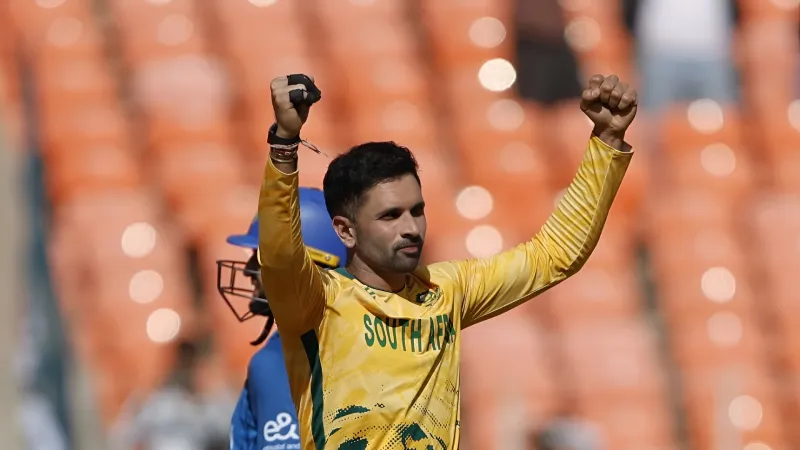

Maharaj to lead South Africa T20I series in New Zealand is a calculated decision rooted in workload management and succession planning. The Protea squad was announced just days after the T20 World Cup, confirming that most senior players will return home. This Proteas squad announcement after the World Cup signals a deliberate reset ahead of the South Africa-New Zealand T20 series in March 2026, with five uncapped players earning opportunities. Rather than prioritizing immediate continuity, South Africa is prioritizing depth, exposure, and long-term squad flexibility.
Scheduling Pressure and Squad Rotation
The timing of this tour defines its structure. The five-match series begins on March 15 and ends on March 25, immediately before the IPL window opens. That congested calendar makes player rotation unavoidable.
Instead of stretching their World Cup core, selectors have opted for controlled experimentation. Only three players currently involved in India Maharaj, George Linde, and Jason Smith, will continue on tour. The rest of the group represents fresh legs and domestic form.
This SA tour of the New Zealand T20I squad list reflects strategic rest rather than weakened selection. South Africa is protecting multi-format assets while testing emerging options in overseas conditions. In modern scheduling cycles, sustainability is as important as squad strength.
Why Keshav Maharaj is the Logical Leader of the South Africa T20I series
Handing responsibility to Maharaj provides leadership stability during a transitional series. He has prior captaincy exposure and has led teams to SA20 finals, which suggests comfort in managing short-format pressure.
New Zealand conditions typically demand tactical discipline. Seamers must operate on tight, hard lengths, while spinners need to control tempo rather than attack recklessly. Maharaj’s left-arm orthodox role becomes especially valuable in overs 7–15, where controlling run rate stabilizes inexperienced attacks.
Appointing a senior bowler also balances a squad featuring multiple uncapped batters. Rather than experimenting with a first-time international captain, the management has reduced volatility at the leadership level.
Uncapped Players and Statistical Signals
A major talking point within the Uncapped players in South Africa T20 squad narrative is the inclusion of Connor Esterhuizen, Dian Forrester, Jordan Hermann, Eathan Bosch, and Nqobani Mokoena.
Mokoena’s SA20 campaign stands out numerically: 13 wickets at a strike rate of 14.76. Those metrics highlight wicket-taking efficiency rather than defensive containment, a valuable trait in New Zealand, where early breakthroughs shape momentum.
Jordan Hermann and Forrester are described as positive stroke-makers. That suggests South Africa may maintain aggressive powerplay intent despite fielding a developmental squad. Tony de Zorzi’s return from injury adds needed top-order experience, while Baartman and Gerald Coetzee, both absent from the World Cup squad, receive a platform to reassert themselves.
Tactical Balance for New Zealand Conditions
From a structural perspective, the squad leans seam-heavy, given New Zealand’s reputation for movement-friendly pitches. Baartman, Coetzee, Lutho Sipamla, and Andile Simelane form the pace backbone, while Maharaj and Linde offer spin variety.
This composition supports flexibility. On green surfaces, pace depth dominates. On slower tracks, dual left-arm spin becomes a control mechanism. That balance prevents predictability across five matches.
Batting remains the bigger uncertainty. Several players lack international exposure, and adapting to swing conditions quickly will determine competitiveness. However, tours like this are not solely results-driven; they are calibration exercises.
Keshav Maharaj to lead South Africa T20I series in New Zealand represents a forward-looking adjustment rather than a temporary fix. The South Africa T20I squad vs New Zealand 2026 reflects a focus on workload protection, developmental exposure, and tactical suitability for overseas conditions. While short-term inconsistency is possible, the broader objective is to expand the squad before the next major global cycle. If two or three uncapped players translate domestic metrics into international performance, this transition tour will validate South Africa’s strategic planning.
Disclaimer: This blog post reflects the author’s personal insights and analysis. Readers are encouraged to consider the perspectives shared and draw their own conclusions.