

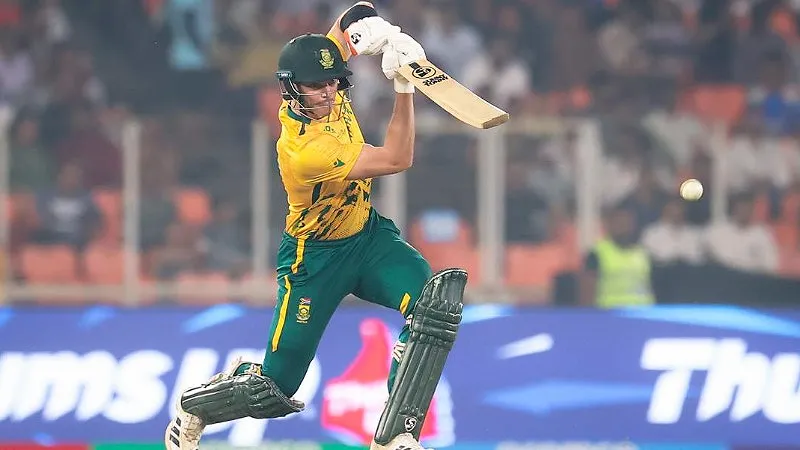

Tristan Stubbs’ role has evolved into a defined finisher position that directly strengthens South Africa’s middle-order stability and death-overs control. After a brief omission, Stubbs’ comeback to the South Africa T20 Squad places him in a role where his strengths are maximized rather than tested. Batting lower, Stubbs complements David Miller. Their partnership adds clarity to the South African middle order. His controlled approach against Canada’s innings has highlighted improved African batting depth without forcing early aggression.
Clear Finisher Role Definition
South Africa’s biggest gain from Stubbs’ inclusion is role certainty. Instead of floating between positions, Tristan’s finisher role is now clearly defined at No. 5 or 6. This allows Stubbs to enter when tempo matters most, post 12 overs rather than rebuilding innings. In modern T20 conditions, especially on Indian surfaces where timing beats power, role clarity often outweighs raw talent.
T20 World Cup Prioritizes Death-Over Control Over Power
Although Stubbs offers value as a six-hitter, the key benefit he has for the team comes through the decisions he makes when under pressure. His appearances in recent matches demonstrate that he approaches batting with a calculated method of targeting his runs rather than quickly accumulating runs. In the match against Canada, his innings were risk-free for the majority of the innings while saving wickets to bat towards the end of the innings. This approach may help South Africa bat deeper than they have been able to in previous World Cups, which is a deficiency within their overall game.
Middle-Order Balance Improvement
A major cause of the South African T20 World Cup middle-order collapse is the overlapping skills of each player in the batting order. Stubbs mitigates that imbalance by being a connector/bridge between two different styles of batting: Accumulators (at the start) and Finishers (towards the end). With the top order tending to attack early, his steady presence absorbs pressure and stabilizes the innings when quick wickets threaten momentum.
Miller–Stubbs Tactical Pairing
The Miller-Stubbs combination has succeeded due to the two players’ knowledge of sequencing. Stubbs can manipulate matchups while Miller absorbs pressure throughout an inning. Therefore, staggered aggressiveness by both of them makes it difficult for fast bowlers with a lot of pace to have predictable bowling plans at the end of innings, particularly when the fast bowler is attempting to bowl a wide yorker.
South Africa’s Finisher Evolution: From Isolated Finishers to Tandems
Historically, South Africa relied on a single end-overs batter from Albie Morkel to peak David Miller. In recent World Cups, this model failed under pressure. The current setup mirrors successful finisher tandems used by title-winning sides, where responsibility is shared. Compared to earlier tournaments, Stubbs’ role resembles a younger Miller: lower risk, high composure, and tactical adaptability rather than brute force.
Tristan Stubbs’ T20WC role addresses that issue directly. By placing him firmly in a finisher’s position, South Africa has improved its batting depth, decision-making at the death, and middle-order stability. His calm presence complements David Miller rather than overlapping with it, creating a more adaptable batting unit. Looking ahead, this structure gives South Africa a better chance of handling high-pressure knockout situations where clarity often decides outcomes. If Stubbs continues to bat with restraint before accelerating, his role could be decisive in matches that swing during the final five overs.
Key Takeaway
Tristan Stubbs’ defined finisher role gives South Africa the middle-order control they’ve lacked in past T20WC.
FAQs
What is Tristan Stubbs’ role in the T20WC?
He plays as a lower-middle-order finisher focused on controlled acceleration in the final overs.
Why was Stubbs preferred over other middle-order options?
His ability to manage tempo and finish innings suits South Africa’s current batting balance.
How did Tristan Stubbs perform against Canada?
He scored a composed not-out innings, showing control rather than early aggression.
Can Stubbs replace David Miller as South Africa’s finisher?
Not immediately, he complements Miller, sharing finishing responsibilities instead of replacing him.
Is South Africa’s T20 World Cup batting depth stronger now?
Yes, clearer roles and better sequencing have reduced middle-order volatility.