

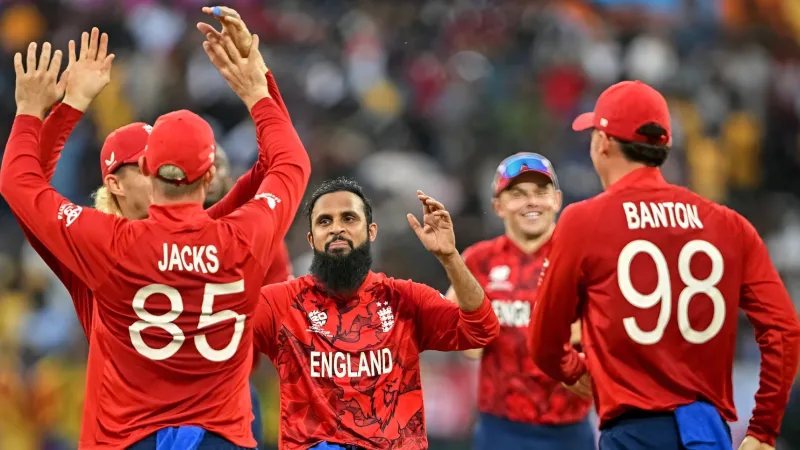

England’s spin structure vs Pakistan could decide this T20 World Cup contest because England’s spinners have consistently dictated tempo, controlled middle overs, and defended competitive even below-par totals in Sri Lankan conditions. The broader England spinners’ strategy has revolved around versatility and phase-specific matchups rather than traditional defensive spin. With the Adil Rashid form in Pallekele looking composed and the Will Jacks bowling performance, Sri Lanka underlining early-overs impact, England’s spin unit is not just supportive, it is central to their tactical identity.
England’s Spin Attack: Four Spinners, Four Tactical Roles
England’s Spin Attack is built on diversity. Adil Rashid operates as the attacking leg-spinner, primarily tasked with breaking partnerships in the middle overs. Will Jacks brings overspin and bounce, offering the rare ability to bowl inside the powerplay without conceding momentum. Liam Dawson provides left-arm orthodox control, typically focused on maintaining pressure through flat, disciplined lines. Jacob Bethell adds an additional slow left-arm option, giving captaincy flexibility depending on matchups.
This combination allows England to adjust based on opposition composition. Pakistan’s batting unit features players comfortable against pace but occasionally prone to slow-down phases against disciplined spin. England’s multi-angle attack leg-spin, off-spin, left-arm orthodox prevents predictable scoring patterns.
Pallekele Data Strengthens the Case
At Pallekele International Stadium, the statistical trend strongly favors England’s spin model. Across four recent T20Is at this venue, England’s spinners combined for 24 wickets with an economy rate under six runs per over. Both Rashid and Jacks claimed seven wickets each in that stretch, while Dawson chipped in consistently.
Importantly, this was not achieved through defensive bowling alone. England defended 146 for 9 in one of those matches, with spin accounting for the majority of wickets as the opposition collapsed below 100. That performance highlights a critical point: England do not require 180-plus totals to win if their spinners control overs 7–15.
In modern T20 cricket, the middle phase determines outcomes more often than powerplays. England’s numbers at Pallekele suggest they understand that dynamic and have optimized accordingly.
Rashid and Jacks: Phase Differentiation
The Adil Rashid form in Pallekele has been particularly influential. His variations, googly, leg-break, and subtle pace shifts create indecision rather than outright turn-dependent dismissals. He thrives when batters attempt acceleration.
Jacks, meanwhile, has redefined England’s spin usage. Will Jacks bowling performance against Sri Lanka, including figures of 3 for 22, came partly inside the powerplay. That tactical choice shifts the pressure curve earlier in the innings. Rather than allowing openers to dominate the seam, England introduces spin disruption immediately.
This strategic boldness sharpens the England vs Pakistan spin battle. Pakistan’s top order prefers pace-on conditions to access power zones. Early spin can force recalibration, slowing scoring rates before the middle overs squeeze begins.
Conditions: Fresh Pitch Variable
The upcoming surface is expected to be fresher than the used strip previously played on. Pallekele generally produces higher-scoring games compared to some Colombo venues, meaning turn may not be excessive.
Here, the Liam Dawson T20 World Cup impact becomes tactically significant. On flatter surfaces, his flatter trajectory and accuracy are more valuable than extravagant spin. England may need to rely on defensive fields, boundary protection, and disciplined lengths rather than attacking catchers.
The strength of the England spin attack vs Pakistan lies in this adaptability. They can attack if a grip exists; they can contain if it does not. That flexibility reduces tactical risk.
The evidence supports a clear conclusion: the England spin attack vs Pakistan gives England a structural edge, especially if the middle overs become decisive. Their quartet has combined variety, economy, and role clarity throughout this T20 World Cup. If conditions offer even moderate assistance, England can dictate tempo and force Pakistan into reactive cricket. On a flatter pitch, precision and field management will matter more than turn. Either way, England’s spin depth is not incidental; it is strategic. If executed cleanly, it could be the defining factor in this clash.
Disclaimer: This blog post reflects the author’s personal insights and analysis. Readers are encouraged to consider the perspectives shared and draw their own conclusions.