

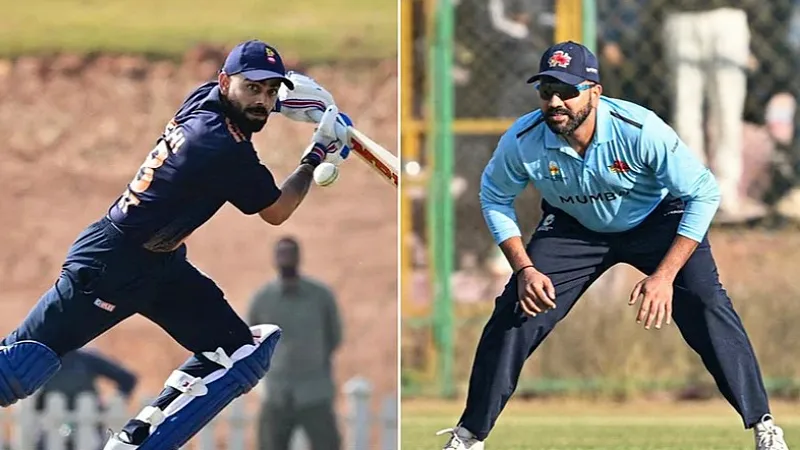

For nearly a decade and a half, the Vijay Hazare Trophy existed in Virat Kohli’s career as a footnote, respected, remembered, but largely bypassed. And yet, in the winter of 2025–26, India’s most dissected batter has quietly returned to the domestic grind, batting like a man with unfinished business rather than fading privileges.
At 37, Kohli has already scored 302 runs in three ODIs against South Africa, earned a Player of the Series award, and then walked straight into India’s 50-over domestic tournament to score 131 off 101 balls and 77 off 61. That’s not nostalgia, that’s intent.
Now, with reports confirming Kohli’s availability for Delhi vs Railways on January 6 before the New Zealand ODI series, the question isn’t whether he needs domestic cricket. It’s whether Indian cricket is quietly relearning how elite preparation actually works.
Domestic Cricket as Tactical Calibration
Kohli’s return isn’t about form, it’s about rhythm. Modern international calendars rarely allow extended batting time without consequence. The Vijay Hazare Trophy offers something bilateral ODIs don’t: repetition without spotlight pressure.
Against Andhra, Kohli didn’t just score runs; he tested strike rotation, middle-overs pacing, and boundary selection. Against Gujarat, his 77 off 61 showed controlled acceleration rather than brute force. This wasn’t stat-padding; it was match-scenario rehearsal. For a batter who thrives on tempo control, 50-over domestic cricket is essentially a live simulation lab.
Why Kohli Stayed, Rohit Stepped Away
It’s a strong contrast. Rohit Sharma scored 155 runs from 94 deliveries against Sikkim. Then he was bowled for a golden duck by Uttarakhand and out of the tournament. Meanwhile, Kohli stayed.
Both have their own approaches to preparing for cricket. For Kohli, his white-ball game is based on building an innings. A player who has spent hours at the crease will be able to build an innings better than one who hasn’t. This philosophy isn’t incorrect; however, Kohli’s decision does signal a greater emphasis on process than what can be seen through statistics.
Form Isn’t Permanent: Systems Are
Kohli’s recent ODI statistics indicate an upswing, but cricket has historically penalized for being too casual. The most successful batters in India, including Tendulkar returning to competitive first-class cricket in 2012 and Dravid playing in the counties, all frequently went back into their domestic systems to refresh their physical muscle memory and to mentally prepare themselves.
The 15 years since Kohli last played in a Vijay Hazare tournament make his return to the domestic scene symbolic. It is not a matter of regaining or re-establishing his importance as a player; it is about re-establishing and solidifying his basic skills. This distinction is small; however, it can be the key to the difference between short-term purple patches and long-term consistent success.
The Hidden Message to India’s Middle Order
When India’s senior-most ODI batter willingly plays Railways on a January afternoon, it sends a message louder than any press conference. Domestic cricket isn’t a fallback; it’s a sharpening stone.
For younger batters juggling IPL reputations and international ambition, Kohli’s presence reframes priorities. Match awareness, not highlight reels, still defines longevity.
Virat Kohli playing another Vijay Hazare match isn’t about Delhi’s campaign; it’s about India’s ODI future. By choosing repetition over rest and refinement over reputation, Kohli is redefining how veterans age in modern cricket.
Key Takeaway
Virat Kohli isn’t chasing form; he’s engineering longevity.
FAQs
- What match could Virat Kohli play next in the Vijay Hazare Trophy?
Delhi’s league match against Railways on January 6 at Alur.
- Why is Kohli playing domestic cricket before an ODI series?
To sharpen tempo control, match rhythm, and innings construction through sustained game time.
- How does this affect India’s New Zealand ODI preparation?
Kohli enters the series battle-hardened, not just rested a strategic advantage in high-stakes ODIs.
Disclaimer: This blog post reflects the author’s personal insights and analysis. Readers are encouraged to consider the perspectives shared and draw their own conclusions.
Step into the world of cricket with JeetBuzz News—where expert opinions, trending Blogs, and behind-the-scenes insights meet all your favorite topics. Stay informed, stay entertained, and never miss the stories shaping the cricketing world—only on JeetBuzz News!