

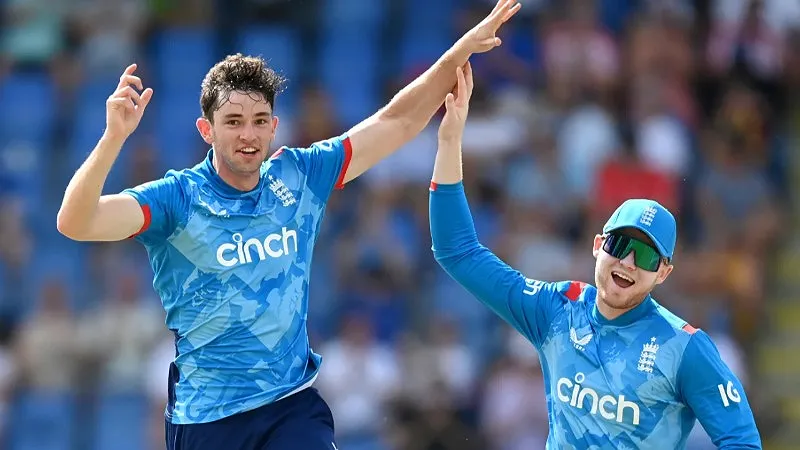

A back stress fracture ended his career at just 25 years old, after only four capped international appearances in total. That single fact captures a pattern the sport keeps producing without ever quite fixing it. Bodies built for extreme pace regularly break down years before the talent inside them actually runs out. Two other recent careers in the same national system followed a near-identical script before this one did. The schedule, not the skill, is usually what runs out first for bowlers built this way.
A Career Cut Short by Injury
He joined his county side in 2021 while studying economics at university, and quickly became one of the most exciting young pace prospects in the country by 2023, taking 21 wickets in that year’s T20 competition at an outstanding average of 11.76 and an economy rate of 6.67 across the tournament. His international debut came in late 2024, on a tour that brought two ODI caps and two T20I caps against the same opponent, and three wickets combined across those four total appearances at the top level.
He hadn’t played competitive cricket since June 2025, sidelined by a back stress fracture for over a year before his retirement was finally announced in August 2026 at just 25 years old. Injuries had already forced him to miss an earlier international call-up well before that debut tour finally arrived.
Young Quicks Forced Out Early by the ECB
The pattern is now well enough documented across multiple careers to call it a genuine trend rather than simple bad luck striking three different bowlers. Fast bowling generates disproportionate stress through the lower back, and each stress fracture measurably raises the odds of the next one occurring.
Player | Age Out | Career Span | Primary Injury | Format Exits |
|---|---|---|---|---|
Turner | 25 | 2021-2026 | Back stress fracture, out since June 2025 | All professional cricket |
Tymal Mills | N/A | 2012-present | Specialist spinal condition | Long-form cricket, T20 only since mid-20s |
Steven Finn | 30 | 2007-2019 | Knee and mechanical breakdown | All formats, retired 2019 |
Three careers, three genuinely different specific injuries, yet one clearly shared underlying pattern across a single national system that keeps producing similar outcomes.
John Turner fast bowler retirement age cricket
His own explanation was direct. The stress fracture that sidelined him for over a year, combined with his broader injury record, made him think seriously about his future both inside and away from the professional game. Two years still remained on his county contract, and a development deal with the national board ran until late 2025.
He chose retirement over another comeback attempt. His county’s director of cricket said he was saddened that this particular journey in the professional game had reached its end so early, calling him a genuine talent whose body simply couldn’t keep pace with his ambition.
The Domestic Workload Behind the Numbers
Before turning 24, he had already combined four-day cricket, one-day cricket, T20 cricket and a domestic franchise competition with international commitments, near-year-round high-intensity bowling for a tall right-arm quick, exactly the body type that generates the highest lumbar loading of any bowling action across the sport.
The injury debt was clearly domestic long before it ever became an international problem for selectors. He made 51 first-team appearances for his county before earning just four caps at the very top level, a workload imbalance that sports medicine researchers increasingly flag as a genuine cumulative risk factor rather than simple bad fortune or coincidence.
Boards Have Options They Rarely Use
New Zealand and Australia have periodically applied genuine rotation policies, resting quick bowlers from specific format combinations to manage their cumulative workload deliberately across a long season rather than reacting only once an injury has already occurred. His own board holds central contracts but has no formally enforced cap on cross-format bowling loads for contracted quicks, leaving that specific responsibility largely to individual counties to manage instead.
His case is especially stark because the heaviest phase of his workload happened domestically, years before the international stage that ultimately capped his brief career at just four total appearances. The real question the John Turner fast bowler retirement age cricket story leaves behind is how early that outcome was actually predictable, and what specific intervention from the county or the board might still have changed it.
Should boards cap domestic bowling loads for young quicks the same way they already manage international workloads carefully? Tell us your view below.
Frequently Asked Questions (FAQs)
Why did John Turner retire from cricket at 25?
A back stress fracture that had sidelined him for over a year forced the decision. He said his broader injury record made him think seriously about his future in the game.
What injury ended John Turner’s cricket career?
A back stress fracture kept him out of competitive cricket from June 2025 onward. That absence lasted over a year before his retirement was announced in August 2026.
Which other fast bowlers retired young from international cricket?
Tymal Mills and Steven Finn both had careers shortened dramatically by serious injury. Mills exited long-form cricket in his mid-twenties, while Finn retired in 2019 at just 30.
How many international matches did John Turner play?
He played four capped internationals in total across one short tour. That West Indies trip brought two ODIs and two T20Is for three wickets combined, and an earlier call-up was blocked by injury.
Is fast bowler workload too high in modern cricket?
Many researchers now treat heavy domestic schedules as a genuine cumulative injury risk. His 51 county appearances before just four caps illustrate that imbalance clearly across formats.