

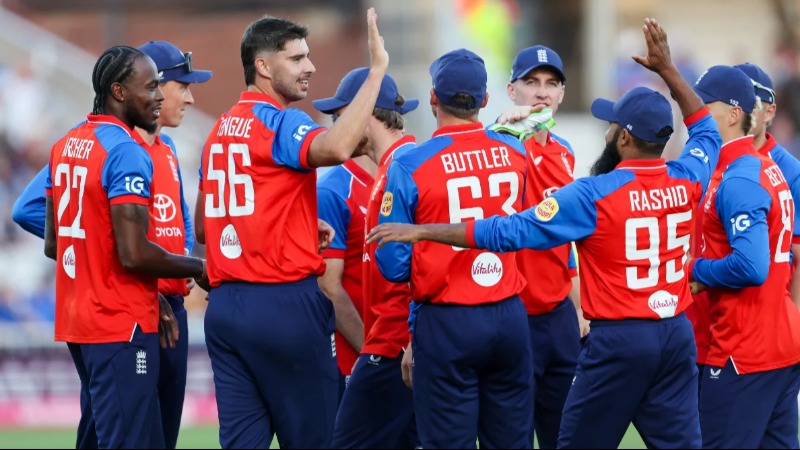

England are winning the pace battle because Jofra Archer and Josh Tongue bowling attack the same length from completely different angles, giving India no time to pick either threat before it’s too late. Add Sam Curran’s leg-cutter and Saqib Mahmood’s new-ball control, and India have faced four bowlers capable of ending an innings inside six overs. Trent Bridge proved it. A 125-run defeat and 76 all out in 11.4 overs left India with more questions than answers heading into the fourth T20I at Bristol.
The New-Ball Weapons Take Shape
Archer slings the ball from wide of the crease over the wicket at real pace. Tongue’s release is almost vertical, extracting a steep bounce from a similar length. Both routinely clear 90mph on English pitches built for seam.
England rested both bowlers for the opener at Chester-le-Street, where Saqib Mahmood took three for 33 and removed Sanju Samson early. Archer returned at Old Trafford, with Tongue making his debut alongside him. By Trent Bridge, bowling together, the pair had become unplayable.
England pace bowlers vs India T20I 2026
The figures below show each bowler’s most productive outing this series, and why India’s innings keep collapsing in clusters rather than fading gradually.
Bowler | Overs | Wickets | Economy | Key Dismissal |
Josh Tongue | 4.0 | 4 | 7.00 | Top edges from short-pitch pace, T20I 3 |
Jofra Archer | 3.0 | 3 | 9.67 | Bouncer to Sooryavanshi, caught Iyer, edged Axar |
Sam Curran | 4.0 | 3 | 8.25 | LBW leg-cutter to Abhishek, skied Kishan, caught Dube |
Saqib Mahmood | 4.0 | 3 | 8.25 | Seam movement and bounce, T20I 1 |
Adil Rashid | 2.4 | 2 | 5.25 | Top edge from Arshdeep, bowled Varun, T20I 3 |
Tongue’s four-wicket haul at Trent Bridge leads the way, but Curran in Manchester and Mahmood in the opener followed the same script: attack the stumps, force the mistake, take the wicket. Rashid’s two scalps, including a bowled dismissal, left the tail with nowhere to hide.
The Wicket-Taking Method Behind The Damage
Tongue’s method against India has barely changed. He hits back-of-length at real pace, attacking the stumps until batters commit early. Abhishek Sharma spooned a top edge to point in the second over. Ishan Kishan pulled straight to deep backward square leg. Shivam Dube was beaten for pace in four balls and edged behind. Harshit Rana fell to a catch at backward point. Four wickets, four batters trying to attack, four fielders waiting.
Archer’s method was one ball: the bouncer, aimed at Vaibhav Sooryavanshi. The 15-year-old had already hit a six off Archer’s first delivery before a rising short ball on his fifth rushed him into a glove through to Buttler. Archer then removed Shreyas Iyer at deep point and found the edge of Axar Patel in the same powerplay spell, a display that won him Player of the Match. He later credited the pairing’s shared intensity all summer. Together, Archer and Tongue shared seven wickets in just 11.4 overs.
The Powerplay Collapse Keeps Repeating
India have followed the same pattern in both completed matches. At Old Trafford, both openers fell inside six overs before Kishan and Iyer steadied things, only for the middle order to collapse again once Curran returned for overs sixteen and seventeen.
At Trent Bridge, the collapse came almost instantly. India were 52 for 5 before the end of the powerplay, the first time in their T20I history they had lost five wickets inside six overs. At 90mph-plus, Archer and Tongue leave no time to reset. Will Jacks added the finishing touch, stumping Tilak Varma, before Rashid mopped up the tail.
One Match Left To Prove It
Harry Brook has led England to 18 wins in his last 21 completed T20Is since taking over last summer, and this pace attack anchors that record. Archer arrived with 15 wickets from 12 prior T20I appearances against India, including a best of four for 33. Tongue, just three matches into his career, brings 57 Test wickets at 29.66, the same discipline now working in the shorter format.
India’s only way back is surviving the opening six overs without losing more than one wicket. If they manage that, the threat posed by England pace bowlers vs India T20I 2026 should ease once the pitch flattens and the fielding restrictions lift. Bristol on July 9 gives India one more chance to show they belong. Archer and Tongue will be waiting.
Has any England pace attack given India this little room to breathe in a T20I series? Say your case in the comments.
FAQs
Who are England’s best bowlers against India in this T20I series?
Josh Tongue and Jofra Archer have been the standout performers. Tongue took four for 28 and Archer three for 29, sharing seven wickets as India were bowled out for a record low.
How did England bowl India out for 76?
England used relentless back-of-length pace to force mistakes in the powerplay. Tongue took four for 28, and Archer three for 29 as India collapsed to 76 all out in just 11.4 overs at Trent Bridge that day.
What is Josh Tongue’s economy rate this series?
Tongue conceded seven runs an over in his best spell of the series. He finished four overs for 28 runs and four wickets at Trent Bridge, comfortably his most economical and productive outing so far.
Which England bowler troubled Vaibhav Sooryavanshi the most?
Jofra Archer dismissed the young opener with a bouncer on just his fifth ball. Sooryavanshi had struck Archer for six off the first delivery he faced before gloving the short ball through to keeper Jos Buttler.
How many wickets has Sam Curran taken against India this series?
Sam Curran has taken four wickets across the first two T20Is. His best figures, three for 33 in Manchester, included trapping Abhishek Sharma lbw with a sharp incoming leg-cutter.