

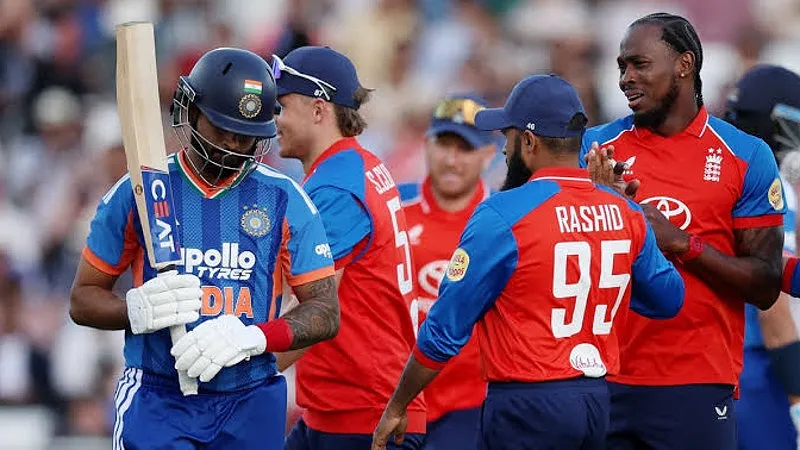

Because the same batting unit that won a World Cup months ago now cannot survive a fast bowler in helpful conditions, and each defeat is worse than the one before it. Bowled out for 76 at Trent Bridge and beaten by 125 runs, the heaviest margin in the format’s history for this team, India have gone from champions to a side without an answer between overs one and six. This is not one bad night. It is three matches building the same failure, and the World Cup cycle is watching.
Trent Bridge And A Historic Low
Chasing 202 at Trent Bridge on July 7, India collapsed to 52 for 5 inside the powerplay, the first time in their men’s T20I history five wickets fell before the sixth over ended.
Josh Tongue took 4 for 28, and Jofra Archer 3 for 29 as India were bowled out for 76 in 11.4 overs, their second-lowest T20I total ever, behind only 74 against Australia in Melbourne in 2008. The 125-run margin is the heaviest defeat in India’s T20I history, turning one bad session into the low point of the tour.
Tracing The Series’ Batting Breakdowns
The pattern was already visible at Manchester, where India set 190 for 7 and still lost by four wickets. Dube fell for 5 off 7 in the sixteenth over just when acceleration was needed, and Axar Patel was run out, forcing the pace. India managed only 37 runs off 35 balls once Iyer was dismissed in the fifteenth over, the innings folding at the exact moment composure mattered most.
Three days later at Nottingham, the same script played out faster. Iyer was caught at deep point off Archer for 5 off 4, Varma was stumped off Will Jacks for 3 off 11, and Dube edged Tongue for 2 off 4. Three specialist batters fell for a combined 10 runs inside the powerplay.
India vs England T20I 2026 middle order collapse
The two completed matches against England laid the pattern out clearly.
Batter | Position | Runs | Average | Strike Rate |
Shreyas Iyer | 4 | 110 | 55.00 | ~131.0 |
Shivam Dube | 5 | 51 | 25.50 | ~111.0 |
Tilak Varma | 5/6 | 30 | 15.00 | ~68.2 |
Axar Patel | 6/7 | 10 | 5.00 | 111.1 |
Varma was unbeaten in the second match (24*), so his average reflects one dismissal only. Axar Patel’s figures come from the third match alone, 10 off 4 after his promotion to number five.
Dube’s series average of 3.50 and strike rate of 63.6 mark a steep drop from the 34.83 average and 159.54 strike rate of his World Cup form. Varma’s total is inflated almost entirely by an unbeaten Manchester cameo; his Nottingham innings read 3 off 11 mid-collapse. The failure is identical across all three. Nobody has adjusted to survive the opening burst of pace before attacking it.
Echoes Of A Familiar Leadership Transition
This is not the first captaincy change to leave India’s middle order without definition. When Hardik Pandya took interim charge in 2022 after a World Cup exit, the roles at four and five rotated match to match, and India lost bilateral series to New Zealand and South Africa.
The current cycle is following the same path. India have not won a match since Iyer took the T20I captaincy, having already lost a series in Ireland before arriving in England, where they trail 2-0 with the series conceded.
Iyer called the Nottingham innings one of the worst he has been part of, and Gambhir has admitted the middle order simply needs to learn how to read the situation, a comment that says as much about the problem as the results do.
The Questions Bristol Must Answer
Dube’s technique against seam movement needs urgent scrutiny. Back-to-back scores of 5 off 7 and 2 off 4 against genuine pace raise doubts about whether he holds his place outside the subcontinent.
Varma needs a fixed role and a powerplay method rather than a back-end cameo, and Iyer’s own returns, 5 at Nottingham and visible discomfort against the short ball, add pressure to the captaincy itself.
The fourth match at Bristol on July 9 is India’s first chance to arrest the slide. The series is gone, but this India vs England T20I 2026 middle order collapse still carries a warning for a squad that must eventually bat in similar conditions at the next World Cup.
Is this a temporary blip against a hot new-ball attack, or a genuine middle-order crisis heading into the next World Cup cycle? Say what you see.
FAQs
Why is India’s middle order struggling against England?
Batters are attacking Jofra Archer and Josh Tongue’s pace without first reading the surface. Dube and Varma have both fallen cheaply, forcing the issue early, with the captaincy change adding to the confusion.
What is India’s lowest T20I total against England?
Seventy-six, made at Trent Bridge on July 7, 2026, is India’s lowest total ever against England. It is also their second-lowest T20I score in history, behind only 74 against Australia in Melbourne in 2008.
How badly has India’s middle overs batting collapsed this series?
Five of India’s top six batters were dismissed for just 48 runs combined in the third T20I. Every one of those wickets fell inside the powerplay, a first in India’s T20I history.
Who is responsible for India’s batting collapse?
No single batter carries the blame; Dube, Varma and captain Iyer have all failed together. Dube averages 3.50 this series, Varma made 3 off 11 at Trent Bridge, and Iyer fell for 5 off 4 at Nottingham.
Can India fix their middle order before the World Cup?
Only with clearer batting roles and a real plan for facing pace in the powerplay. The fourth T20I at Bristol is as much a World Cup audition as a game to win.