

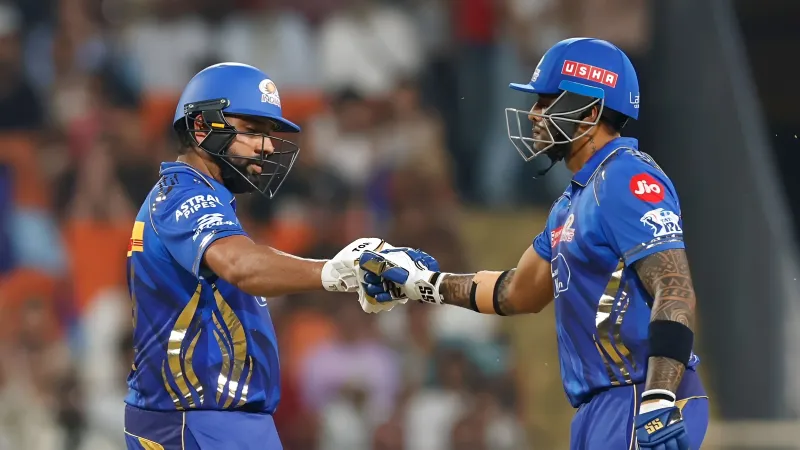

Two batters. Same franchise. Same 360 matches compared. Suryakumar Yadav has 9,459 runs at a strike rate of 152.73 and an average of 35.16. Rohit Sharma has 9,564 runs at 133.51 and an average of 31.88. The runs are almost identical. The strike rate gap is not. That 19-point difference in strike rate across 360 matches is the entire debate in two numbers. It tells you Rohit builds and Suryakumar destroys. It tells you the Mumbai Indians need both.
Suryakumar vs Rohit: Overall Numbers After 360 Matches Each
Player | Matches | Runs | Average | Strike Rate | 100s | 50s |
Suryakumar Yadav | 360 | 9,459 | 35.16 | 152.73 | 6 | 63 |
Rohit Sharma | 360 | 9,564 | 31.88 | 133.51 | 6 | 66 |
Rohit edges Suryakumar on total runs and fifties. Suryakumar edges Rohit on average and strike rate. The innings profile is completely different. Rohit reaches 66 fifties because he converts starts steadily and bats long. Suryakumar reaches a higher average because his dismissals come less often in the lower run zones; he either scores quickly or gets out attacking, which keeps the average inflated relative to a batter who grinds through difficult phases.
Strike Rate Is Where Suryakumar Wins
152.73 versus 133.51. In high-scoring conditions like Wankhede Stadium, that 19-point difference translates to roughly two extra boundaries per innings. Two boundaries per innings across fourteen group stage matches is 28 additional boundaries for MI compared to the version of the batting order where Rohit occupies the same role. Suryakumar doesn’t just score faster; he scores faster specifically in the middle overs, where pitch conditions have settled, and bowlers are searching for variations.
IPL 2026 Win Situations Favour Suryakumar
Player | Matches (Wins) | Runs | Average | Strike Rate | 100s | 50s |
Suryakumar Yadav | 230 | 6,406 | 42.42 | 163.04 | 5 | 48 |
Rohit Sharma | 209 | 6,478 | 41.00 | 139.70 | 5 | 47 |
In IPL 2026 and across T20 cricket generally, the question that matters most is what each player produces when the team wins. In winning matches, Suryakumar’s strike rate climbs to 163.04. Rohit’s climbs to 139.70. Both improve in wins, that’s expected. Suryakumar’s improvement is steeper, which suggests he’s not just benefiting from favorable conditions but actively creating them. A strike rate of 163 in matches MI win means Suryakumar is often the reason the total reached the winning number, rather than a contributor to a team victory achieved by other means.
Chasing Is Where This Gets Decisive
Chasing is where the comparison stops being theoretical. Suryakumar averages 38.10 at 150.87 in chases. Rohit averages 30.00 at 126.28. That average gap, eight runs per innings, means Suryakumar’s wicket is worth significantly more in a pressure chase than Rohit’s. His strike rate in chases stays above 150, which means he doesn’t slow down when the required rate climbs. Rohit’s 126 in chases confirms his instinct remains measured even when the match demands urgency.
Both Players Are Needed at MI
The comparison isn’t meant to argue Rohit out of the team. It’s meant to clarify what each player provides. Rohit at the top gives MI a structured powerplay; he reads bowling attacks early, identifies the gaps, and keeps the innings from collapsing when the new ball moves. Suryakumar at three gives MI the gear change that converts a solid start into a threatening total.
- Who is more valuable to the Mumbai Indians right now, Suryakumar’s strike rate or Rohit’s experience and structure at the top? Drop your take and follow for IPL updates.
FAQs
What is the main difference between Suryakumar vs Rohit in T20 cricket?
Suryakumar focuses on aggressive scoring with a higher strike rate, while Rohit plays a more balanced and consistent role.
How does Rohit Sharma contribute to the Mumbai Indians despite a lower strike rate?
He provides stability at the top and anchors innings, which helps the team handle difficult match situations.
Which player is better in T20 chases?
Suryakumar Yadav has a better average and strike rate in chases, making him more effective in pressure scenarios.
Can the Mumbai Indians rely more on Suryakumar than Rohit?
They rely on both differently, Suryakumar for acceleration and Rohit for structure, making both crucial to team balance.
Disclaimer: This blog post reflects the author’s personal insights and analysis. Readers are encouraged to consider the perspectives shared and draw their own conclusions.