

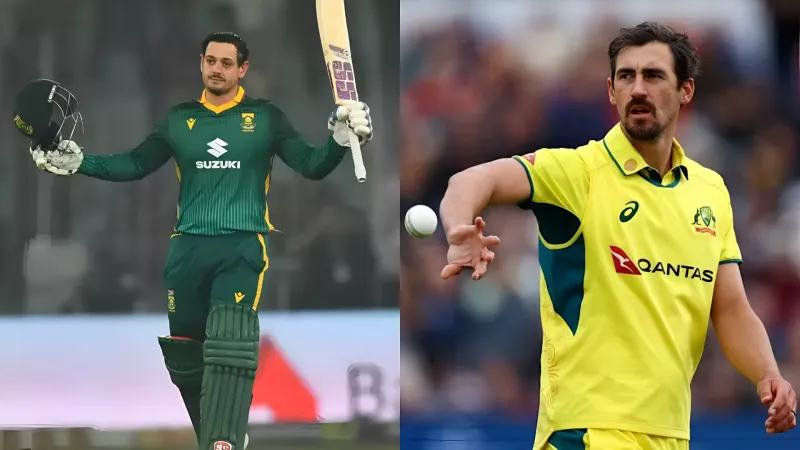

This week’s new-ball contest is tilting toward Australia’s depth rather than any single duel. In the Durban opener, Starc didn’t even take the new ball, and Nathan Ellis removed de Kock for 14 with his first delivery. Australia are rotating their three senior quicks ahead of the October Tests, so the headline matchup may only surface in patches. For de Kock, the real danger is whoever holds the ball in the first ten overs, not any one name printed on the teamsheet.
The Proteas Opener’s Record Against Australia
Quinton de Kock has 1,018 runs in 29 ODIs against Australia at an average of 36.35, with three centuries and three fifties. His 178 at Centurion in 2016 is still the highest individual score by anyone in this rivalry. Australia is one of only three opponents against whom he has passed 1,000 runs, alongside India and Sri Lanka.
Across 161 ODIs, he averages 46.55 at a strike rate of 96.64. That’s the profile of an opener who can take a new-ball spell apart inside five overs. It’s also why Australia’s plan for the first ten overs matters more than any other phase of this contest.
de Kock vs Starc ODI Series 2026
The three-match contest started on 24 September at Kingsmead, Durban, billed as de Kock’s power at the top against Starc’s ability to swing a new ball. The opener didn’t follow the script. Australia won the toss, chose to bowl and handed the new ball to Josh Hazlewood and Nathan Ellis instead.
Ellis struck with the first ball of his spell, having de Kock caught for 14. South Africa reached 40 for 2 at the end of the powerplay. Starc only came on later, as Matthew Breetzke and Temba Bavuma rebuilt the innings. So the marquee duel never got its opening act. That tells you plenty about how Mitchell Marsh wants to use his senior left-armer this week.
The Left-Armer Australia Keep in Reserve
Starc has 247 ODI wickets from 130 matches at an average of 23.58, with a best of 6 for 28. He was the fastest bowler in history to reach 200 ODI wickets. Few Australian quicks are trusted with both the new ball and the death overs in the same innings.
That versatility is why Marsh can afford to hold him back. Durban showed the stand-in captain is happy to save Starc for later rather than burn him up front.
|
Player |
ODI Matches |
Runs or Wickets |
Average |
Strike Rate / Economy |
|
Quinton de Kock (vs Australia) |
31 |
1,035 runs |
36.50 |
SR not separately listed |
|
Quinton de Kock (career) |
161 |
7,123 runs |
46.56 |
SR 96.69 |
|
Mitchell Starc (career) |
130 |
247 wickets |
23.59 |
SR 26.9 balls/wkt |
De Kock scores heavily against this attack, but not at his career level. Starc’s strike rate of a wicket every 26.9 balls explains why Australia feel no need to rush him.
Hazlewood Rotation Changes the Matchup
Australia are managing Starc, Hazlewood and Pat Cummins across the three games rather than playing all three every time. The trio face South Africa again in Tests from 9 October, and that date drives every selection call.
Cummins arrived in South Africa after Starc and was expected to miss Durban entirely, leaving Marsh in charge. Hazlewood and Starc were tipped to share the first and third games, with Cummins handling the second in Johannesburg. Then there’s Nathan Ellis, in career-best form after Australia’s Zimbabwe tour. He’s a genuine new-ball option now, which means de Kock may not face Starc up front in every match.
The Powerplay Battle Beyond One Bowler
Kingsmead has traditionally offered pace bowlers some early seam movement without being unplayable. Senwes Park in Potchefstroom, which hosts the finale, has produced an average first-innings score of 235 across 47 ODIs. Neither venue promises an easy first ten overs.
Australia’s approach looks settled after Durban: give the new ball to whichever quick is freshest. That blunts the individual headline but sharpens the depth Marsh can throw at South Africa’s top order.
For de Kock, the threat is less about one bowler than about whoever is holding the ball when the innings is ten overs old. The de Kock vs Starc ODI series 2026 billing may sell tickets, but Australia’s rotation is writing the real plot.
Would you open with Starc in Johannesburg, or keep trusting Ellis and Hazlewood up front? Tell us in the comments.
Frequently Asked Questions (FAQs)
Has Mitchell Starc dismissed Quinton de Kock in ODIs?
Yes, Starc has dismissed de Kock in ODI cricket, including in Hobart in November 2018. He did not bowl to him with the new ball in the 2026 Durban opener, where Ellis took the wicket.
Is Mitchell Starc playing the first ODI against South Africa?
Yes, Starc was named in Australia’s XI for the first ODI in Durban. The match started on 24 September 2026, but Hazlewood and Ellis shared the new ball while Starc came on later.
What is Quinton de Kock’s ODI record against Australia?
De Kock has scored 1,018 runs in 29 ODIs against Australia at an average of 36.35. His three centuries include a career-best 178 at Centurion in 2016, the highest score by anyone in this rivalry.
Who is captaining Australia in the first ODI?
Mitchell Marsh is captaining Australia in the first ODI at Durban. Regular ODI captain Pat Cummins was rested for the opener as part of workload management before the Test series starting on 9 October.
Where are the South Africa vs Australia ODIs being played?
The three ODIs are at Kingsmead in Durban, the Wanderers in Johannesburg and Senwes Park in Potchefstroom. All three matches are being played between 24 and 30 September 2026.
Disclaimer: This blog post reflects the author’s personal insights and analysis. Readers are encouraged to consider the perspectives shared and draw their own conclusions.