

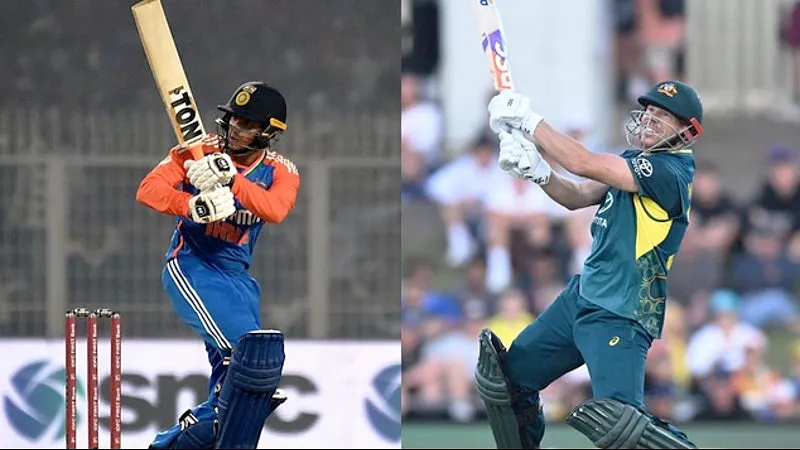

Raw numbers say Abhishek is 45 points faster than Warner ever managed across his whole career. Context says the gap isn’t nearly that simple, though. T20I scoring has climbed steadily since Warner’s debut back in 2009, and Abhishek built his entire career inside cricket’s most aggressive batting period yet seen. Strip out the era, and the picture gets considerably murkier fast. Here’s what the data actually supports once you account properly for when in cricket’s history each man played his cricket.
A Career Built Over Fifteen Years
David Warner played 110 T20Is between January 2009 and June 2024, scoring 3,277 runs at an average of 33.43 and a strike rate of 142.47. That includes one century, 28 fifties, a top score of 100 not out, and six ducks along the way. It’s a career built for consistency across fifteen years rather than one explosive peak.
His pace also had to survive cricket’s slower early seasons. Between 2008 and 2011, teams batting first averaged only around 150 in a full innings, a rate that translates to a scoring tempo well below anything considered fast by today’s standards. Warner’s numbers were shaped by facing bowling attacks in that slower environment for a large chunk of his career.
Abhishek Sharma vs David Warner T20I strike rate
Abhishek debuted in July 2024 and has already scored 1,629 runs from 55 innings at a strike rate of 187.24, the best career mark in T20I history among players past 250 balls faced. His numbers include two centuries, eleven fifties, and a top score of 135 that came off just 54 balls against England, with thirteen sixes in that single innings alone.
That knock is the single most telling data point in this comparison: a century in 37 balls, the second-fastest hundred by any Indian batter in the format. Where Warner built his reputation over a decade and a half, Abhishek has produced numbers that outpace him inside barely two full seasons of international cricket.
Player | Career Strike Rate | Active Era |
|---|---|---|
David Warner | 142.47 | 2009-2024 |
Abhishek Sharma | 187.24 | 2024-2026 |
Scoring Pace Shifts Across the Years
League-wide run rates moved from roughly 7.5 per over in Warner’s earliest seasons down to a decade-low of 7.48 in 2013, before climbing to 8.4 per over by 2015, an eleven percent jump in just two years. That’s the environment Warner spent the first half of his career playing inside, one where boundaries were harder to find, and bowlers dictated more of the terms.
By the time Abhishek arrived, IPL innings totals alone had risen from an average of 158 in the 2008-12 period to 186 in the impact-substitute years of 2023-24. Batting had simply become a different sport, and Abhishek’s numbers reflect a format that now rewards the kind of approach Warner rarely had the license to play early on.
Powerplay Speed Across Two Careers
Powerplay scoring tells a similar story. Rates sat around 7.7 per over as early as 2008, dipped through the early 2010s when spinners in that phase averaged just 6.49 per over, then broke past 8 per over between 2017 and 2019 before settling near 7.71. By 2024, Travis Head alone was scoring powerplay runs across all T20 cricket at a strike rate above 193.
That trajectory matters because both Warner and Abhishek built their games around punishing the new ball. Warner did it against fields and bowling plans built for a slower game, while Abhishek arrived once franchises and international sides had already rewired their entire approach to the first six overs.
Ducks, Peaks and the Raw Numbers
Warner was dismissed for a duck six times across his T20I career, a low number given how long he played, while Abhishek has already hit a rough patch of his own, out for nought in three straight innings during the 2026 World Cup against the USA, Pakistan and the Netherlands. Both men have shown they can go cold, which is worth remembering before either career gets reduced to a single strike rate figure.
None of this erases what the Abhishek Sharma vs David Warner T20I strike rate comparison shows on paper, but it does explain a meaningful share of it. Batting nearly two decades apart in a format that keeps accelerating means the two were never really measuring themselves against the same game.
Does era explain the whole gap, or is Abhishek simply a different level of player? Tell us your take below.
Frequently Asked Questions (FAQs)
Who has the higher T20I strike rate, Abhishek Sharma or David Warner?
Abhishek Sharma’s career strike rate of 187.24 is well clear of Warner’s 142.47. The gap sits at roughly 45 points across their respective careers to date.
What is David Warner’s highest T20I score?
Warner’s best T20I innings was an unbeaten century, his only one in the format. He finished with 3,277 career runs at an average of 33.43 from 110 matches.
What is Abhishek Sharma’s highest T20I score?
Abhishek’s top score is 135 not out, the highest by any Indian batter in T20Is. He reached that century off just 37 balls against England in February 2025.
Has T20I scoring gotten faster over the years?
Yes, run rates have climbed sharply since the format’s early seasons. Run rates rose from around 7.5 per over near 2010 to over 8.4 per over by 2015.
How many ducks has Abhishek Sharma made in T20Is?
Abhishek has been dismissed for nought in three consecutive innings during one tournament. That streak came at the 2026 T20 World Cup against the USA, Pakistan and the Netherlands.