

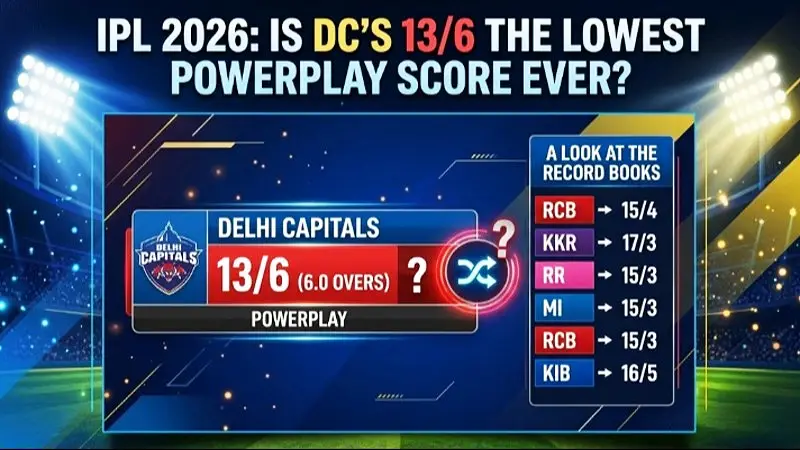

Delhi Capitals didn’t just lose a power play against Royal Challengers Bengaluru. They rewrote a record that had survived 17 seasons. Their 13 for 6 in six overs is the lowest powerplay score in competition history, a figure that surpasses collapses that previously defined the outer limits of batting failure inside the first six overs. Four other entries share the same territory across different seasons and conditions. Understanding all five explains why the powerplay remains the most unforgiving phase in T20 cricket, regardless of which team or which era is producing the numbers.
DC vs RCB Produced a Historic Shame
The IPL 2026 collapse in the DC vs RCB fixture didn’t unfold gradually. It cascaded. RCB’s bowlers attacked a consistent fourth-stump line from the first over, and DC’s top order reached outside their natural striking arc repeatedly in response.
RCB didn’t need swing or dramatic movement. They needed precision and DC’s poor shot selection, and they received both consistently across 36 deliveries. Six wickets in a powerplay means every partnership from the seventh over onward is formed by batters with no rhythm and no realistic target to manage. The 13 runs accompanying those dismissals confirmed DC weren’t simply losing wickets. They were surrendering a match before the sixth over finished.
Historical Collapses Followed the Same Blueprint
Rajasthan Royals’ 14 for 2 against Royal Challengers Bengaluru in Cape Town in 2009 shares a structural pattern with every other entry on this list. The surface offered seam movement. Batters hesitated rather than adapting quickly enough, scoring dried up, and the required rate climbed past the territory where either patience or aggression produced a reliable answer.
SRH’s 14 for 3 against the Rajasthan Royals in 2022 arrived under chase conditions, which compounded every error. When a batting side already needs aggression and the bowling attack responds with controlled variations and hard lengths, no comfortable option remains. Attacking produces edges. Defending produces dot balls. Both entries confirm that low powerplay scores combined with scoreboard pressure are the most suffocating combination this format produces.
CSK Proved Containment Can Also Destroy
Chennai Super Kings appear on this list twice, and neither entry involves a dramatic collapse. Their 15 for 2 against Kolkata Knight Riders at Eden Gardens in 2011 and 16 for 1 against Delhi Capitals in 2015 were containment failures rather than batting disasters. The wickets mattered less than the runs not scored.
The 16 for 1 entry is the most instructive of all five examples. One wicket in six overs should represent a position of control. At 16 runs, it describes the opposite: batters who survived the powerplay without converting survival into anything their team could build from. Both CSK entries prove that powerplay failure doesn’t require dramatic wicket loss.
IPL 2026 Rewrote the Powerplay Standard
The 13 for 6 entry establishes a new benchmark for what powerplay bowling dominance actually looks like across this competition’s history. Previous entries on this list fell between 14 and 16 runs, scores that felt extreme but left some residual contest alive in the innings that followed. Six wickets removed that residue entirely.
A batting side reaching the seventh over with 13 on the board isn’t managing a difficult situation. They’re managing a mathematical impossibility dressed as a cricket match. What the most recent entry demonstrated above all others is that coordinated new-ball bowling, when it meets a top order making simultaneously poor decisions, produces scorelines no previous record had prepared anyone to describe.
Rank | Match | Score | Season |
1 | DC vs RCB | 13/6 | 2026 |
2 | RR vs RCB | 14/2 | 2009 |
3 | SRH vs RR | 14/3 | 2022 |
4 | CSK vs KKR | 15/2 | 2011 |
5 | CSK vs DC | 16/1 | 2015 |
- Is DC’s 13 for 6 against RCB the most complete powerplay destruction in competition history, or does another collapse from this list feel more remarkable to you? Drop your pick in the comments and follow for IPL updates.
FAQs
Q: What is the lowest power play score in IPL history?
Delhi Capitals’ 13 for 6 against Royal Challengers Bengaluru in 2026 is the lowest recorded powerplay score in the competition.
Q: Why did Delhi Capitals collapse to 13 for 6 against RCB in the power play?
RCB bowled a consistent fourth-stump line throughout, and DC’s top order repeatedly played poor shots outside their natural striking arc.
Q: Which team appears most often in the five lowest IPL powerplay scores?
Chennai Super Kings appear twice, recording 15 for 2 in 2011 and 16 for 1 in 2015 across two different opponents.
Q: Can a team recover from a power play collapse as severe as DC’s 13 for 6?
Recovery is theoretically possible but requires middle-order partnerships of 70-plus and exceptional bowling that the batting collapse makes almost impossible to generate.