

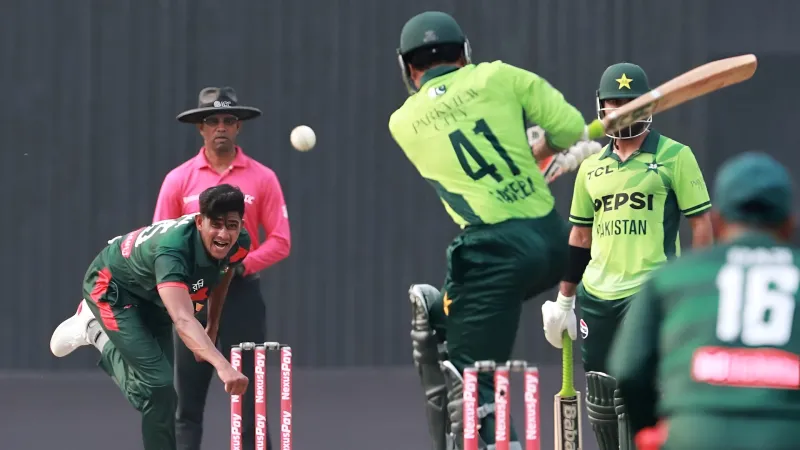

Pakistan were 69 for 5. They were eventually bowled out for 114. Nahid Rana dismissed Sahibzada Farhan, Shamyl Hussain, Maaz Sadaqat, Mohammad Rizwan, and Salman Agha in a single spell that didn’t rely on raw pace; it relied on hard lengths, precise seam presentation, and a surface at Shere Bangla National Stadium that rewarded exactly the type of bowling Rana and his senior partners had specifically planned for. The collapse wasn’t chaotic. It was structural, and it was designed before the match began.
Why Hard Lengths on the Mirpur Surface Became Unplayable
Rana’s tactical decision, guided by pre-match conversations with Mustafizur Rahman and Taskin Ahmed, was to attack hard lengths rather than chase higher speeds. On Mirpur’s surface, the ball rises awkwardly from a back-of-length zone that is too short to drive and too full to pull comfortably. Batters who look settled against conventional pace find themselves on the back foot against deliveries that climb into the body from lengths they had calculated as manageable.
Pakistan’s top order made exactly that miscalculation. Farhan, who had looked composed in the opening overs, committed to a drive against a delivery that climbed sharply and edged behind. Rizwan, Pakistan’s most experienced middle-order batter, was undone by a cross-seam delivery that held its line rather than straightening, producing an inside edge onto the stumps. Each wicket followed the same pattern: a length that looked hittable and wasn’t.
How the Collapse Unfolded After the First Breakthrough
The first wicket changed the match’s psychological architecture entirely. Once Rana removed Farhan, Pakistan’s batting order faced a compounding problem; each subsequent batter arrived knowing the required rate was climbing and the surface was not going to assist recovery. That combination of scoreboard pressure and pitch difficulty is where Rana’s second and third wickets came from, rather than from any change in his bowling.
Pakistan slid from 69 for 5 to 114 all out without producing the partnership that would have made the target competitive. Mustafizur Rahman and Taskin Ahmed maintained the pressure Rana had created, disciplined lines that prevented Pakistan from manipulating gaps while the required rate continued climbing. The collapse was not a single spell of fortune but a sustained bowling unit executing a match plan across forty-five overs.
How Bangladesh vs Pakistan 1st ODI Exposed Pakistan’s Vulnerability to Bounce
The Bangladesh vs Pakistan 1st ODI result confirmed a specific tactical vulnerability in Pakistan’s current batting lineup; their top and middle order struggle against hard-length bowling that generates bounce rather than conventional seam or swing movement. Rana’s five victims were all dismissed by deliveries that climbed or held rather than moved laterally, suggesting the vulnerability is technical rather than situational.
Pakistan’s preparation for Mirpur had anticipated spin; Shere Bangla’s historical profile as a surface that turns significantly in the middle overs is well-documented. What they encountered instead was a young seamer who had specifically prepared for the bounce the surface offers before it dries and slows, a phase Pakistan’s batters had not fully accounted for in their pre-match planning.
Why Shaun Tait’s Influence Made the Difference
Pace bowling coach Shaun Tait’s philosophy, trust your strengths, adapt your tactics, prioritise seam position over raw speed, was visibly present in every over Rana bowled. The mid-140s kph pace was secondary to the seam orientation, the aggressive length, and the cross-seam variation that produced Rizwan’s dismissal. Tait’s influence has redirected Rana’s development from a raw pace prospect into a tactically aware seamer capable of constructing a match plan and executing it across a ten-over spell.
- Do you think Nahid Rana has established himself as Bangladesh’s most dangerous pace bowler after this performance, or does Mustafizur Rahman still hold that status? Drop your view in the comments and follow for Bangladesh vs Pakistan ODI series coverage.
FAQs
What made Nahid Rana’s bowling effective against Pakistan?
His ability to hit hard lengths and generate bounce forced Pakistan’s batters into uncomfortable positions, leading to multiple mistakes.
How fast does Nahid Rana usually bowl?
Nahid Rana is known for bowling at a high pace, often delivering in the mid-140 km/h range while focusing on control and seam movement.
Why did Pakistan collapse in the ODI opener?
Pakistan struggled to adapt to the bounce and pressure created by Bangladesh’s disciplined pace attack, which triggered quick wickets.
How important were Mustafizur Rahman and Taskin Ahmed in the match?
Their on-field guidance helped Rana identify the right line and length on the Mirpur pitch, strengthening the overall pace strategy.
Can Nahid Rana become Bangladesh’s leading fast bowler?
If he continues developing his skills and consistency, Rana has the potential to become a key leader of Bangladesh’s pace attack in future international matches.
Disclaimer: This blog post reflects the author’s personal insights and analysis. Readers are encouraged to consider the perspectives shared and draw their own conclusions.