

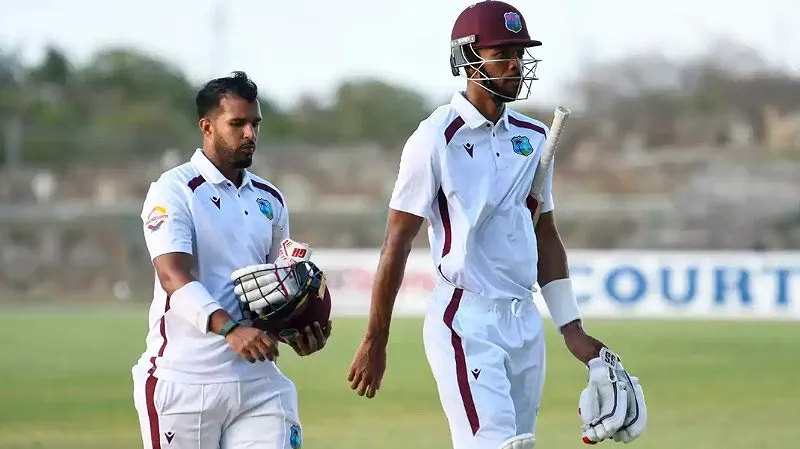

Sri Lanka’s attack didn’t fail because of poor bowling alone; it failed because they had four frontline options for all but a single over. Lahiru Kumara pulled up with a hamstring problem on the first ball of his second over, and the gap never closed. Jangoo and Chase built their world-record 401 against an attack stretched thin, with one spinner forced through a 56-over marathon and the captain reduced to bowling himself. The shortage, not the skill on show, decided how big the stand could grow.
The Over That Changed the Innings
Kumara pulled up with a hamstring problem delivering the first ball of his second over of the day, having barely bowled a full over before limping off. He didn’t return for the rest of the innings. His final figures read 1-0-4-0, by far the shortest workload of any bowler on either side.
With their fastest and sharpest option gone before the contest had even turned, the other four seamers and spinners on Sri Lanka’s team sheet were left to share the remaining 145.5 overs of a marathon West Indies innings, against batters with no intention of slowing down.
Dinusha’s Marathon and an Attack Down to Four
That redistribution fell hardest on left-arm spinner Sonal Dinusha, who bowled 56 overs for 234 runs and just 2 wickets, comfortably the most expensive spell of the match and a workload no Sri Lanka bowler would have expected to carry into the contest.
It isn’t a record by historical standards; Chuck Fleetwood-Smith once conceded 298 in a single Test innings for Australia back in 1938, but it reflects exactly the kind of attritional over-count a four-man attack faces when it has to bowl out a side that adds 458 runs for the loss of one wicket across an entire day.
Bowler | Overs | Runs | Wickets | Economy |
Asitha Fernando | 28 | 56 | 2 | 2.00 |
Lahiru Kumara | 1 | 4 | 0 | 4.00 (injured, did not return) |
Kasun Rajitha | 26 | 102 | 0 | 3.92 |
Milan Rathnayake | 35.5 | 124 | 5 | 3.46 |
Sonal Dinusha | 56 | 234 | 2 | 4.18 |
Dhananjaya de Silva | 5 | 17 | 0 | 3.40 |
Kusal Mendis | 9 | 46 | 0 | 5.11 |
Sri Lanka bowling collapse vs West Indies Test
Captain Dhananjaya de Silva tried to manufacture variety once his frontline options ran short of answers, turning to part-time off spin from Kusal Mendis and bowling a handful of overs himself. Mendis finished with figures of 9-0-46-0, de Silva 5-0-17-0, both spells unsuccessful and both a sign of an attack stretched well past its planned design.
None of this reflects badly on the four bowlers who carried the workload; Fernando and Rajitha both went for under four an over despite the conditions, and the shortage was structural rather than a matter of execution. One injury, with no specialist cover behind it, turned a five-man plan into a four-man problem for the rest of the day.
The Afternoon Surge That Broke the Attack
The damage wasn’t evenly spread through the day. Jangoo, by his own admission, faced fifteen dot balls to open his day-three innings, and both batters were watchful early while the quicks made the most of the second new ball. Once that period passed, the afternoon session became the moment the bowling discipline visibly cracked: Jangoo and Chase plundered 136 runs at better than five an over, Jangoo strong square of the wicket and through the covers, with Dinusha increasingly targeted for the straight six.
Milan Rathnayake was the exception, staying threatening throughout every spell he bowled that day, and he eventually completed a maiden five-wicket haul, 5 for 124 from 35.5 overs, creating chances even when the rest of the attack had nothing left to offer.
The Lesson Heading Into the Second Match
The hosts went on to win by an innings and 217 runs, with Kemar Roach reaching 300 Test wickets in the second-innings rout. The deeper lesson for the next match, starting July 3 at the same Antigua venue, is about depth rather than just one bad day with the ball.
This Sri Lanka bowling collapse vs West Indies Test result shows what happens when a four-man attack with no specialist back-up has to absorb an injury to its lead seamer against batters in form. Kumara’s fitness, and whether Sri Lanka add a fifth frontline option before the next Test, will decide whether a result like this one repeats itself.
Could a fully fit Sri Lanka attack have kept that stand under 300? Have your say in the comments.
FAQs
What is the highest sixth-wicket partnership in Test cricket history?
Amir Jangoo and Roston Chase hold the record with 401 runs for West Indies. The stand passed the previous mark of 399 set by Jonny Bairstow and Ben Stokes in 2016.
How many overs did Sonal Dinusha bowl against West Indies in the first Test?
Dinusha bowled 56 overs in West Indies’ first innings. He finished with figures of 2 for 234, the most expensive spell of the match.
Why was Lahiru Kumara not bowling for Sri Lanka in this match?
Kumara suffered a hamstring injury on the first ball of his second over on day two and never returned. His final figures read 1-0-4-0, the shortest workload of any bowler in the innings.
What was Amir Jangoo’s score on Test debut against Sri Lanka?
This was actually Jangoo’s third Test, not his debut; he scored 233. It was his maiden Test century, which he converted straight into a double-hundred.
Did Roston Chase score a century in the first Test against Sri Lanka?
Yes, Chase scored 194, his sixth Test century. He fell six runs short of a double-century after ending a long run without one.