

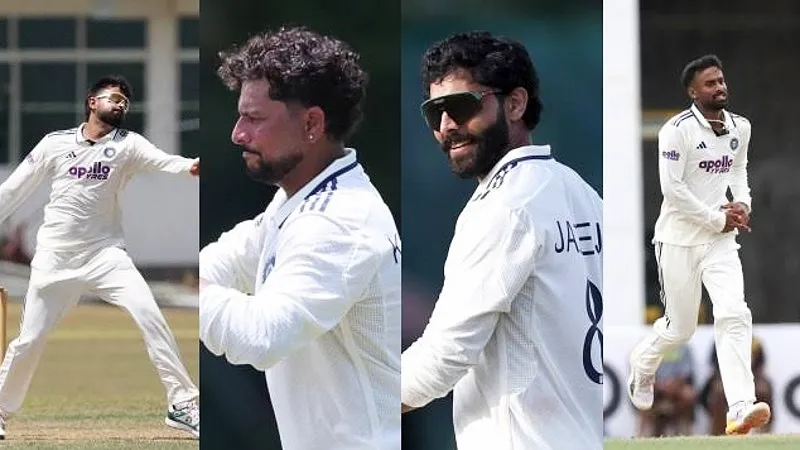

India’s first Test tour of the island in nine years opened at Galle International Stadium, and Shubman Gill’s side arrived without two frontline options, Jasprit Bumrah injured and Washington Sundar unavailable for the opener. What they brought instead was an unusual blueprint: three left-arm spinners in Ravindra Jadeja, Kuldeep Yadav, and debutant Manav Suthar, a combination no touring side has tried here before. On a surface carrying rain moisture and a long history of turn, that selection call deserves unpacking properly, well beyond the obvious explanation of Bumrah’s absence.
India vs Sri Lanka 2026 Test series spin attack
Losing Bumrah removes the primary seam threat, but it also sharpens the strategy. Galle’s pitch turns from the final session of Day 1, with footmarks deepening through Days 3 to 5. The selectors have stacked every variety of left-arm spin: Jadeja’s disciplined orthodox accuracy, Kuldeep’s wrist-spin drift and wrong’uns, and Suthar’s flighted variation from a 23-year-old debutant who took seven wickets on debut against Afghanistan in June. The hosts’ top order leans right-handed, and left-arm bowlers create rough outside off stump and awkward angles for that kind of batter.
Jadeja’s Case For Trust
Here is how the key spinners on both sides compare.
Bowler | Team | Style | Recent Average | Home / Away Record |
|---|---|---|---|---|
Ravindra Jadeja | India | Left-arm orthodox | Avg 23.72 vs SL (33 wkts / 7 Tests) | 13 wkts in India’s 2017 3-0 win in SL |
Kuldeep Yadav | India | Left-arm wrist spin | 12 wkts vs WI (Oct 2025, 2 Tests) | 38 wkts in 9 home Tests at avg 23.39 |
Manav Suthar | India | Left-arm orthodox | 7 wkts in 1 Test debut (best 6/33) | 8 wkts in FC series vs Aus A, Sep 2025 |
Prabath Jayasuriya | Sri Lanka | Left-arm orthodox | 125 wkts in 23 Tests at avg 32.03 | 96 wkts in 14 home Tests; avg 27.26 |
Ramesh Mendis | Sri Lanka | Off-spin | 71 wkts in 16 Tests at avg 31.15 | Consistent home performer at Galle |
Jadeja is India’s most reliable weapon, chasing his 400th Test wicket from a career total of 348 wickets. Kuldeep’s wrist-spin variation, capable of landing a googly without telegraphing it, poses a different puzzle to batters already managing Jadeja’s control. Suthar, the youngest of the trio, adds a third orthodox option who can find turn both ways off the same pitch.
Jayasuriya’s Fortress Record At Galle
The home side’s counter-weapon is a 34-year-old who has mastered these conditions for a decade. His overall average of 32.03 compresses to 27.26 in home Tests, where he has taken 96 wickets and 11 five-wicket hauls, including one ten-wicket match haul. By early last year, across ten Tests at this ground alone, he had claimed 79 wickets and nine five-wicket hauls, seven of them here specifically.
This will be his first Test against India, making the head-to-head entirely unprecedented, and Day 1 commentary already notes the ball gripping from the moisture left by earlier rain.
The Moist Pitch Changes Everything
The historical first-innings average at this venue sits near 365 to 375, but deterioration defines the surface sharply as the match wears on: the third-innings average drops to 239, and the fourth-innings figure falls to just 154. The hosts have won 27 of 49 Tests played here since 1998, with only six draws, reflecting how decisively conditions shape results at this ground.
Batting first, the tourists reached 262 for 2 on the opening day, which is standard practice at this ground since teams batting first typically prevail. Whether those same easy morning conditions return once the surface dries further is the question that will define the rest of the match.
The Contest Comes Down To Nerve
Two asymmetries define this battle. The tourists’ three left-arm spinner options give Gill unmatched variety, yet none have bowled to this lineup before in Tests, while the home spinner has mastered this exact ground but has never faced these batters either. The hosts’ lineup, thinned by injuries, leans on its captain and a recalled wicketkeeper-batter, both better equipped to read orthodox spin than to pick a googly they rarely see.
With Devdutt Padikkal unbeaten on 118 and Rishabh Pant building alongside him at 262 for 2, the tourists are positioned to set a total that forces the hosts to bat under real pressure from Day 3 onward, which is precisely the plan behind India vs Sri Lanka 2026 Test series spin attack selection this week.
Which of the three spinners do you think decides this Test? Drop your prediction below.
Frequently Asked Questions (FAQs)
Why is India playing three left-arm spinners?
India turned to three left-arm spin varieties because Bumrah is injured and Galle’s pitch deteriorates sharply after Day 3. Jadeja, Kuldeep, and Suthar each bring a different angle to pressure the largely right-handed home order.
What is Ravindra Jadeja’s record against Sri Lanka?
Jadeja has taken 33 wickets in seven Tests against Sri Lanka at an average of 23.72. He also scored 326 runs in nine innings, including a century, during that stretch.
How good is Prabath Jayasuriya at Galle?
Jayasuriya’s Galle record ranks among the best by any spinner at a single venue in the format. He took 79 wickets in ten Tests there by early last year, seven of nine five-wicket hauls coming at this ground.
What are the pitch conditions like at Galle?
Galle’s pitch starts flat but degrades fast, with the fourth-innings average dropping to just 154 runs. Spin becomes a major factor from the final session of Day 1 onward as footmarks widen.
Who is in India’s squad for the Sri Lanka series?
Shubman Gill captains a squad built around three left-arm spin options and an experienced batting core. Jasprit Bumrah and Sai Sudharsan are both out through injury, and Washington Sundar missed the opening Test.