

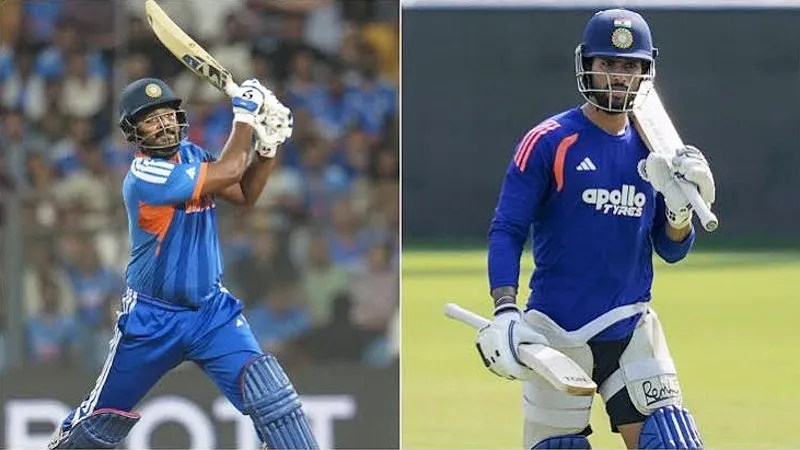

Samson’s slump is loud and easy to see. Varma’s problem is quieter and much harder to fix: across 13 T20Is in 2026, he has hit just 14 sixes, and his strike rate against off-spin has fallen to roughly 116, well below what India needs from a No. 5 tasked with accelerating once pace is withdrawn. Samson’s poor run is three bad innings. Varma’s pattern has now held for an entire year of cricket, and opposition bowlers have started building plans specifically to exploit it.
The Debate Everyone Is Missing Beyond Samson
Samson’s dismissals of 5, 0 and 1 in his last three innings are easy to quantify and simpler to criticise. Management dropped him for Vaibhav Sooryavanshi in the second T20I at Old Trafford, and the teenager responded with two sixes in 14 before being stumped off Will Jacks’ off-spin.
While that debate ran loud, Tilak Varma, India’s vice-captain and nailed-on No. 5, quietly posted 24 in Manchester, with 17 of those runs coming in a single last over off Jofra Archer’s pace. Against England’s spinning trio of Jacks, Dawson and Rashid through the middle overs, he was almost entirely contained.
India T20I Tilak Varma Sixes Middle Overs Slump
The numbers tell a specific story. Across 13 T20I matches in 2026, spanning the World Cup and the England series, Varma has hit 14 sixes, a modest return for a batter at India’s pivotal No. 5 slot expected to accelerate through the middle overs.
Batter | Pos. | T20I SR vs Spin | Sixes (2026 T20Is) | Dot Ball % vs Spin |
Tilak Varma | No. 5 | 128.40 career, ~116 vs off-spin since 2025 | 14 in 13 matches | 32.8% career |
Shivam Dube | No. 6 | 148.50 career, ~165.20 since 2025 | 24 in 14 matches | 26.4% |
Ishan Kishan | No. 3 | 154.40 career | 29 in 12 matches | 29.1% |
Shreyas Iyer | No. 4 | 156.60 career | 10 in 8 matches | 24.5% |
Phase-specific middle-overs figures for the other three aren’t publicly available at innings level. Their overall recent T20I strike rates run high: Dube at 172.83 across his last 10 matches, Kishan near 193 through the World Cup, and Iyer widely rated effective against spin.
His dot-ball percentage against spin, 32.8% for his career, means roughly one in three deliveries from slow bowlers produces nothing from his bat, a real flaw in a lineup that needs its No. 5 to accelerate once pace is withdrawn.
Spin Bowlers Are Exploiting The Pattern
England have mapped this weakness with tactical precision. Dawson, Jacks and Rashid deliver flat, slower-paced deliveries through overs 7 to 15, while Sam Curran adds leg-cutters and change-up lengths with the same effect. Analysts following the series note that once slow bowlers arrive, Varma appears unable to lift the scoring rate.
His two sixes in Manchester arrived exclusively off Archer’s pace in the final over, the one phase where his comfort is unquestioned. Against England’s spinners and Curran’s cutters through the middle stretch, he was in near-total suppression.
The Fallout For The Finishing Plans
When Varma consumes deliveries at roughly 116 strike rate in the 10 to 15 over band, the arithmetic cascades. India scored 77 from 57 balls in the middle phase of the first T20I in Durham, then just 37 from 35 balls between overs 13 and 18 in Manchester, the same ground where England posted 304 for 2 last September.
Shivam Dube offers a useful comparison. His recent strike rate of 172.83 and reputation as India’s primary spin-hitter at No. 6 underline how much the gap at No. 5 matters. With Varma in and slow bowling operating, India cannot accelerate from that slot, forcing Dube and the lower order to compensate.
Can This Be Fixed Before The Series
Three T20Is remain in this England series. Former India cricketer Irfan Pathan has publicly called for Rajat Patidar to replace Varma in the XI, citing both the six-left-handed-batter problem and the middle-overs gap. Varma’s semi-final cameo of 21 off 7 against England at the T20 World Cup shows the ceiling is real once pace is in the equation.
But the India T20I Tilak Varma sixes middle overs pattern, 14 across 13 matches this year, combined with a 32.8% dot-ball rate against spin, reflects a habit tournament adrenaline can briefly mask but not fix. England’s bowlers have already printed the blueprint.
Should India persist with Varma at No. 5, or is it time to try Patidar against spin-heavy attacks? Share your take below.
FAQs
Why is Tilak Varma not scoring sixes in T20Is?
Varma struggles to clear the boundary against spin and slow change-ups. His career strike rate against spinners is 128.40, dropping to roughly 116 against off-spin since 2025, with a 32.8% dot-ball rate against spin.
What is Tilak Varma’s strike rate in the middle overs?
His career strike rate against spin, the bowling type dominating overs 7 to 15, is 128.40. That drops to around 116 against off-spin since 2025, matching his modest 14 sixes across 13 matches in 2026.
Is Tilak Varma under pressure in India’s T20I squad?
Yes, increasingly so, after a modest 14 sixes across 13 T20Is in 2026. Former India cricketer Irfan Pathan has called for Rajat Patidar to replace him, though Varma retains the vice-captaincy for now.
How does Tilak Varma compare to Sanju Samson in T20Is?
Samson’s recent form looks worse, with three single-figure scores in his last three innings. His strike rate of 184.84 in his last seven matches is far higher, making his issue a slump, not a pattern.
Who is India’s best middle-overs finisher in T20Is?
Shivam Dube, batting at No. 6, is India’s recognised spin-hitter with a recent strike rate of 172.83. The structural issue is that No. 5, Varma’s slot, is where spin dominates overs 7 to 15.