

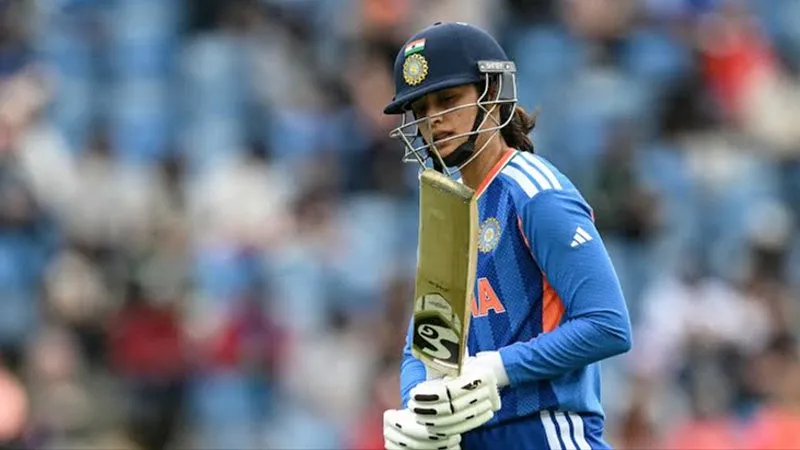

Smriti Mandhana’s ranking held at 5th because the ICC system doesn’t just count runs, it weighs them against opposition, result, and match stage. Her two biggest scores, 68 against Pakistan and 74 against the Netherlands, came in wins over the tournament’s weaker sides. Against South Africa and Australia, the matches that decided India’s fate, she managed only 17 and 38, both ending in dismissals that cut promising innings short. Beth Mooney’s title-winning run took the top spot, and India’s exit meant Mandhana’s bigger totals never converted into ranking points.
Mooney’s Rise Overshadowed a Quieter India Story
Beth Mooney’s return to the top of the rankings, built on a 61* in the semi-final win over West Indies and a match-winning 64 in the final, defined the post-tournament conversation. England’s Nat Sciver-Brunt jumped five spots to 16th, and South Africa’s Tazmin Brits climbed three places to 11th, both rewarded for knockout performances India never got to produce.
South Africa’s Laura Wolvaardt stayed 3rd on 771 points, and Hayley Matthews held 4th on 754. Read correctly, the ranking table is close to a map of who reached the knockouts, and India’s frozen position says everything about which side of that line they landed on.
Smriti Mandhana T20I Batting Ranking World Cup 2026 Freeze
The paradox becomes clear once the context behind each score is added. She scored 68 against Pakistan and 74 against the Netherlands, both wins against the weaker sides. Against South Africa, in a game India needed, she made 17 before being bowled attempting a scoop with the stumps exposed. Against Bangladesh she managed just 8, and against Australia, the only match that could have sent India through, she contributed 38 before a run-out ended her innings mid-partnership with Jemimah Rodrigues.
Batter | Runs | Average | Strike Rate | Ranking After World Cup |
Smriti Mandhana | 205 | 41.00 | 146.0 | 5th, 746 pts (holds position) |
Shafali Verma | 179 | 35.80 | 117.76 | 6th, 717 pts (holds position) |
Harmanpreet Kaur | 141 | 47.00 | 143.87 | 11th, 632 pts (up 1 place) |
Jemimah Rodrigues | 92 | 23.00 | 116.45 | 16th, 605 pts (holds position) |
Shafali’s strike rate reflects the fullest public match data; full ball-by-ball figures for Harmanpreet and Jemimah were not available in aggregate form.
Shafali And Jemimah’s Missed Moments
The same pattern ran through the rest of India’s top order. Shafali Verma’s 179 runs peaked with 53 off 34 balls against Bangladesh, a knock good enough for Player of the Match. Against South Africa she struck a quickfire 31 before top-edging a short ball, and against Australia she looked set on 34 before Sophie Molineux had her bowled.
Jemimah Rodrigues, shuffled between No. 3 and No. 4, managed 34 against Australia and 26 against Bangladesh but never provided the finishing acceleration needed. Together, Mandhana, Shafali, and Harmanpreet scored 525 of India’s 846 group-stage runs, 62.1 percent of the total, but those runs piled up in matches that didn’t decide anything.
The Middle-Order Collapse Behind Both Losses
India were eliminated in the group stage for a second straight tournament, following their 2024 exit in the UAE, and both defeats followed a near-identical script. Against South Africa, India raced to 59 in the powerplay but faded to 158/7 as the middle order failed to build on it. Marizanne Kapp’s unbeaten 81 off 45 balls chased the target down inside 19.1 overs.
Against Australia at Lord’s, Harmanpreet Kaur’s late assault of 56 off 27, including three sixes in the final over, lifted India to 170/4. It wasn’t enough. Australia completed the highest successful chase in Women’s T20 World Cup history, reaching 172/4 with six wickets in hand as Ellyse Perry’s 56 and Ashleigh Gardner’s unbeaten 53 added a match-defining 100 for the fourth wicket.
The Gap India Must Still Close
Mandhana’s 205 runs earned her a Player of the Tournament shortlist, and Sree Charani’s 14 wickets gave India’s bowling a genuine highlight. But a ranking frozen at 5th on 746 points tells the real story: the top order scores heavily against manageable bowling, then goes quiet once the opposition improves.
That pattern has now produced two straight group-stage exits, sitting awkwardly beside India’s ODI World Cup title from November 2025. The Smriti Mandhana T20I batting ranking World Cup 2026 freeze is really a symptom of a wider issue: the gap between India’s one-day form and the sharper edge T20 demands.
Should India’s top order be reshuffled before the next World Cup cycle, or is the batting order not the real problem? Share your view below.
FAQs
Why did Smriti Mandhana’s ranking not improve after the World Cup?
Her two biggest innings came against the group’s weaker sides. She scored 68 and 74 against Pakistan and the Netherlands, but only 17 and 38 in the losses to South Africa and Australia.
How did India’s batters perform at the 2026 Women’s T20 World Cup?
India’s top order scored heavily, but mostly against weaker opposition. They posted 846 runs in five matches, with Mandhana, Shafali, and Harmanpreet combining for 62.1 percent of the total.
Why did India fail to reach the Women’s T20 World Cup semi-finals?
Defeats to South Africa and Australia in the group stage ended their run. India’s middle order failed to build on strong starts, and the side also dropped 11 catches across the tournament.
Who are the top-ranked Women’s T20I batters in 2026?
Beth Mooney leads the post-World Cup rankings on 785 points. She’s followed by Georgia Voll on 779, Laura Wolvaardt on 771, Hayley Matthews on 754, and Smriti Mandhana rounds out the top five on 746.
What was Shafali Verma’s form like at the 2026 World Cup?
Shafali Verma scored 179 runs across five matches, peaking with a Player of the Match innings. Her 53 off 34 against Bangladesh stood out, though she fell early against South Africa and Australia.